Entropion
Peer reviewed by Dr Colin Tidy, MRCGPLast updated by Dr Hayley Willacy, FRCGP Last updated 6 Mar 2025
Meets Patient’s editorial guidelines
- DownloadDownload
- Share
- Language
- Discussion
- Audio Version
- Add to preferred sources on Google
In this series:Watering eyes
An entropion occurs where your eyelid turns towards the eye. The eyelashes then rub against the front of your eye (cornea). Irritation, pain and watering of the eye are the main symptoms. Taping the eyelid to your cheek, lubricant eye ointment and sometimes botulinum toxin injections help to control symptoms. People often require surgery if the problem persists.
At a glance
Entropion is when your eyelid turns inwards towards your eye.
Trichiasis is when eyelashes rub against the front of your eye.
It causes irritation, pain, and watery eyes.
Entropion usually affects older people in the UK due to muscle weakness.
Treatment can include taping the eyelid or botulinum toxin injections.
Surgery can correct the eyelid's position if the condition will not recover on its own.
In this article:
Video picks for Eyelid problems
Continue reading below
Entropion and trichiasis
Eye with entropion
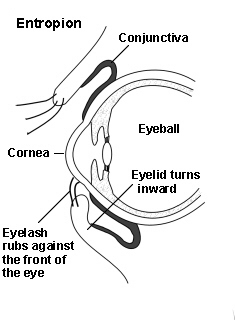
An entropion occurs where an eyelid turns inwards towards your eye. This causes the eyelashes to rub against the front of your eye (the cornea). Trichiasis is the medical term used to describe the eyelashes turning in against the front of the eye. The lower eyelid is most commonly affected.
Entropion symptoms
Back to contentsIrritation and pain on the front of the eye.
A watery eye.
If left untreated, the front of the eye (the cornea) may become damaged (a corneal ulcer may develop). The cornea is vital for vision and a damaged cornea may affect eyesight.
Continue reading below
Entropion causes
Back to contentsIn the UK, entropion mainly occurs in older people, associated with weakness of the small muscles around the eyelid.
The main cause of entropion worldwide is trachoma. This is a common infection in tropical countries, which affects the front of the eye. This can lead to scarring and disruption to the eyelid, which makes it turn inwards.
Less common causes include scarring (from eye infections, trauma, Stevens-Johnson syndrome or chemical damage) or muscle spasm (spasticity). Rarely, you can be born with a defect that causes the eyelid to turn inwards.
Entropion treatment
Back to contentsIf the cause is likely to be temporary, such as an infection or minor injury, the following may be enough until the condition recovers:
Taping the eyelid to your cheek; or
Injecting the muscles of your eyelid with botulinum toxin.
Lubricating eye ointment is often prescribed in the meantime to protect the front of your eye (cornea).
Continue reading below
What is entropion repair surgery?
Back to contentsIf you have a condition which is unlikely to recover by itself, you will be offered surgery. A small operation is performed to turn the eyelid back to its normal position. This stops the eyelashes from rubbing on the eye. The operation is usually successful and prevents any further damage to the front of the eye.
Dr Mary Lowth is an author or the original author of this leaflet.
Patient picks for Eyelid problems

Eye health
Blepharitis
Blepharitis means inflammation of the eyelids. It causes the eyes to feel irritated and the eyelids may be puffy and red. It can be a troublesome and recurring condition with no one-off cure. Eyesight is rarely affected.
by Dr Doug McKechnie, MRCGP

Eye health
Ectropion
Ectropion is a condition in which part or all of the lower eyelid turns outwards away from the eye. There are various causes but the most common cause is an ageing effect of the eyelid that occurs in some older people. A straightforward operation can usually cure the problem.
by Dr Colin Tidy, MRCGP
Frequently asked questions
What is the difference between entropion and trichiasis?
Entropion is when the eyelid itself turns inwards towards the eye. Trichiasis is the medical term used to specifically describe the eyelashes turning in against the front of the eye, which can be caused by entropion.
Which eyelid is most commonly affected by entropion?
The lower eyelid is most commonly affected by entropion.
What are the potential long-term consequences if entropion is not treated?
If entropion is left untreated, the continuous rubbing of eyelashes against the front of the eye (cornea) can lead to damage, potentially causing a corneal ulcer. Since the cornea is vital for vision, this damage can affect eyesight.
Besides aging, what are some other less common reasons someone might develop entropion?
Less common causes of entropion include scarring from eye infections, trauma, Stevens-Johnson syndrome, or chemical damage. Muscle spasms (spasticity) can also be a cause. Very rarely, some people are born with a defect that causes their eyelid to turn inwards.
How do temporary treatments like taping or injections help with entropion?
If the cause of entropion is likely to be temporary, such as a minor injury or infection, taping the eyelid to the cheek or injecting the eyelid muscles with botulinum toxin can help until the condition resolves on its own. These methods aim to reposition the eyelid or relax the muscles temporarily.
What is the purpose of lubricating eye ointment when treating entropion?
Lubricating eye ointment is often prescribed to protect the front of your eye (the cornea) from irritation and damage while other treatments are taking effect or while awaiting surgery.
Further reading and references
- Khan AZ, Ueland HO, Bohman E, et al; Entropion. Tidsskr Nor Laegeforen. 2024 Dec 16;144(15). doi: 10.4045/tidsskr.24.0191. Print 2024 Dec 17.
- Deka A, Saikia SP; Botulinum toxin for lower lid entropion correction. Orbit. 2011 Jan;30(1):40-2.
- Boboridis KG, Bunce C; Interventions for involutional lower lid entropion. Cochrane Database Syst Rev. 2011 Dec 7;(12):CD002221. doi: 10.1002/14651858.CD002221.pub2.
- Bergstrom R, Czyz CN; Eyelid Reconstruction, Entropion. StatPearls Publishing; 2023.
Continue reading below
About the authorView full bio

Dr Hayley Willacy, FRCGP
General Practitioner, Medical Author
MBChB (1992), DRCOG, DFFP, MRCOG (Part 1) MRCGP (2007), DFSRH (2013), MSc - medical education (2020)
Dr Hayley Willacy was an NHS GP working in northwest England, who retired from clinical practice in 2022 after 30 years.
About the reviewerView full bio

Dr Colin Tidy, MRCGP
General Practitioner, Medical Author
MBBS, MRCGP, MRCP (Paediatrics), DCH
Dr Colin Tidy is an NHS Doctor, based in Oxfordshire.
Article history
The information on this page is written and peer reviewed by qualified clinicians.
Next review due: 5 Mar 2028
6 Mar 2025 | Latest version

Ask, share, connect.
Browse discussions, ask questions, and share experiences across hundreds of health topics.

Feeling unwell?
Assess your symptoms online for free
Sign up to the Patient newsletter
Your weekly dose of clear, trustworthy health advice - written to help you feel informed, confident and in control.
By subscribing you accept our Privacy Policy. You can unsubscribe at any time. We never sell your data.