Pyloric stenosis
Peer reviewed by Dr Toni Hazell, FRCGPLast updated by Dr Philippa Vincent, MRCGPLast updated 18 Nov 2024
Meets Patient’s editorial guidelines
- DownloadDownload
- Share
- Language
- Discussion
- Audio Version
- Add to preferred sources on Google
Pyloric stenosis affects between 2 and 5 out of 1,000 newborn babies. It causes a blockage of food at the stomach outlet (pylorus). The main symptom is projectile vomiting after every meal causing weight loss and dehydration. A small operation is needed, which cures the problem.
At a glance
Pyloric stenosis is a narrowing of the stomach outlet into the small intestine.
Symptoms often start in babies aged 2 to 6 weeks, who appear otherwise healthy.
Forceful vomiting after feeds is the main symptom, which tends to worsen over days.
Babies with pyloric stenosis remain alert and hungry but may not gain weight.
An operation usually cures the problem, allowing babies to recover quickly.
See a doctor if your baby has forceful vomiting to rule out pyloric stenosis.
What is pyloric stenosis?
pyloric stenosis
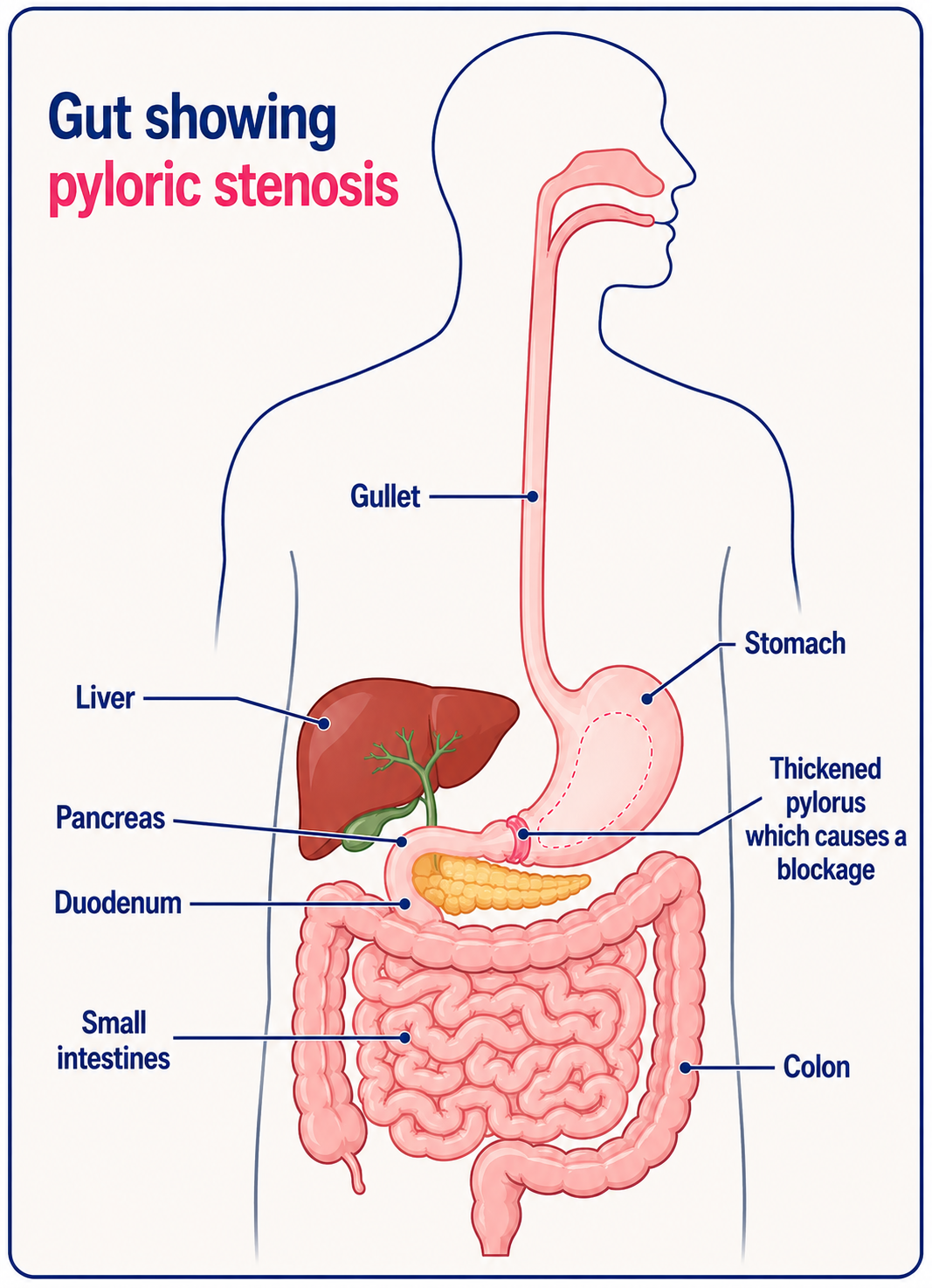
The outlet of the stomach into the small intestine is called the pylorus. Stenosis means a narrowing. Pyloric stenosis means a narrowed outlet of the stomach.
Food and drink pass down the gullet (oesophagus) into the stomach. Here the food and drink mixes with acid and are partially digested. The stomach then normally passes the food and drink into the small intestine to be fully digested and absorbed into the body.
When the outlet from the stomach into the small intestine is narrowed this causes a serious illness unless it is treated.
What are the symptoms of pyloric stenosis?
Symptoms typically begin in a baby aged between 2 and 6 weeks who is otherwise healthy.
Vomiting after a feed is the main symptom. The vomiting may start like a 'normal' vomit but often the vomiting is forceful and milk may be vomited quite a distance like a fountain. This is called projectile vomiting.
The baby remains alert and hungry, and will usually feed well - only to vomit the milk back soon after feeding. The vomiting tends to become worse and worse over several days.
Little food or drink passes through the narrowed pylorus which becomes narrower over time. This means that little or no food reaches the bowels, so babies often pass very little faeces (poo). Affected babies do not gain weight, and are in danger of quickly becoming dehydrated and seriously ill if the condition is not treated.
Note: it is very common for newborn babies to vomit. The vast majority of babies who vomit do not have pyloric stenosis.
What causes pyloric stenosis?
The muscle in the wall of the outlet of the stomach into the small intestine (pylorus) is abnormally thick. This causes the outlet from the stomach to become narrowed (stenosed). It is not known why this occurs though some risk factors have been identified. Use of a particular type of antibiotic shortly after birth has been shown to be a risk factor for developing pyloric stenosis.
Pyloric stenosis affects between 2 and 5 out of 1,000 babies. Boys are affected more commonly than girls. It can sometimes run in families. It is more common in babies who are bottle fed, who were born by caesarean section or who were born prematurely. It is more common in first-born babies. It is also more common in babies born to women who smoked during pregnancy.
It is seen most commonly in white babies and less frequently in Black or Asian babies.
Are any tests needed for pyloric stenosis?
Often the story is enough to make a doctor suspect the diagnosis of pyloric stenosis. A doctor may examine the baby's abdomen whilst they are feeding. A typical bulge next to the stomach can sometimes be felt as the muscles in the stomach and stomach outlet (pylorus) contract.
An ultrasound scan may be done if there is doubt about the diagnosis. This painless test is very reliable at detecting the thickened pylorus. Possibly because ultrasound is being used more frequently, pyloric stenosis is being diagnosed earlier and fewer babies are becoming very unwell before being diagnosed.
What is the treatment for pyloric stenosis?
A small operation, done under a general anaesthetic, normally cures the problem. A small cut is made in the skin over the stomach outlet (pylorus) and the pylorus itself is then cut to create a channel for food to pass through. This operation is called a pyloromyotomy.
Food and milk can then pass easily out of the stomach into the bowel.
A pyloromyotomy is now usually done by keyhole surgery. This uses only a tiny cut to the skin to allow fine instruments into the abdomen to cut the pylorus muscle.
The operation is usually totally successful. Normal feeds are started again shortly after the operation. Most babies recover quickly and have no further problems.
Can pyloric stenosis be prevented?
Pyloric stenosis cannot be prevented. Although there are certain risk factors which might make it more likely, there is always a combination of factors causing pyloric stenosis so it cannot be prevented.
Patient picks for Baby and toddler

Children's health
Undescended testicles
An undescended testicle (testis) is more common in boys who are born prematurely. Although in the majority of cases the testicle descends by the age of 6 months, some boys will need an operation. This is called an orchidopexy. This operation brings the testicle down from the tummy (abdomen) into the testicular sac (scrotum). There is an increased risk of infertility and also cancer if the testicle remains in the abdomen.
by Dr Laurence Knott

Children's health
Retinopathy of prematurity
Retinopathy of prematurity is an eye condition which can develop in premature babies. It can cause loss of vision or visual impairment if not treated. However, this can usually be prevented by regular screening of premature babies and early treatment.
by Dr Mary Harding, MRCGP
Frequently asked questions
How quickly do symptoms of pyloric stenosis usually get worse?
The vomiting from pyloric stenosis tends to worsen gradually over several days. Initially, it might seem like a 'normal' vomit, but it becomes more frequent and forceful over time.
How does pyloric stenosis affect a baby’s bowel movements?
Because very little food or drink can pass through the narrowed pylorus into the bowels, babies with pyloric stenosis often pass very little faeces (poo). This is due to the lack of material reaching the intestines for digestion and elimination.
What is the recovery like immediately after the operation for pyloric stenosis?
After the pyloromyotomy operation, babies typically recover quickly. Normal feeding can usually be restarted shortly after the procedure, and most babies experience no further problems.
Are there any long-term effects on a baby's health after having pyloric stenosis and surgery?
The operation for pyloric stenosis is usually totally successful. Most babies recover quickly and generally have no further problems after the condition is treated.
When should I be concerned about my baby's vomiting?
You should be concerned if your baby, typically between 2 and 6 weeks old, starts vomiting forcefully, especially if the vomit shoots out some distance. This is called projectile vomiting. Also, be concerned if the vomiting gets progressively worse over several days, even if your baby remains hungry.
Further reading and references
- Galea R, Said E; Infantile Hypertrophic Pyloric Stenosis: An Epidemiological Review. Neonatal Netw. 2018 Jul;37(4):197-204. doi: 10.1891/0730-0832.37.4.197. Epub 2018 Jul 1.
- Garfield K, Sergent SR; Pyloric Stenosis.
About the authorView full bio

Dr Philippa Vincent, MRCGP
General Practitioner, Medical Author
MB BS, Bsc, MRCGP (2000), DCH, DFSRH, DRCOG
Dr Philippa Vincent is an NHS GP working in North London.
About the reviewerView full bio

Dr Toni Hazell, FRCGP
MBBS, BSc, FRCGP, DFSRH, Dip GU med, DRCOG, DCH (London, UK, 2000)
Dr. Toni Hazell qualified from St. Mary’s Hospital Medical School and did her VTS at Northwick Park Hospital.
Article history
The information on this page is written and peer reviewed by qualified clinicians.
Article also available in English, German, Spanish, French, Italian, Portuguese, Hindi, Hebrew, Arabic, and Swedish.
Next review due: 17 Nov 2027
18 Nov 2024 | Latest version
Join the conversation
Share your thoughts or experiences with others in our patient communities.

Ask, share, connect.
Browse discussions, ask questions, and share experiences across hundreds of health topics.

Feeling unwell?
Assess your symptoms online for free
Sign up to the Patient newsletter
Your weekly dose of clear, trustworthy health advice - written to help you feel informed, confident and in control.
By subscribing you accept our Privacy Policy. You can unsubscribe at any time. We never sell your data.
More in children's health
- Anxiety in children
- Blocked nose in babies
- Breathing difficulties in children
- Childhood gastro-oesophageal reflux
- Children's cancers
- Club foot
- Congenital heart disease
- Cot death
- Dyslexia
- Eczema in children
- Head lice and nits
- Hirschsprung's disease
- Meningitis
- Meningococcal vaccine for meningitis
- Nausea and vomiting
- Perthes' disease
- Safeguarding children
- Spina bifida
- Teething