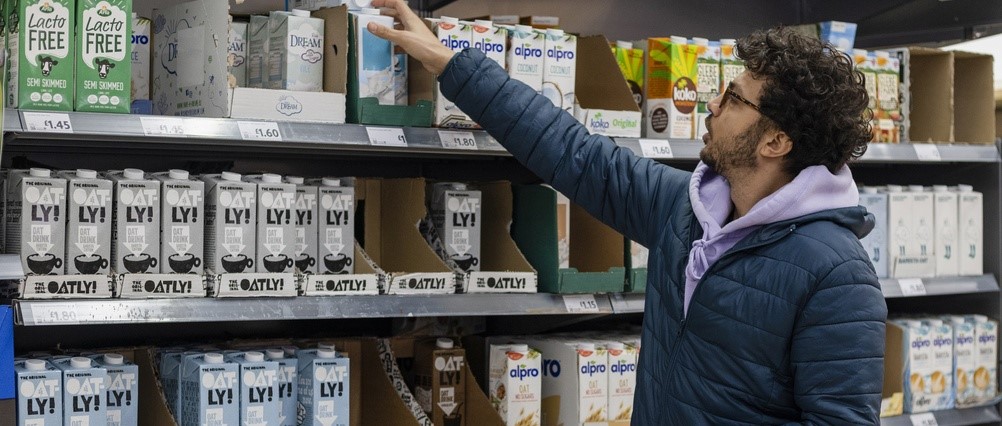
Ultra-processed foods: Are dairy-free milks like oat or soya good for us?
Peer reviewed by Dr Krishna Vakharia, MRCGPAuthored by Lydia SmithOriginally published 2 Nov 2023
Meets Patient’s editorial guidelines
- DownloadDownload
- Share
- Language
- Discussion
- Audio Version
- Add to preferred sources on Google
Sales of plant-based milks, like oat, soya, almond and coconut milk, have increased dramatically in the last few years. Around 1 in 3 British people drink dairy-free milks, turning it into a £400 million-a-year market in the UK. But with many of these drinks classed as ultra-processed, are they actually good for us?
Ultra-processed food is food that you cannot make at home because it contains a lot of ingredients that you usually don’t have in your kitchen. These foods are often cheap, convenient, have a long shelf-life and contain additives like emulsifiers, sweeteners, preservatives and stabilisers.
Ultra-processed foods like ready meals, crisps and sweets are not good for us - so it’s generally accepted that they should be eaten in moderation.
However, although dairy-free milks are often seen as a healthier alternative to dairy, these are actually ultra-processed too. However, this doesn’t necessarily mean they’re all bad for us.
"Plant-based milks are classed as an ultra-processed food," says Reema Patel, dietitian at Dietitian Fit. "This is because they can contain a number of added ingredients, such as preservatives, oils, fats, emulsifiers and artificial stabilisers. Sometimes, they contain sugars - but not always.
"The processing of the product itself - such as the soy, oats or almonds - changes the food from its natural state, in order to turn it into a milk," explains Patel. "The challenge to develop plant-based milks to have a similar nutrition content to cow’s milk means that some fortification and addition of ingredients is required, as well as helping to improve the shelf life of products."
Are dairy-free milks good for us?
Foods can be processed in many different ways, so some are worse for us than others - and not all dairy-free milks are the same. While some contain added sugar or oil, others do not.
"Some plant-based milks are less processed - such as organic options," says Patel. "These are usually a mix of the plant product and water, with nothing else added."
In some ways, Patel explains, dairy-free milks can be healthy as they’re often low in calories, fats and salts. "However, we want to find an option that provides us with the most nutrition with the least amount of additives and preservatives. Some non-dairy milks contain added sugars or thickeners, which make these products less than ideal," she says.
"Compared to cow’s milk, very few plant-based milks will match it for nutrition, but if you would like to switch to a non-dairy milk, choose something that contains no added sugars and minimal preservatives."
Of course, dairy-free milks offer a good alternative to cow’s milk for people who can’t consume dairy. For example, if you’ve got an allergy or if you’re vegan. Oat milk can be a gentle, safe alternative for children with a cow’s milk protein allergy. The best ones contain added vitamins and nutrients like calcium, which are essential for growth, development and general health.
Make your own oat milk
If you’ve got time to spare, you could also try making your own plant-based milk at home. Although these might not stay fresh for as long as shop-bought versions, you’ll know they’re less processed.
To make your own oat milk:
What you will need:
A sieve; a clean cloth, muslin type if available; a food processor or blender.
Ingredients:
100g of porridge oats; 750ml cold water; a pinch of salt.
Method:
Put the porridge oats into a bowl and pour in tap water until the oats are covered.
Cover the bowl with a tea towel and leave overnight - somewhere cool but not in the fridge.
In the morning, strain the mixture through a sieve, throw away the water and rinse the oats under a tap.
Pour the oats into a food processor with 750ml of cold water and half a teaspoon of fine salt then blend until smooth.
Line a sieve with a piece of cloth - muslin works best as the cloth needs small holes - put it over a bowl and pour the oat milk into it.
Strain the mixture through the lined sieve using a spoon.
You can add water to the mix to make it thinner if you want. The oat milk will keep in the fridge for 2 to 3 days.
How to choose a healthy dairy-free milk
Not everyone has the time - or wants to - to make their own dairy-free milk. But knowing what to look out for, or to avoid,when shopping for supermarket alternatives can be helpful.
Patel says: "Choose one that contains no added sugars or sweeteners. It would also be ideal to choose one without any preservatives, thickeners or added oils. Although these give the product a longer shelf-life, they contribute to the processing of the milk.
"If you go for an organic plant based milk, these will usually only contain a few ingredients, and have nothing added. Keep in mind that many plant based milks lack protein and some vitamins and minerals such as calcium, iodine and B12, so it is important to include other foods in your diet to provide these nutrients."
Patient picks for Healthy eating
Diet and nutrition
Are carbs actually bad for you?
Diet fads have left most of us confused. Take carbohydrates, the stuff that potatoes, pasta, bread and sugary foods are made of. In the 1970s, these were blamed for being fattening. Then starchy carbs were rehabilitated and health officials advised that these should provide at least half our daily calories. Now, carbs seem to be the enemy again according to some. So, where does that leave us now?
by Dr Carrie Ruxton, PhD, Child Nutrition
Diet and nutrition
What happens to your body after giving up caffeine?
For many people, caffeine is a staple part of their day. Present in tea, coffee, energy drinks, Coca Cola and even chocolate, the substance is the planet's most popular psychoactive drug. According to the British Coffee Association, Brits alone get through 95 million cups of coffee a day. It almost goes without saying, then, that giving up caffeine can be tough.
by Abi Millar
About the authorView full bio
Authored by

Lydia Smith
Feature writer
BA, MA, MSc
Lydia Smith is an award-winning journalist and feature writer who has written extensively on women's health and mental health. She is currently studying for an MSc in psychology.
About the reviewerView full bio

Dr Krishna Vakharia, MRCGP
Chief Medical Officer for Health, Optum UK
MBChB, MRCGP(2013), BMedSci (hons), DFSRH, DRCOG, PGDipDerm (Distn)
Dr Krishna Vakharia is an NHS GP. She is also a regular examiner for the postgraduate Diploma in Practical Dermatology at Cardiff University as well as being the Chief Medical Officer for health at Optum UK.
Article history
Article also available in English, German, Spanish, French, Italian, Portuguese, Hindi, Hebrew, Arabic, and Swedish.
2 Nov 2023 | Originally published
Authored by:
Lydia SmithPeer reviewed by
Dr Krishna Vakharia, MRCGP
Join the conversation
Share your thoughts or experiences with others in our patient communities.

Ask, share, connect.
Browse discussions, ask questions, and share experiences across hundreds of health topics.

Feeling unwell?
Assess your symptoms online for free
Sign up to the Patient newsletter
Your weekly dose of clear, trustworthy health advice - written to help you feel informed, confident and in control.
By subscribing you accept our Privacy Policy. You can unsubscribe at any time. We never sell your data.