
Epididymo-orchit
Granskad av Dr Colin Tidy, MRCGPSenast uppdaterad av Dr Rachel Hudson, MRCGPSenast uppdaterad 11 sept 2024
Uppfyller patientens redaktionella riktlinjer
- Ladda nerLadda ner
- Dela
- Language
- Diskussion
- Ask Patient
- Ljudversion
- Lägg till i föredragna källor på Google
I denna serie:Skrotala knölar, smärta och svullnadTestikeltorsionEpididymal cystaVaricoceleHydrocele hos vuxnaHydrocele hos spädbarn
Epididymo-orchit är en inflammation i bitestikeln och/eller testikeln. Bitestikeln och testikeln kan svullna och pungen kan bli förstorad, öm och röd. Hos vuxna beror epididymo-orchit vanligtvis på en infektion, oftast från en urinvägsinfektion eller en sexuellt överförbar infektion. En kur med antibiotika brukar vanligtvis rensa infektionen.
Överblick
Epididymo-orchitis is inflammation of the epididymis and/or testicle.
It is often caused by an infection, such as a urine infection or a sexually transmitted infection.
Symptoms include rapid swelling, tenderness, and redness of the scrotum, often with pain.
Treatment usually involves a course of antibiotics and painkillers.
Most people recover fully, but complications like ongoing pain or reduced fertility can occur.
Videoval för Testicle and scrotum disordersVideobibliotek
What is epididymo-orchitis?
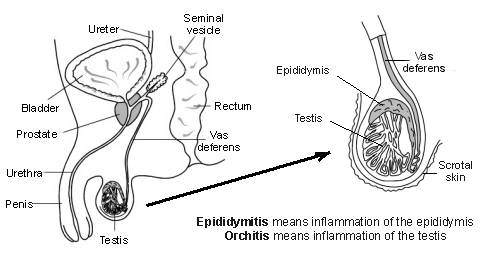
Epididymit means inflammation of the epididymis (the structure next to the testicle (testis) that is involved in making, storing and transporting sperm).
Orchitis means inflammation of a testicle.
As the epididymis and testis lie next to each other, it is often difficult to tell if the inflammation is of the epididymis (epididymitis), the testis (orchitis) or both. Therefore, the term epididymo-orchitis is often used.
Testis - epididymitis and orchitis
Causes of epididymo-orchitis
In boys who have not reached puberty, epididymo-orchitis is rare and symptoms are usually not due to an infection though they can occasionally occur as a result of a urinvägsinfektion. The most common cause at this age is thought to be urine refluxing into the duct that sperm pass down (the ejaculatory duct, or vas deferens).
Rarely, epididymo-orchitis in children can be a complication of Henoch-Schönleins purpura, a condition caused by inflammation of the blood vessels.
In over-14s, most cases of epididymo-orchitis are due to an infection. Causes of infection include the following:
A complication from a urine infection
Germs (bacteria) such as E. coli that cause urine infections can sometimes track down the vas deferens (the tube that connects the epididymis to the urethra) to cause an epididymo-orchitis. This can happen at any age and is the most common cause of epididymo-orchitis in men aged over 35 years. This is because partial blockage of urine flow becomes more common with increasing age, either due to an enlarged prostate gland or narrowing of the urethra (urethral stricture). The urethra is the tube that urine flows out of from the bladder. Partial blockage of urine makes you more prone to develop urinary tract infections.
Sexually transmitted infection
A sexually transmitted infection (STI/STD) is the most common cause of epididymo-orchitis in young men (but can occur in any sexually active man). It most commonly occurs with chlamydial and gonorrhoeal infections. In men, these infections typically infect the urethra to cause a urethritis. However, sometimes the infection can track down the vas deferens to the epididymis and testicle (testis).
The mumps virus
The mumps virus used to be a common cause. Most people with påssjuka develop swelling of the parotid salivary glands near the jaw. However, mumps in boys also causes epididymo-orchitis in about 1 in 5 cases. The virus gets to the testicles via the bloodstream. This cause is now less common since the measles, mumps and rubella (MMR) immunisation is now routinely given to children.
An operation to the prostate gland or urethra
This may allow germs (bacteria) into the urethra which may track down to the testicles. Epididymo-orchitis used to be a common complication after removal of the prostate gland (prostatectomy). This is now rare due to newer surgical techniques.
Medicinering
Epididymo-orchitis can occasionally be a side-effect of a medicine called amiodaron (a medication used for heart rhythm problems). It normally occurs at doses above 200 mg, especially when the dosage range reaches 400-800 mg.
Uncommon causes of epididymo-orchitis
Other viral infections are uncommon causes of epididymo-orchitis. Infection from other parts of the body can travel in the blood to the testicles, such as tuberkulos (TB) and brucellosis. When this happens it is usually in people who have a problem with their immune system (for example, people with AIDS).
Schistosomiasis is a tropical infectious disease that can cause epididymo-orchitis. Men with Behçet's disease may develop inflamed testicles to cause a non-infective epididymo-orchitis. Injury to the scrotum can cause inflammation of the epididymis and testicle.
How common is epididymo-orchitis?
Epididymo-orchitis occurs in about 1 in 1,000 males. It is common in men aged 15-30 years and in men aged over 60 years and is rare before puberty. About 3 in 10 boys who have mumps after puberty develop orchitis. The risk of developing epididymo-orchitis is increased if a catheter or other instruments are inserted into the urethra.
Symptoms of epididymo-orchitis
Symptoms usually develop quickly - over a day or so. The affected epididymis and testicle can swell rapidly and the scrotum often becomes enlarged, tender and red. It can be very painful. Sometimes there is pain without significant swelling or redness but it will be very tender when examined.
There may be other symptoms if the epididymo-orchitis is a complication from another infection. For example, there may be pain on passing urine if there is a urine infection or a discharge from the penis if there is a sexually transmitted infection. As with any infection, there may be a hög temperatur (feber) and general symptoms of feeling unwell.
Diagnosing epididymo-orchitis
Tests to look for infecting germs (bacteria)
A urine test will usually be done if a urine infection appears to be the root cause. A urine sample might also be taken if a sexually transmitted infection is thought to be the root cause (swabs from the penis used to be taken but urine tests will often give the necessary results nowadays). Sexual partners of people with epididymo-orchitis caused by a sexually transmitted infection will also need testing.
Ideally, someone with epididymo-orchitis should be assessed in a sexual health clinic, particularly under the age of 40 where 50% of epididymo-orchitis infections will be due to a sexually transmitted infection.
Se de separata broschyrerna kallade Klamydia, Uretrit hos män och Gonorré för mer information.
Blodprov
Blood tests may occasionally be requested including a full blood count or CRP to look for evidence of infection and inflammation. However, these would not usually be needed.
Tests of the urinary tract
Tests to look into the urethra and bladder may be needed if a urine infection is the cause and if this is thought to be due to other urinary tract abnormalities. Referral to a urology specialist may be considered depending on the results of some of the tests (eg if there is still urine left in the bladder after passing urine).
Se de separata broschyrerna kallade Urinvägsinfektion hos män och Urinvägsinfektion hos barn för mer information.
Treatment for epididymo-orchitis
A course of antibiotic medicines is usually advised as soon as epididymo-orchitis is diagnosed; these are usually given for two weeks. These normally work well. Pain usually eases within a few days but swelling may take a week or so to go down, sometimes longer. The choice of the antibiotikum depends on the most likely underlying cause of the infection.
Symptoms should start to improve within three days and further advice should be sought if there is no improvement or if the symptoms have not completely disappeared in two weeks.
If a sexually transmitted infection is the cause then sex should be avoided until treatment and follow-up have been completed. Sexual partners of men with epididymo-orchitis caused by a sexually transmitted infection may also need antibiotic treatment.
The vast majority of epididymo-orchitis infections are caused by bacteria which is why antibiotics are prescribed. Antibiotics do not kill viruses and they are not needed if a viral infection is the cause - for example, mumps.
Supportive underwear may help to ease the pain. Painkillers and ice packs (ice should never be applied directly to the skin) will also ease the pain.
Complications of epididymo-orchitis
Most people recover fully from epididymo-orchitis and complications are uncommon. Possible complications include:
Ongoing pain or swelling in the testicle - this settles within three months in more than four in five men with epididymo-orchitis.
A collection of pus due to infection (an abscess) occasionally develops in the scrotum. This may need a small operation to drain the pus.
Reduced fertility in the affected testicle (testis), especially in cases caused by the mumps virus.
An ongoing inflammation occasionally develops (chronic epididymitis).
Rarely, serious damage to the testicle may occur and result in dead tissue (gangrene) in the testicle that needs to be surgically removed.
Patientval för Testicle and scrotum disorders
Mäns hälsa
Blod i sädesvätska
Haematospermia means there is blood in the semen. Usually there are no other symptoms such as pain. In men under 40 years old it is usually harmless and resolves without any treatment. However, it can also be caused by a number of conditions that need investigations and treatment.
av Dr Hayley Willacy, FRCGP

Mäns hälsa
Varicocele
A varicocele is like varicose veins of the small veins (blood vessels) next to one testicle (testis) or both testicles (testes).
av Dr Doug McKechnie, MRCGP
Vanliga frågor
What is the difference between epididymitis and orchitis?
Epididymitis refers to inflammation of the epididymis, a structure next to the testicle involved in sperm production, storage, and transport. Orchitis, on the other hand, is the inflammation of a testicle itself. Because these structures are so close, it's often hard to distinguish between them, so the combined term epididymo-orchitis is frequently used.
How can epididymo-orchitis affect men differently at various ages?
In boys who haven't reached puberty, epididymo-orchitis is rare and usually not due to infection, though a urine infection can sometimes be the cause. It's more commonly seen in men aged 15-30 and over 60. In men over 35, it's frequently caused by urine infections, often linked to age-related issues like an enlarged prostate. In younger, sexually active men, it's most commonly linked to sexually transmitted infections.
Are there common signs that might indicate what's causing my epididymo-orchitis?
Yes, depending on the underlying cause, you might experience additional symptoms. For example, if a urine infection is the cause, you might have pain when urinating. If it's a sexually transmitted infection, you might notice a discharge from the penis. General symptoms like a high temperature and feeling unwell can also occur with any infection.
What should I do if my symptoms don't improve after starting antibiotics for epididymo-orchitis?
If your symptoms don't start to improve within three days of starting antibiotics, or if they haven't completely disappeared within two weeks, you should seek further medical advice. It's important to ensure the treatment is effective or to check for other potential issues.
If epididymo-orchitis is caused by a sexually transmitted infection, do my sexual partners need treatment?
Yes, if your epididymo-orchitis is caused by a sexually transmitted infection, your sexual partners may also need antibiotic treatment. Additionally, you should avoid sexual activity until both your treatment and any follow-up care are complete.
Vidare läsning och referenser
- Epididymitis and Orchitis; Urology Care Foundation
- Rupp TJ, Leslie SW; Epididymitis.
- BASHH patient leaflet epididymo-orchitis (2022)
Om författarenVisa fullständig biografi
Uppdaterad av

Dr Rachel Hudson, MRCGP
Allmänläkare och medicinsk författare
MBChB, MRCGP (2008), BSc (Medical Science), DFSRH, DRCOG, DCH
Dr Rachel Hudson är en NHS-läkare som arbetar i nordvästra England.
Om recensentenVisa fullständig biografi

Dr Colin Tidy, MRCGP
Allmänläkare, Medicinsk Författare
MBBS, MRCGP, MRCP (Paediatrics), DCH
Dr Colin Tidy är en NHS-läkare, baserad i Oxfordshire.
Artikelhistorik
Artikeln finns också på Engelska, Tyska, Spanska, Franska, Italienska, Portugisiska, Hindi, Hebreiska, Arabiska, och Svenska.
Next review due: 10 Sept 2027
11 sept 2024 | Senaste versionen
Medicinska yrkesverksamma
Looking for more in-depth clinical detail? Our Professional Reference articles are written for doctors, nurses and other healthcare professionals. They include comprehensive clinical guidance, diagnostic information and UK/European evidence summaries. If you need the clinical version, you can read the Professional Reference article on this topic.
Dela dina tankar eller erfarenheter med andra i vår patientgemenskaper.
Enkel tillgång till pålitliga behandlingar och hälsotjänster online.
Common conditions
Get help with common conditions through the NHS, without a GP appointment.





Anmäl dig till Patientens nyhetsbrev
Din veckovisa dos av tydliga, pålitliga hälsoråd - skrivna för att hjälpa dig känna dig informerad, självsäker och i kontroll.
Genom att prenumerera accepterar du våra Sekretesspolicy. Du kan avsluta prenumerationen när som helst. Vi säljer aldrig dina uppgifter.