Hydrocele in infants
Peer reviewed by Dr Philippa Vincent, MRCGPLast updated by Dr Toni Hazell, FRCGPLast updated 14 Nov 2024
Meets Patient’s editorial guidelines
- DownloadDownload
- Share
- Language
- Discussion
- Audio Version
- Add to preferred sources on Google
In this series:Scrotal lumps, pain and swellingTesticular torsionEpididymo-orchitisEpididymal cystVaricoceleHydrocele in adults
A hydrocele is a collection of fluid in the scrotum, sometimes found in newborn boys. Most hydroceles go down within the first few months of life in babies and so do not need treatment. If a hydrocele persists then a small operation can usually cure the problem.
At a glance
A hydrocele is a fluid collection in a sac around a testicle in the scrotum.
It usually feels like a smooth, fluid-filled balloon and is often painless.
Hydroceles are very common in newborn babies.
They often improve on their own within the first year of life without treatment.
Surgery may be advised if a hydrocele persists beyond 12-24 months.
The normal scrotum and testes
The scrotum is normally loose, soft and fleshy. It holds the two testicles (testes). Usually you can easily feel the testes in the scrotum. A tube (the vas deferens) takes sperm from each testicle (testis) to the penis. It is normal for one testis to hang lower than the other.
What is a hydrocele?
A hydrocele is a collection of fluid in a sac in the scrotum next to a testicle (testis). It usually occurs on one side but sometimes a hydrocele forms over both testicles (testes). It is common in newborns.
Diagram of a hydrocele
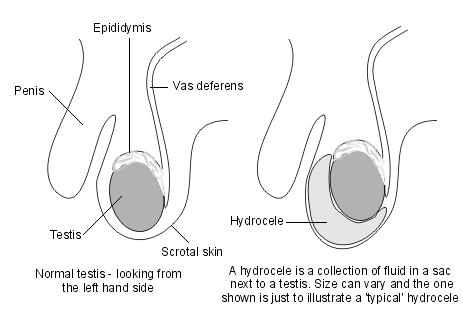
The normal testis is surrounded by a smooth protective tissue sac. You cannot normally feel this. It makes a small amount of 'lubricating' fluid to allow the testis to move freely. Excess fluid normally drains away into the veins in the scrotum. If the balance is altered between the amount of fluid that is made and the amount that is drained, some fluid accumulates as a hydrocele.
What do hydroceles look and feel like?
A hydrocele feels like a small fluid-filled balloon inside the scrotum. It feels smooth and is mainly in front of one of the testicles (testes). They can vary in size. Hydroceles are normally painless. Sometimes fluid can move back and forth between the hydrocele and the abdominal cavity - this is called a communicating hydrocele and you might see swelling that appears to move between the tummy (abdomen) and the scrotum. Another type of hydrocele is called non-communicating, where the fluid stays in the scrotum. There may be no hydrocele symptoms - your baby is unlikely to be in pain - but you might notice an apparent lump or swelling in the scrotum.
What causes hydroceles?
Some babies are born with a hydrocele. Hydroceles are very common in babies. When babies develop in the womb (uterus), the development of the testicles (testes) sees the testicles move from the tummy (abdomen) to the scrotum. Sometimes the passage which allows this to happen (the processus vaginalis) does not close completely. This may then lead to a hydrocele developing.
Hydroceles can sometimes be associated with an inguinal hernia, which occurs when part of the intestine pushes through a weak spot in the muscles of the abdominal wall.
In older children a hydrocele may have other causes such as injury, torsion of the testis or nephrotic syndrome.
Are any investigations needed for hydrocele?
The diagnosis of hydrocele can normally be made by history and examination. If there is doubt about the nature of the scrotal lump, an ultrasound may be needed.
What is the treatment for hydrocele?
Hydroceles usually improve without any treatment within the first year of life. An operation is usually only advised if the hydrocele persists after 12-24 months of age.
If your child also has a hernia, often seen as a lump in the groin area, then this will usually be corrected in the same operation.
The operation for a hydrocele involves making a very small incision (cut) in the lower tummy (abdomen) or the scrotum. Sometimes the procedure is done by keyhole surgery (laparoscopically). The fluid is then drained from around the testicle (testis). The passage between the abdomen and the scrotum will also be sealed off so the fluid cannot reform in the future. This is a minor operation and is performed as a day case, so does not usually involve an overnight stay in the hospital.
There are no long-term effects of having a hydrocele. Having a hydrocele does not affect the testicles (testes) or a boy's ability to have children in the future.
Patient picks for Baby and toddler

Children's health
Childhood gastro-oesophageal reflux
Gastro-oesophageal reflux is very common in babies and young children. Regurgitation of a small quantity of milk after a feed without any other symptoms (possetting) is harmless in young infants and doesn't need any investigations or treatment. Reflux may be more severe and associated with other symptoms. This condition is usually diagnosed without needing any tests but some babies with more troublesome symptoms may be referred for further investigations. There are various treatments available including feed thickeners, anti-regurgitant milks, Gaviscon® and various medications. However, for the majority of cases, gastro-oesophageal reflux is a self-limiting condition and, with time, improves without any complications.
by Dr Doug McKechnie, MRCGP

Children's health
Baby-led weaning
Weaning is the process of adding food other than breast milk or infant formula to your baby's diet. Advice on when exactly to do this varies.
by Dr Mary Elisabeth Lowth, FRCGP
Frequently asked questions
What is the usual recovery time after an operation for a hydrocele?
The article mentions that the operation for a hydrocele is a minor procedure and is performed as a day case, meaning it does not usually require an overnight stay in the hospital. While a specific recovery time isn't detailed, the nature of it being a day case suggests a relatively quick return to normal activities, although some rest and care would be expected immediately after.
Can a hydrocele affect my child's fertility later in life?
No, having a hydrocele does not affect the testicles or a boy's ability to have children in the future. The article explicitly states that there are no long-term effects of having a hydrocele in this regard.
Are there different kinds of hydroceles?
Yes, there are two main types mentioned: communicating and non-communicating hydroceles. A communicating hydrocele allows fluid to move back and forth between the hydrocele and the abdominal cavity, causing the swelling to appear to move. In a non-communicating hydrocele, the fluid remains contained within the scrotum.
What happens if a hydrocele persists beyond two years of age?
If a hydrocele persists after 12-24 months of age, an operation is usually advised to correct it. This procedure involves draining the fluid and sealing off the passage between the abdomen and the scrotum to prevent recurrence.
How is a hydrocele diagnosed in children?
A hydrocele is normally diagnosed through a medical history and physical examination. An ultrasound scan may be used if there is any uncertainty about the nature of the scrotal lump.
Further reading and references
- Verma S, Agrawal V, Acharya H, et al; Laparoscopic suture-less herniotomy using tissue-sealing device for paediatric hydrocele. J Minim Access Surg. 2019 Jan 4. pii: 249452. doi: 10.4103/jmas.JMAS_251_18.
- EAU Paediatric Urology Guidelines. Edn. presented at the EAU Annual Congress Copenhagen; European Association of Urology, 2018 - updated 2023
About the authorView full bio
Updated by

Dr Toni Hazell, FRCGP
MBBS, BSc, FRCGP, DFSRH, Dip GU med, DRCOG, DCH (London, UK, 2000)
Dr. Toni Hazell qualified from St. Mary’s Hospital Medical School and did her VTS at Northwick Park Hospital.
About the reviewerView full bio

Dr Philippa Vincent, MRCGP
General Practitioner, Medical Author
MB BS, Bsc, MRCGP (2000), DCH, DFSRH, DRCOG
Dr Philippa Vincent is an NHS GP working in North London.
Join the conversation
Share your thoughts or experiences with others in our patient communities.

Ask, share, connect.
Browse discussions, ask questions, and share experiences across hundreds of health topics.

Feeling unwell?
Assess your symptoms online for free
Sign up to the Patient newsletter
Your weekly dose of clear, trustworthy health advice - written to help you feel informed, confident and in control.
By subscribing you accept our Privacy Policy. You can unsubscribe at any time. We never sell your data.