Mallet finger
Peer reviewed by Dr Colin Tidy, MRCGPLast updated by Dr Hayley Willacy, FRCGP Last updated 15 Sept 2024
Meets Patient’s editorial guidelines
- DownloadDownload
- Share
- Language
- Discussion
- Audio Version
- Add to preferred sources on Google
A finger that bends down at the end joint and cannot be straightened is called a mallet finger. It is caused by an injury to the tendon that straightens (extends) the finger. A splint worn day and night for 6-8 weeks will cure the problem in most cases.
At a glance
A mallet finger is when the end of a finger bends towards the palm and cannot straighten.
It is caused by an injury that tears the tendon responsible for straightening the fingertip.
Symptoms include pain, swelling, and the inability to straighten the end of the finger.
Treatment usually involves wearing a splint continuously for 6-8 weeks.
Surgery may be needed if splinting does not work or if there is a cut to the finger.
What is a mallet finger?
A mallet finger describes a condition in which the end of a finger is bent (flexed) towards the palm and cannot straighten.
What causes a mallet finger?
The usual cause is an injury to the end of the finger. The injury tears the tendon that straightens (extends) the end of the finger.
It is sometimes called baseball finger, as it is a common injury when trying to catch a fast, hard ball. If the catch is missed slightly then the ball hits the straight finger. This may force the end of the finger to bend (flex) further than normal and tear the tendon. Without the use of this tendon, the finger stays bent (flexed).
Diagram of the hand showing mallet finger
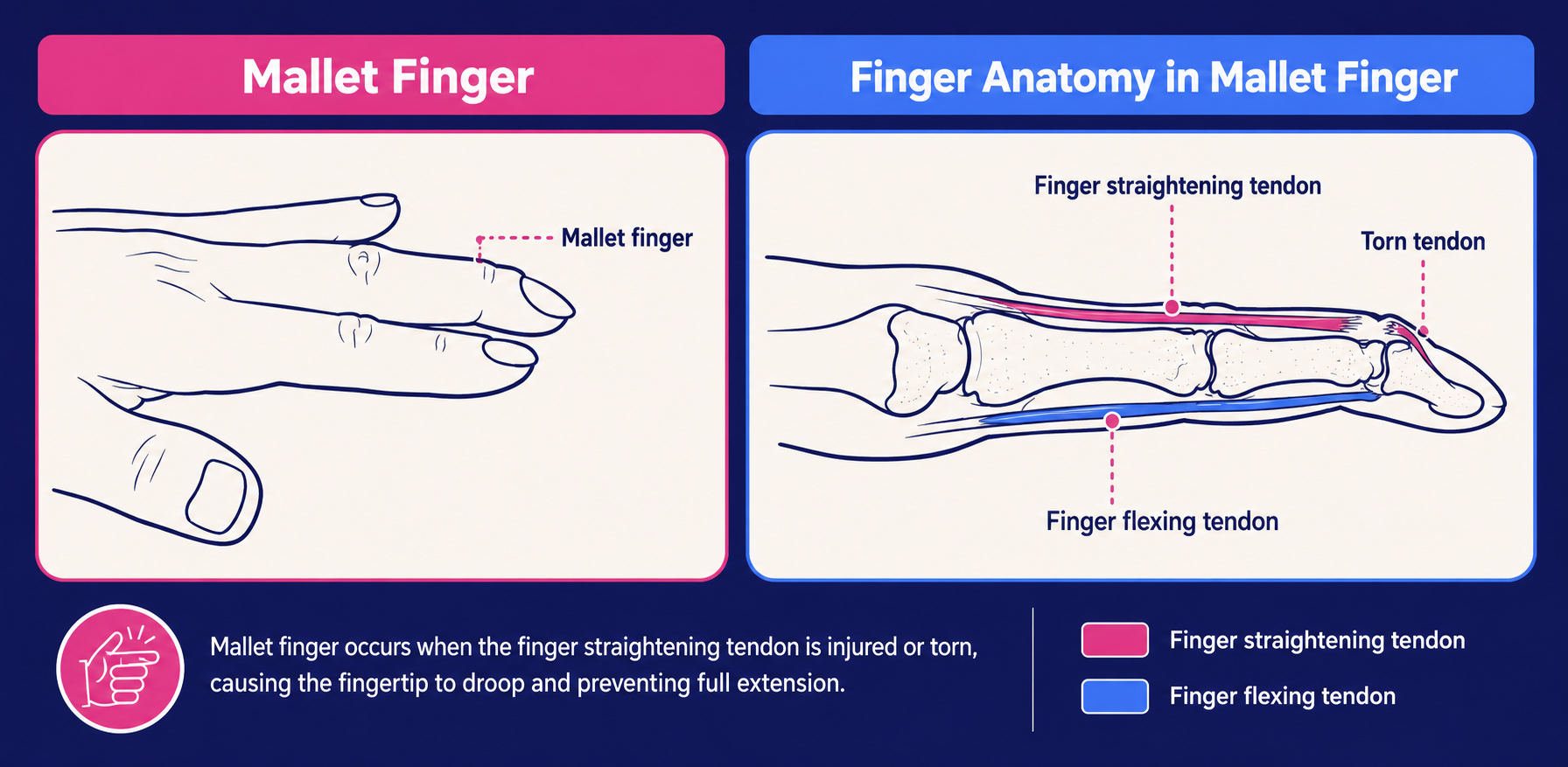
Sports injuries are a common cause of mallet finger. However, any injury that forces the end joint of a finger to over-bend can cause it. (Sometimes the tendon does not tear but the injury causes a piece of bone to be pulled off the finger where the tendon is attached. This is called an avulsion fracture. The result is the same, as the tendon then cannot pull on the bone.)
What are the symptoms of a mallet finger?
After the injury, the end of your finger may:
Be painful and swollen.
Lie in a bent (flexed) position.
Not be able to straighten (extend) at the end.
Mallet finger
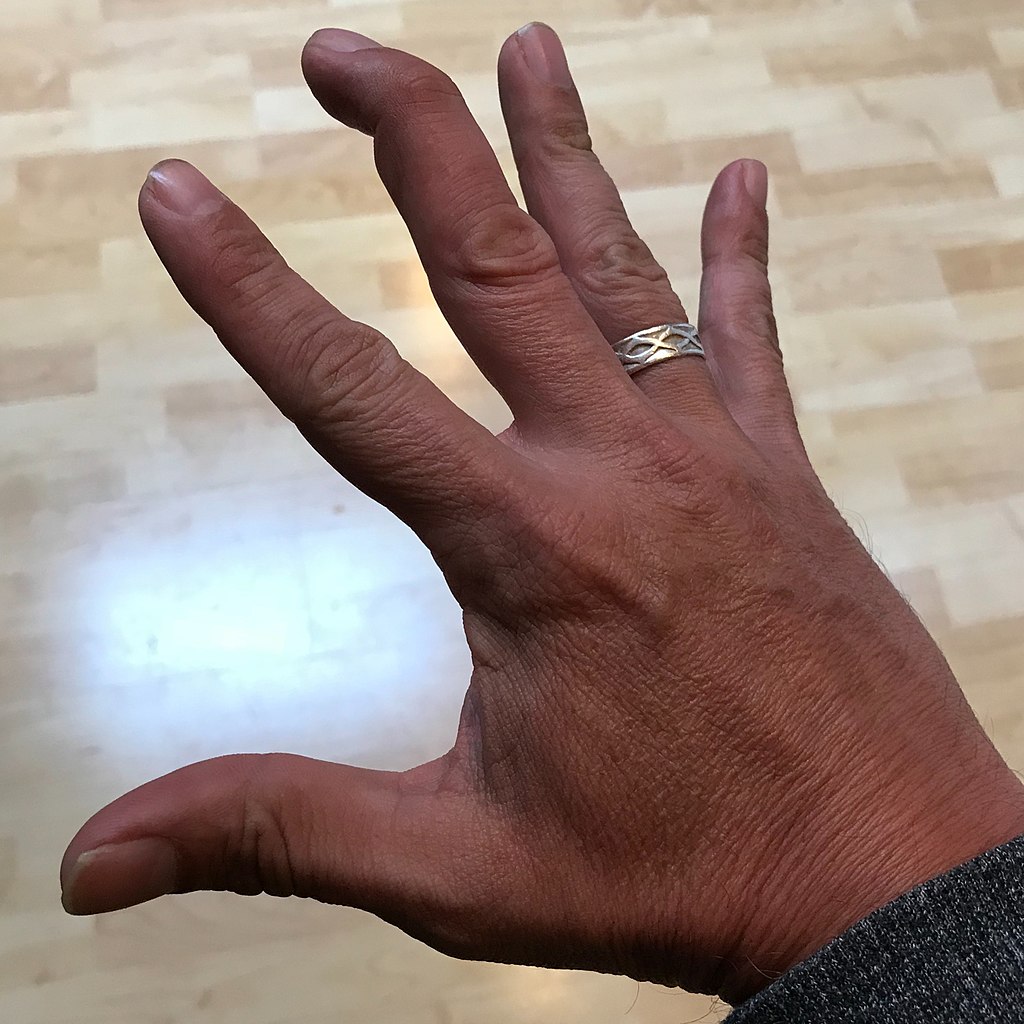
© Clappstar, CC BY-SA 4.0, via Wikimedia Commons
How is mallet finger diagnosed?
The clinician can usually diagnose a mallet finger from listening to how the injury occurred and how the finger looks and feels when examined. If there is any doubt they may request an x-ray.
What is the treatment for mallet finger?
Splint
A splint is worn for 6-8 weeks to keep the finger straight with the end joint bent backwards slightly (overextended). It must be worn all the time, day and night.
There are many different types of splints available. The type of splint given often depends on the size and shape of your finger. You must not take the splint off at any time during this treatment. If you have to take it off (for example, to wash) then you must keep that finger straight and not allow it to bend (flex).
Keeping the finger straight constantly allows the two ends of the torn tendon or bone to stay together and heal. About three in four cases heal well with this treatment.
Surgery
Surgery is needed to repair the torn tendon if the above fails. (Surgery may be advised straightaway if there is a cut to your finger; however, most injuries that cause mallet finger do not cut the skin.)
Recovering from mallet finger
It may take several months for your finger to fully recover its function. Any redness, swelling and tenderness of your skin over the end of your finger may persist for the first few months after the injury. These symptoms will usually improve eventually.
Can mallet finger be prevented?
As most mallet finger injuries occur during sports, taking care when playing with a hard ball is advisable but prevention may not always be possible. You can prevent the deformity returning by using the splint exactly as directed by your clinician.
Patient picks for Joint pain
Bones, joints and muscles
Frozen shoulder
Frozen shoulder (in medical terms, adhesive capsulitis of the shoulder) is a condition where the shoulder becomes painful and stiff, often for no particular reason. Shoulder movements become reduced, sometimes completely 'frozen'. It usually only affects one shoulder but can affect both. It is thought to be due to scar-like tissue forming in the shoulder capsule. Without treatment, symptoms usually go away but this can take a long time, up to three years in some cases. Various treatments may ease the pain and improve the movement of your shoulder.
by Dr Philippa Vincent, MRCGP
/og.png)
Bones, joints and muscles
Temporomandibular Joint Disorder (TMD)
Temporomandibular disorders are problems affecting the jaw joint and the muscles and other tissues around the jaw joint. These disorders usually cause pain or reduced movement of the jaw, and sometimes sounds such as clicking or grating of the jaw joint. There are various causes but generally temporomandibular disorders are not serious and often improve with simple treatments.
by Dr Rosalyn Adleman, MRCGP
Frequently asked questions
What should I do immediately after getting a mallet finger injury?
The article suggests that after the injury, the end of your finger may be painful, swollen, and bent. While it doesn't give immediate first aid advice, generally for an injury that causes pain and swelling, it's advisable to avoid bending the affected finger and seek medical attention to confirm the diagnosis and receive appropriate treatment.
Are there different kinds of splints used for mallet finger?
Yes, there are many different types of splints available for mallet finger. The specific type you receive often depends on the size and shape of your finger.
How do I care for my skin if I'm wearing a splint for 6-8 weeks?
The article states that you must not take the splint off at any time during treatment, even to wash. However, if you absolutely have to remove it, you must keep the affected finger straight and not allow it to bend. This implies that cleaning around the splint or the finger itself would need to be done very carefully to ensure the finger remains straight.
What are the chances of my finger healing well with splint treatment?
About three in four cases of mallet finger heal well with splint treatment, provided it is worn exactly as directed.
When might surgery be considered as a first option for mallet finger?
Surgery may be advised straightaway if there is a cut to your finger. However, most injuries that cause mallet finger do not involve a cut through the skin.
After the splint is removed, can the mallet finger deformity come back?
Yes, the deformity can return. To prevent this, it's crucial to use the splint exactly as directed by your clinician throughout the entire treatment period.
Further reading and references
- Yee J, Waseem M; Mallet Finger Injuries.
- Handoll HH, Vaghela MV; Interventions for treating mallet finger injuries. Cochrane Database Syst Rev. 2004;(3):CD004574.
- Salazar Botero S, Hidalgo Diaz JJ, Benaida A, et al; Review of Acute Traumatic Closed Mallet Finger Injuries in Adults. Arch Plast Surg. 2016 Mar;43(2):134-44. doi: 10.5999/aps.2016.43.2.134. Epub 2016 Mar 18.
About the authorView full bio

Dr Hayley Willacy, FRCGP
General Practitioner, Medical Author
MBChB (1992), DRCOG, DFFP, MRCOG (Part 1) MRCGP (2007), DFSRH (2013), MSc - medical education (2020)
Dr Hayley Willacy was an NHS GP working in northwest England, who retired from clinical practice in 2022 after 30 years.
About the reviewerView full bio

Dr Colin Tidy, MRCGP
General Practitioner, Medical Author
MBBS, MRCGP, MRCP (Paediatrics), DCH
Dr Colin Tidy is an NHS Doctor, based in Oxfordshire.
Article history
The information on this page is written and peer reviewed by qualified clinicians.
Article also available in English, German, Spanish, French, Italian, Portuguese, Hindi, Hebrew, Arabic, and Swedish.
Next review due: 14 Sept 2027
15 Sept 2024 | Latest version
Join the conversation
Share your thoughts or experiences with others in our patient communities.

Ask, share, connect.
Browse discussions, ask questions, and share experiences across hundreds of health topics.

Feeling unwell?
Assess your symptoms online for free
Sign up to the Patient newsletter
Your weekly dose of clear, trustworthy health advice - written to help you feel informed, confident and in control.
By subscribing you accept our Privacy Policy. You can unsubscribe at any time. We never sell your data.
More in bones, joints and muscles
- Ankylosing spondylitis
- Back and spine pain
- Back pain in children
- Broken toe
- Disease-modifying antirheumatic drugs
- Greater trochanteric pain syndrome
- Groin strain
- Hamstring injury
- Hypermobility spectrum disorders
- Lupus
- Meniscal tears
- Meralgia paraesthetica
- Motor neurone disease
- Myasthenia gravis
- Pelvic fractures
- Preventing steroid-induced osteoporosis
- Sports injuries
- Sprains and strains
- Temporomandibular Joint Disorder (TMD)
- Whiplash neck sprain