Cri du chat-syndrom
Granskad av Dr Colin Tidy, MRCGPSenast uppdaterad av Dr Hayley Willacy, FRCGP Senast uppdaterad 20 nov 2023
Uppfyller patientens redaktionella riktlinjer
- Ladda nerLadda ner
- Dela
- Language
- Diskussion
- Ljudversion
- Lägg till i föredragna källor på Google
Cri du chat syndrome is a chromosome problem caused by a missing piece of chromosome 5. The syndrome is called cri du chat (French for cry of the cat) because affected babies often have a high-pitched cry.
Not all babies with the missing piece of chromosome 5 will develop cri du chat syndrome. Cri du chat syndrome may cause a variety of abnormalities, especially affecting the head and face. Other features may include learning difficulties and slow growth and development.
There is no specific treatment. However, physiotherapy, speech and language therapy, and surgical treatment for some abnormal features may be needed. Many affected children will survive well into adulthood. However, those babies severely affected may die within the first year of life.
Överblick
Cri du chat syndrome is a rare genetic condition caused by a missing piece of chromosome 5.
It causes a high-pitched, cat-like cry in babies, feeding difficulties, and distinctive facial features.
Babies with this syndrome may also have a small head, learning difficulties, and delayed development.
Diagnosis can occur before or after birth through chromosome testing.
There is no specific cure, but supportive therapies can help with development.
The severity of symptoms varies, but most people with the condition live into adulthood.
What is cri du chat syndrome?
Cri-du-chat is a rare condition caused by a defect in the genes. A piece of the short arm of chromosome 5 is missing or deleted. The number and severity of symptoms shown will depend on how much is missing from the chromosome. Another name for Cri-du-chat is 5p syndrome because '5p' means the short arm of chromosome 5.
Symptoms of cri du chat syndrome
Not all babies with a missing short arm of chromosome 5 will develop cri du chat syndrome. Some will have only very mild abnormal features or have no abnormal features at all.
There are a number of clinical features of cri du chat syndrome, which include:
The baby has a cry which is high-pitched and has been described as sounding like a cat. Cri-du-chat means cry of the cat in French. The mewing cry becomes less obvious with increasing age.
Sucking and feeding difficulties are common in the first year of life.
Features in the baby's head may include a small head (microcephaly), small jaw (micrognathia) and wide-set eyes.
Abnormal, distinctive facial features that include downward slant to the eyes, low or abnormally shaped ears and skin tags in front of the ear. There may be an extra fold of skin over the inner corner of the eye (epicanthic fold).
Cri du chat
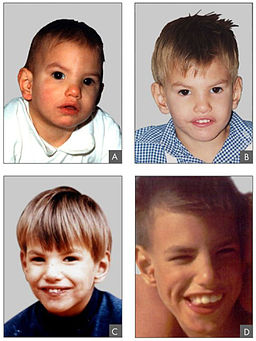
© (By Paola Cerruti Mainardi, via Wikimedia Commons)
Abnormal features in the hands and feet include partial webbing or joining together (fusing) of the fingers or toes. There may be a single line (crease) in the palm of the hand (there are normally two skin creases).
The affected newborn baby may be small and grow slowly. The affected child may have learning difficulties. There may be slow development of motor skills (eg, a delay in walking) and of speech and language.
Other features may include a hernia in the groin and separation of the muscles in the tummy. There is also an increased risk of heart defects and abnormalities in the brain, kidneys or gut (bowel).
Causes of cri du chat syndrome
Cri du chat syndrome is a chromosome problem caused by a missing piece of chromosome 5. The missing piece of the chromosome is the short (called 'p') arm of chromosome 5. Therefore cri du chat syndrome is said to be caused by deletion of chromosome 5p.
Most cases (around 80 in 100) are thought to occur as a result of damage to the chromosome during the development of the egg or sperm. It is thought that around 12 cases in 100 are caused by an unbalanced translocation, which is a chromosomal re-arrangement in the parent's genes.
How common is cri du chat syndrome?
Cri du chat syndrome is very rare. It affects about 1 in every 30,000 newborn babies.
How is cri du chat syndrome diagnosed?
Cri du chat syndrome can either be diagnosed before birth (prenatally) or after birth (postnatally).
Prenatal diagnos
Diagnosis before birth may be made by ultrasound or by testing the baby's chromosomes during the pregnancy. See the separate leaflets called Amniocentesis, Chorionic Villus Sampling and Ultrasound Scan.
Postnatal diagnosis
Diagnosis after birth will be made by investigations if a baby has any features suggesting cri du chat syndrome. See the separate leaflet called Genetic Testing. The parents of a child with cri du chat syndrome should also have genetic counselling and testing to find out whether one parent has a change in chromosome 5.
Further tests will be needed to assess any features associated with cri du chat syndrome (eg, a skull X-ray and a magnetisk resonanstomografi (MRT) skanning to assess any skull and face abnormalities or an ultrasound scan of the heart (echocardiogram) to assess any heart defects).
Treatment for cri du chat syndrome
Can cri du chat be cured?
There is no specific treatment for cri du chat syndrome. However, affected babies and children may need a great deal of physiotherapy and speech and language therapy.
Provision of early special schooling and a supportive home environment helps in development of social and intellectual ability. Surgical treatment may be needed to correct some abnormal features (for example, hernia) or any other associated features (for example, heart defects).
What is the prognosis for cri du chat syndrome?
The outlook (prognosis) depends on the severity of abnormal features. Learning difficulties and speech and language problems are common. However, most people with cri du chat syndrome survive well into adulthood.
About 1 in 10 babies born with cri du chat syndrome are severely affected and die within the first year of life. Intellectual disability is common.
Because of the head and face abnormalities, serious lung infection (pneumonia) is more common.
Understanding chromosomes and cell division
Chromosomes are found in the centre (nucleus) of a cell. They carry genetic information in the form of genes. 'Genetic' means that the condition is passed on through families by special codes called genes. Each cell of your body contains chromosomes which are made up of many genes.
In general, each cell in your body contains 46 chromosomes arranged in 23 pairs. One chromosome from each pair is inherited from your mother and the other is inherited from your father.
One of these chromosome pairs is known as the sex chromosomes because this pair determines our sex. Females have two of the same kind of sex chromosome (XX). Males have two different sex chromosomes (XY).
The Y chromosome contains the male determining genes. So, a normal female is 46, XX and a normal male is 46, XY. The other 22 pairs of chromosomes are numbered according to size with 1 being the longest pair and 22 being the shortest pair of chromosomes.
However, egg and sperm cells only have 23 chromosomes (1 chromosome from each pair). This is so that, when an egg and a sperm meet during conception, the child that is produced also has 46 chromosomes in each cell.
New body cells are produced for growth and repair by cells dividing, producing two 'daughter' cells. Each chromosome can duplicate an exact copy of itself so that each new cell that is formed has a full, identical set of chromosomes.
Rarely, there is a problem with the child's chromosomes. Possible problems include too many chromosomes, too few chromosomes or damage to one or more chromosomes. The abnormal chromosomes may mean that the baby cannot survive and so may cause a miscarriage.
However, babies with some chromosome abnormalities may survive but are affected by various medical problems (called a syndrome).
What causes cri du chat syndrome?
Cri du chat syndrome is a chromosome problem caused by a missing piece of chromosome 5. The missing piece of the chromosome is the short (called 'p') arm of chromosome 5. Therefore cri du chat syndrome is said to be caused by deletion of chromosome 5p.
Most cases are thought to occur as a result of damage to the chromosome during the development of the egg or sperm.
Patientval för Genetiska tillstånd

Barnhälsa
Congenital pulmonary airway malformation
Congenital pulmonary airway malformation (CPAM) is a rare abnormality of lung development. It is found either in unborn babies or in young babies. The name has recently changed from congenital cystic adenomatoid malformation (CCAM). It is increasingly detected by the routine ultrasound scan during pregnancy. Congenital means present from birth. Pulmonary means related to the lungs. The severity of the abnormality is very variable. Some lesions can shrink or even disappear without treatment. Some lesions cause the baby to have breathing problems very soon after birth. Some lesions cause severe problems for the baby and may have a poor outcome.
av Dr Hayley Willacy, FRCGP

Barnhälsa
Wilsons sjukdom
Wilsons sjukdom är en genetisk störning där koppar ansamlas i kroppen, främst i levern och hjärnan. Utan behandling kan ansamlingen av koppar orsaka allvarliga symtom. Behandlingen består av medicinering för att avlägsna överskottskoppar och/eller förhindra ytterligare ansamling av koppar.
av Dr Philippa Vincent, MRCGP
Vanliga frågor
What does 'Cri du chat' mean?
'Cri du chat' is a French term that translates to 'cry of the cat'. This name describes the high-pitched, cat-like cry that is characteristic of babies born with the syndrome.
Can people with cri du chat syndrome live into adulthood?
Yes, most individuals with cri du chat syndrome survive well into adulthood. The outlook depends on how severe the abnormal features are. However, about 1 in 10 babies with the syndrome are severely affected and may die within the first year of life.
Are there any physical differences in hands and feet associated with cri du chat syndrome?
Yes, babies with cri du chat syndrome can have abnormal features in their hands and feet. These may include partial webbing or fusing of fingers or toes. Additionally, they might have a single crease across the palm of their hand, whereas typically there are two.
How common is cri du chat syndrome?
Cri du chat syndrome is a very rare condition, affecting approximately 1 in every 30,000 newborn babies.
Is it possible for a baby to have the genetic deletion but not show symptoms of cri du chat syndrome?
Yes, not all babies who have a missing piece of the short arm of chromosome 5 will develop cri du chat syndrome. Some may present with only very mild abnormal features, or in some cases, no abnormal features at all.
Vidare läsning och referenser
- Cri-du-Chat Syndrome; Online Mendelian Inheritance in Man (OMIM)
- Ajitkumar A, Jamil RT, Mathai JK; Cri Du Chat Syndrome.
- Traisrisilp K, Yanase Y, Ake-Sittipaisarn S, et al; Prenatal Sonographic Features of Cri-du-Chat Syndrome: A Case Report and Analytical Literature Review. Diagnostics (Basel). 2022 Feb 6;12(2):421. doi: 10.3390/diagnostics12020421.
- Nevado J, Bel-Fenellos C, Sandoval-Talamantes AK, et al; Deep Phenotyping and Genetic Characterization of a Cohort of 70 Individuals With 5p Minus Syndrome. Front Genet. 2021 Jul 30;12:645595. doi: 10.3389/fgene.2021.645595. eCollection 2021.
Om författarenVisa fullständig biografi

Dr Hayley Willacy, FRCGP
Allmänläkare, Medicinsk Författare
MBChB (1992), DRCOG, DFFP, MRCOG (Part 1) MRCGP (2007), DFSRH (2013), MSc - medical education (2020)
Dr Hayley Willacy var en NHS-läkare som arbetade i nordvästra England och gick i pension från klinisk praktik 2022 efter 30 år.
Om recensentenVisa fullständig biografi

Dr Colin Tidy, MRCGP
Allmänläkare, Medicinsk Författare
MBBS, MRCGP, MRCP (Paediatrics), DCH
Dr Colin Tidy är en NHS-läkare, baserad i Oxfordshire.
Artikelhistorik
Informationen på denna sida är skriven och granskad av kvalificerade kliniker.
Artikeln finns också på Engelska, Tyska, Spanska, Franska, Italienska, Portugisiska, Hindi, Hebreiska, Arabiska, och Svenska.
Nästa granskning: 18 nov 2028
20 nov 2023 | Senaste versionen

Fråga, dela, anslut.
Bläddra i diskussioner, ställ frågor och dela erfarenheter inom hundratals hälsorelaterade ämnen.

Känner du dig sjuk?
Bedöm dina symtom online gratis
Anmäl dig till Patientens nyhetsbrev
Din veckovisa dos av tydliga, pålitliga hälsoråd - skrivna för att hjälpa dig känna dig informerad, självsäker och i kontroll.
Genom att prenumerera accepterar du våra Sekretesspolicy. Du kan avsluta prenumerationen när som helst. Vi säljer aldrig dina uppgifter.
Mer om barns hälsa
- Akut diarré hos barn
- Bronkiolit
- Mobbning
- Barndomsleukemier
- Kongenital binjurebarkshyperplasi
- Utvecklingsdysplasi i höften
- Ehlers-Danlos syndrom
- Matförgiftning hos barn
- Öroninflammation med vätska
- Behandling och förebyggande av huvudlöss
- Intraventrikulär blödning hos spädbarn
- Juvenil idiopatisk artrit
- Norovirus
- Respiratoriskt syncytialvirus (RSV)
- Retinoblastom
- Rosola
- Symptom på sepsis hos barn
- Stelkramp och stelkrampvaccin
- Urinvägsinfektion hos barn