Leverbiopsi
Granskad av Dr Toni Hazell, FRCGPSenast uppdaterad av Dr Philippa Vincent, MRCGPSenast uppdaterad 24 maj 2023
Uppfyller patientens redaktionella riktlinjer
- Ladda nerLadda ner
- Dela
- Language
- Diskussion
- Ask Patient
- Ljudversion
- Lägg till i föredragna källor på Google
A liver biopsy involves taking a small sample of tissue from the liver. Liver cells can then be looked at in detail. It is used to diagnose and monitor certain conditions.
Notera: the information below is a general guide only. The arrangements, and the way tests are performed, may vary between different hospitals.It is vital to always follow the instructions given by the hospital at which the procedure is being performed.
Överblick
A liver biopsy is a procedure to remove a small sample of liver tissue.
It is done to diagnose or monitor liver damage or disease.
A needle is usually inserted through the skin into the liver to get the sample.
Less commonly, the sample is taken via a vein, during surgery, or with an endoscope, if other methods are unsuitable.
You will usually have local anaesthetic so you shouldn't feel pain during the biopsy.
You will be monitored for several hours afterwards to check for complications like bleeding.
Seek medical advice if you have bleeding, swelling, fever, or pain that doesn't go away.
Videoval för BiopsiVideobibliotek
What is a liver biopsy?
A biopsy is a procedure in which a small sample of tissue is removed from a part of the body. The sample is then looked at under a microscope or tested in other ways. A liver biopsy is a common procedure when a small sample of liver tissue is removed.
Why is a liver biopsy done?
A liver biopsy is done to diagnose and monitor damage or disease of the liver. This can include cirros, some metabolic liver disorders, or inflammation of the liver (hepatit) which can be due to various causes.
How is a liver biopsy done?
Diagram showing liver position and biopsy site
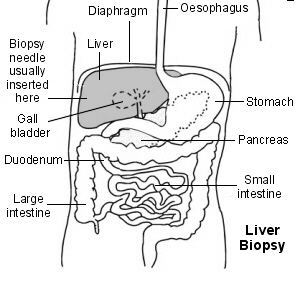
You will be asked to lie on a couch on your back, or on your left side. The skin over your liver is cleaned with antiseptic. Your liver lies under your ribs and your main breathing muscle (the diaphragm), on the upper right-hand side of your tummy (abdomen).
Some local bedövningsmedel is then injected into a small area of skin and tissues just over a part of your liver (usually between two lower ribs on the right-hand side). This stings a little at first, but then makes your skin in this area numb. A special hollow needle is then pushed through your skin into your liver.
You will have to hold your breath for 5-10 seconds when the needle is quickly pushed in and out (you will be told exactly when). This is because the liver moves slightly when you breathe in and out. As the needle comes out it brings with it a small sample of liver tissue.
The doctor who does the biopsy may use an ultrasound scanner eller datortomografi (CT) skanning for guidance. The scan locates the exact site of your liver so the biopsy needle is inserted at exactly the right place. The scan is painless.
In some people it is not possible to carry out the procedure in the way described above. Some conditions affect your liver's ability to make substances that help blood clot. If you have one of these conditions there is more chance of bleeding after the biopsy due to a reduced ability for the blood to clot.
Using a different procedure to take the biopsy can reduce the risk of bleeding in these people. Usually this involves inserting a hollow, thin tube (a catheter) into a vein in your neck (jugular vein) or groin. The skin will be made numb by a local anaesthetic before the procedure.
The catheter is then gently guided to the veins inside your liver. A small needle on the tip of the catheter makes a tiny hole in the wall of the vein. The needle collects a sample of liver tissue which is then retained in the catheter as it is taken out of your body.
This second procedure has less chance of causing bleeding if you have problems with blood clotting. In people with no clotting problems, the first method is normally used. Your hospital will advise you which method will be used to take the biopsy.
Another type of liver biopsy is a laparoscopic liver biopsy which is undertaken at the time of surgery for something else - for example, gallbladder removal. There is no special preparation for this procedure apart from what you should do for the surgery itself.
Another method for performing a liver biopsy is via a camera (endoscopy). An endoscopic ultrasound scan uses an endoscope with an ultrasound probe attached to create detailed pictures of internal organs and structures. This is a new technique which is not available in all hospitals.
Does a liver biopsy hurt?
Because of the local anaesthetic, you should not feel any pain. However, you may feel some mild discomfort or pressure as the doctor pushes on the needle. Any pain or discomfort you experience is usually eased with smärtstillande.
What preparation is needed before a liver biopsy?
You will usually have a blood test done shortly before the biopsy to check how well your blood will clot. This is to make sure that you are not likely to bleed too much following the biopsy. You may be advised not to take any medicines that affect blood clotting, such as aspirin and warfarin, for one week before the biopsy. (You will usually be advised to take your other medication as normal before the biopsy. However, you may need to discuss this with your hospital doctor.)
You will need to sign a consent form at some point before the procedure to say that you understand what it involves, and the small risk involved.
Liver biopsy risks
Complications are very uncommon. The most common complication is some mild pain or discomfort in the area where the liver biopsy was taken.
In a small number of cases there is some bleeding from the biopsy site. This is usually minor and soon stops. Occasionally, the bleeding is more severe and (rarely) it requires a blood transfusion and/or an operation to deal with it. The main reason you are monitored for several hours after the biopsy is to check for bleeding.
A rare complication is for bile to leak from the liver internally. There is a small risk that the small wound will become infected after the biopsy.
After a liver biopsy
You will need to lie on your side on a bed and be observed for several hours to check that you have no bleeding. Therefore, you may wish to bring in a book or a music player for this time. If you come into hospital for the test, you may need to stay in overnight. However, if the biopsy was done early in the morning, you may be able to go home later in the day.
Any pain or discomfort you experience is usually eased with painkillers. The result of the biopsy may take a week or so to come back. Your doctor may advise you not to take part in contact sports such as rugby for a certain length of time after the procedure. This is to make sure your liver has a chance to heal properly.
You should seek medical advice if:
Bleeding occurs from the biopsy site.
The biopsy site becomes red, angry looking or swollen.
You develop a hög temperatur (feber).
The biopsy site is still painful three days later and painkillers do not help.
Patientval för Biopsi

Kirurgi och procedurer
Biopsi
En biopsi är ett medicinskt test där ett litet vävnadsprov tas från en del av kroppen. Vävnadsprovet undersöks under ett mikroskop av en specialist. Genom att titta på de små cellerna som utgör vävnadsprovet kan specialisten hjälpa till att ställa en diagnos. Obs: informationen nedan är endast en allmän vägledning. Arrangemangen och sättet tester utförs på kan variera mellan olika sjukhus. Följ alltid instruktionerna från din läkare eller lokala sjukhus.
av Dr Philippa Vincent, MRCGP
Kirurgi och procedurer
Endometriebiopsi
En endometriebiopsi är ett medicinskt ingrepp där en del vävnad från livmoderns (uterus) innerfoder tas bort och sedan undersöks under ett mikroskop. Det är ett kort dagkirurgiskt ingrepp. Provet tas med ett rör som förs genom slidan.
av Dr Doug McKechnie, MRCGP
Vanliga frågor
What conditions can a liver biopsy help diagnose or monitor?
A liver biopsy can help to diagnose and monitor liver damage or disease, such as cirrhosis, certain metabolic liver disorders, and inflammation of the liver (hepatitis) which can stem from various causes.
Are there different ways a liver biopsy can be performed?
Yes, there are several methods. The most common involves inserting a needle through the skin over the liver. For people with blood clotting issues, a transjugular biopsy may be used, where a thin tube is guided through a vein in the neck or groin to the liver. A laparoscopic liver biopsy can be done during other surgeries. A newer technique uses an endoscope with an ultrasound probe, though this isn't available everywhere.
What typically happens immediately after a liver biopsy?
After the biopsy, you will need to lie on your side and be monitored for several hours to ensure there is no bleeding. This is why you might want to bring a book or music. If the biopsy is done in the morning, you might go home later the same day, but sometimes an overnight stay is needed. Any pain is usually managed with painkillers.
When can I expect to receive the results of my liver biopsy?
The results of the biopsy can take about a week or so to become available.
When should I seek medical advice after a liver biopsy?
You should seek medical advice if you experience bleeding from the biopsy site, if the site becomes red, swollen, or looks inflamed, if you develop a high temperature (fever), or if the biopsy site is still painful after three days and painkillers aren't helping.
Vidare läsning och referenser
- Guidelines on the Use of Liver Biopsy; Neuberger
- Indications for Liver Biopsy; Ingram
Om författarenVisa fullständig biografi
Uppdaterad av

Dr Philippa Vincent, MRCGP
Allmänläkare, Medicinsk Författare
MB BS, Bsc, MRCGP (2000), DCH, DFSRH, DRCOG
Dr Philippa Vincent är en NHS-läkare som arbetar i norra London.
Om recensentenVisa fullständig biografi

Dr Toni Hazell, FRCGP
MBBS, BSc, FRCGP, DFSRH, Dip GU med, DRCOG, DCH (London, UK, 2000)
Dr. Toni Hazell tog examen från St. Mary’s Hospital Medical School och genomförde sin VTS vid Northwick Park Hospital.
Artikelhistorik
Artikeln finns också på Engelska, Tyska, Spanska, Franska, Italienska, Portugisiska, Hindi, Hebreiska, Arabiska, och Svenska.
Nästa granskning: 12 maj 2028
24 maj 2023 | Senaste versionen
Medicinska yrkesverksamma
Looking for more in-depth clinical detail? Our Professional Reference articles are written for doctors, nurses and other healthcare professionals. They include comprehensive clinical guidance, diagnostic information and UK/European evidence summaries. If you need the clinical version, you can read the Professional Reference article on this topic.
Dela dina tankar eller erfarenheter med andra i vår patientgemenskaper.
Enkel tillgång till pålitliga behandlingar och hälsotjänster online.
Common conditions
Get help with common conditions through the NHS, without a GP appointment.





Anmäl dig till Patientens nyhetsbrev
Din veckovisa dos av tydliga, pålitliga hälsoråd - skrivna för att hjälpa dig känna dig informerad, självsäker och i kontroll.
Genom att prenumerera accepterar du våra Sekretesspolicy. Du kan avsluta prenumerationen när som helst. Vi säljer aldrig dina uppgifter.