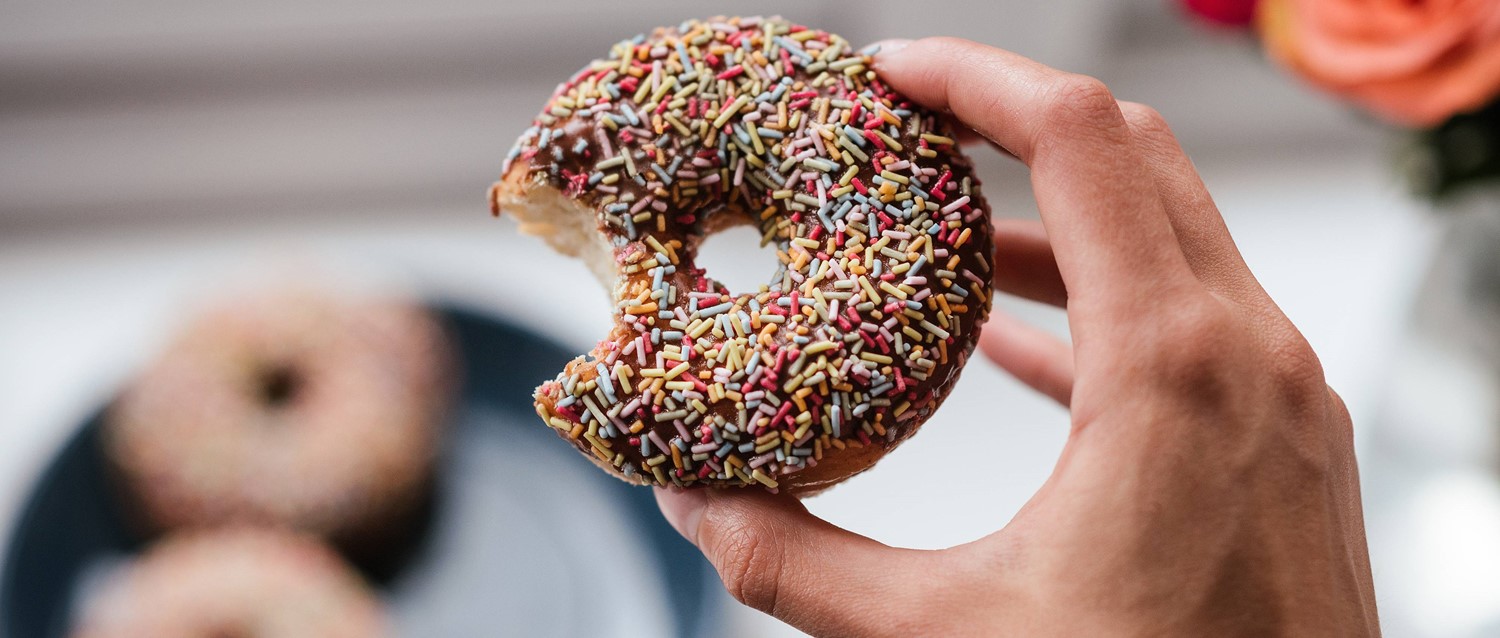
Hur man slutar hetsäta
Granskad av Dr Sarah JarvisFörfattad av Sarah GrahamUrsprungligen publicerad 28 Dec 2018
Uppfyller patientens redaktionella riktlinjer
- Ladda nerLadda ner
- Dela
- Language
- Diskussion
- Ask Patient
- Ljudversion
- Lägg till i föredragna källor på Google
It's supposed to be the most wonderful time of the year. But if you struggle with your weight, eating, and body image, the weeks around Christmas and the New Year can be an absolute minefield.
From the cultural imperative to stuff our faces throughout December, to our collective obsession with the New Year diet and gym membership, the whole festive period can very easily turn into one long, drawn-out cycle of bingeing and restriction. Yet most of us know that it doesn't really work for viktnedgång, at least not in any kind of sustainable way.
"I can completely understand why people fall off track in January; those New Year dieting decisions are usually quite rash, because we make them when we're full of chocolate and wine," says behavioural change specialist Shahroo Izadi, who says she sees more referrals in the third week of January than at any other time of year.
A vicious circle
"I used to diet a lot, so I would lose massive amounts of weight, but I would never keep it up. I was always doing it from a harsh and punitive place, reinforcing this idea that I was bad and weak," she says. "Those sorts of conversations I was having with myself - first about having gained weight, and then about needing to lose it as quickly as possible, and placing so much of my life on hold until I did - were actually increasing the likelihood of me overeating because that's such a horrible mental state to be in."
However, it was Shahroo's background working with drug and alcohol addictions that eventually helped her lose eight stone, and keep it off. At first glance, it might sound just as extreme an approach - after all, we can't abstain from food in the way you might from alcohol or drugs. But is there something in specialist anti-addiction techniques that could help us develop a healthier and more balanced relationship with food?
Overeaters Anonymous
"I had long suspected that some of the tools that work in addiction treatment would also work with weight loss, because they're just basic behavioural change tools; they're about increasing your self-esteem and self-belief," Shahroo explains.
"As part of my job, I went to quite a few 12-step peer-to-peer meetings like Alcoholics Anonymous and Narcotics Anonymous - and then I heard about Overeaters Anonymous," she adds. "I went to an Overeaters Anonymous meeting, and what I saw was people who were following a framework around support, connection, self-awareness, and building resilience; looking at their resentments and the things that were triggering those behaviours in the first place, whilst also not being able to be fully abstinent from their drug of choice: food."
Stress, anxiety and boredom are typical triggers that have us all reaching for one bad habit or another - whether it's alcohol, drugs, nail biting, or binge eating. So while there are obvious differences between overeating and substance abuse or addiction, the emotional purpose it serves may well be similar.
"What usually happens [when people binge] is that the individual is in a dysthymic state, feeling anxious, unhappy or lonely," explains Dr Alan Wear, an ätstörning specialist from The Priory. "In this state, they often have thoughts which promote behaviours that make them feel better in a short-term way."
Break the cycle
So how do you break the cycle? "I think first and foremost, it's about not concentrating on what's wrong with your behaviour, but looking at what's right with it and what purpose it's serving in your life. A lot of the time it's about avoidance - we eat, or abuse substances, to avoid uncomfortable thoughts, memories, and feelings," says Shahroo. "When we talk about how a behaviour is serving us, and gain that self-awareness, we're better placed to replace those habits with healthier ones."
Of course, there's still a level of discipline involved, and recognising the excuses you use to self-sabotage.
"The starting point is accepting that you are in control of your eating; it's not food controlling you," says Dr Wear. "Understanding why you binge is the next step. What is making you unhappy? Where are the stressors in your life? Some analysis of this may help, along with avoiding situations where you are likely to binge," he adds.
If you mainly overeat when you're stressed, Shahroo says: "diversify your coping mechanisms for stress innan you decide to change your life profoundly in terms of food and tränings. Otherwise, you're going to be white knuckling the process and left with this sort of void."
For her, one of the most effective coping mechanisms was taking up karaoke - but it could be something completely different that works for you. "Sunday evenings were always really hard for me because I'd get bored and overeat," she explains. "One week I just decided to go to a karaoke booth by myself, get a coffee, and sing for a couple of hours. Since then, whenever I have a desire to binge, or I'm triggered by something, I book myself a karaoke booth.
The key, Shahroo adds, is about being kinder to yourself: "I'll tell myself, 'you can eat whatever you like; just first go and have a sing, and see if you still want to afterwards'. To this day, I've never wanted to. Singing's a really mindful activity - you're so engrossed in one thing that nothing else is coming in, and so the craving passes," she says.
"I'm not a good singer, by the way," she adds. "It's really important to find things that are purely for joy, with no outcome, and that reinforce your self-worth. I try to do tiny acts of self-care each day, just to acknowledge that I have a body worth taking care of and I have a brain worth taking care of. That leaks into all your little habits and really helps you to champion yourself."
Patientval för Hälsosam kost

Kost och näring
Behöver du dricka åtta glas vatten om dagen?
The European Food Standards Agency reminds us that up to 30% of our fluid intake comes from food - especially fruit and vegetables. They recommend that adults should make up the rest with about three pints (for women) and four pints (for men) of non-alcoholic fluids a day.
av Dr Sarah Jarvis
Kost och näring
Är kolhydrater verkligen dåliga för dig?
Diettrender har gjort de flesta av oss förvirrade. Ta kolhydrater, som finns i potatis, pasta, bröd och söta livsmedel. På 1970-talet fick de skulden för att göra oss tjocka. Sedan återupprättades stärkelsehaltiga kolhydrater, och hälsomyndigheter rekommenderade att de skulle stå för minst hälften av vårt dagliga kaloriintag. Nu verkar kolhydrater återigen vara fienden, enligt vissa. Så var står vi nu?
av Dr Carrie Ruxton, PhD, Barnnutrition
Om författarenVisa fullständig biografi
Författad av

Sarah Graham
Frilansande hälsojournalist
MA, Tidning, Journalistik
Sarah Graham är en prisbelönt frilansande hälsojournalist och grundare av den feministiska kvinnors hälsobloggen Hysterical Women.
Om recensentenVisa fullständig biografi

Dr Sarah Jarvis
Klinisk konsult
MA (Cantab), BM, BCh (Oxon), DRCOG, FRCGP, MBE
Efter att ha utbildat sig i medicin vid Cambridge och Oxford blev Dr Sarah Jarvis MBE allmänläkare.
Artikelhistorik
Artikeln finns också på Engelska, Tyska, Spanska, Franska, Italienska, Portugisiska, Hindi, Hebreiska, Arabiska, och Svenska.
28 Dec 2018 | Ursprungligen publicerad
Författad av:
Sarah GrahamGranskad av
Dr Sarah Jarvis
Dela dina tankar eller erfarenheter med andra i vår patientgemenskaper.
Anmäl dig till Patientens nyhetsbrev
Din veckovisa dos av tydliga, pålitliga hälsoråd - skrivna för att hjälpa dig känna dig informerad, självsäker och i kontroll.
Genom att prenumerera accepterar du våra Sekretesspolicy. Du kan avsluta prenumerationen när som helst. Vi säljer aldrig dina uppgifter.