How to check yourself for testicular cancer
Peer reviewed by Dr Krishna Vakharia, MRCGPAuthored by Lydia SmithOriginally published 20 Oct 2022
Meets Patient’s editorial guidelines
- DownloadDownload
- Share
- Language
- Discussion
- Audio Version
- Add to preferred sources on Google
Checking your testicles can be an easy way to make sure there aren't any unusual lumps and bumps, which can be the first sign of testicular cancer. However, it can be difficult to know what you're doing, especially if you've not done it before.
How common is testicular cancer?
Testicular cancer is a very common type of cancer. There are around 2,400 new testicular cancer cases in the UK every year1, which is more than six every day. Carrying out a self-examination is an important part of staying healthy - especially if you have a family history of testicular cancer, and noticing any changes early could mean catching cancer cells earlier.
Why is it important to check your own testicles?
"Regularly checking your testicles is an important part of keeping on top of your health,” says Kieran Kelly, manager at the testicular cancer charity The OddBalls Foundation.
"It's quick, easy and could potentially save your life. It's important to check regularly because you need to know what feels normal for you. Therefore, if you do notice any changes, you can be proactive and seek the medical help required."
How to check your testicles
From puberty onwards, it is important to check your testicles regularly. Testicular cancer is usually always cured but it is easier to treat when it is diagnosed early. Examining yourself once a month means you know what feels normal for you.
First, you need to hold your scrotum in the palm of your hand. Use your fingers and thumb to examine each testicle. You should feel for lumps or swellings, anything unusual or any differences between your testicles.
"The best time to check yourself is after having a warm bath or a warm shower because your testicles become more soft and easier to feel for any physical changes," says Kelly.
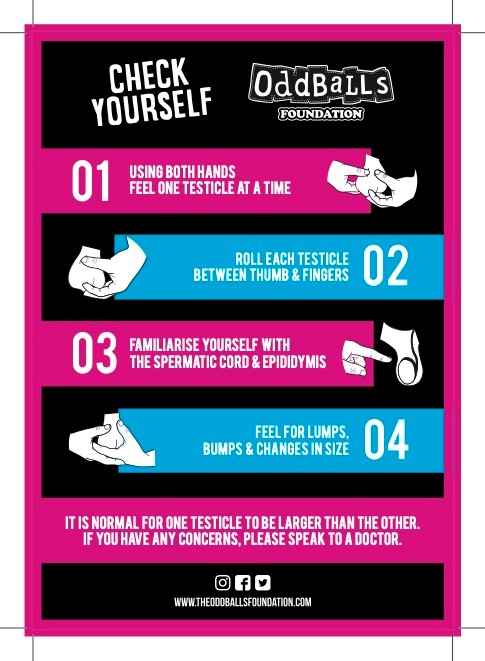
Kelly recommends a four-step process for checking yourself. "Step one involves using both hands to feel one testicle at a time. Step two involves rolling the testicle between your thumb and your fingers to inspect any changes," he says.
"Step three encourages people to familiarise themselves with the spermatic cord and the epididymis tube (- tube that carries sperm - that connects to the back side of each testicle," adds Kelly.
The epididymis feels like a coiled tube and it is common to get harmless cysts and benign lumps in that area, which can be treated. However, every lump needs to be assessed just in case.
"Lastly, step four involves feeling for lumps, bumps and any changes in size. It's important to note that it is normal for one testicle to be larger than the other. We encourage everyone to speak to a doctor if they have any concerns whatsoever, as it's always better to be safe than sorry."
Oddballs Foundation Testicle Checker
What are the signs of testicular cancer?
The most common symptom of testicular cancer is a lump in a testicle, or a dull ache or feeling of heaviness in the scrotum. Another symptom is a painless lump or swelling in a testicle, which may suddenly get larger and become painful.
"Some people who have been diagnosed with testicular cancer have been unable to report any specific signs but they just felt like something didn't feel right or normal to them," says Kelly. Other conditions can also cause lumps or swellings.Most lumps are not cancer. However, it is important you get your doctor to check anything unusual as soon as possible.
What should you do if you are worried about testicular cancer?
If you notice any changes in your testicles or are worried that something doesn't seem right, it's important not to feel embarrassed and to speak to your doctor as soon as you can. Not all lumps and bumps are a sign of testicular cancer, but if you do receive a diagnosis, chemotherapy, radiotherapy and surgery are the three main treatments. Although cancer can be a scary diagnosis, the outlook and survival rates for testicular cancer is one of the best for all cancers2.
"It's important to get things checked out early because treatment for testicular cancer is much more effective when started early," says Kelly.
Further reading
Patient picks for Testicle conditions

Men's health
Testicle pain: what could it be?
Testicle pain or discomfort can be a symptom of a minor injury or health issue, but it may also be a sign of something more serious. What are the possible causes of your pain? And how do you know when to get it checked out by a professional?
by Amberley Davis

Men's health
Does testicular cancer affect your fertility?
Testicular cancer has one of the highest survival rates of all cancer types, but the implications for male fertility vary depending on the type of treatment given.
by Amberley Davis
About the authorView full bio

Lydia Smith
Feature writer
BA, MA, MSc
Lydia Smith is an award-winning journalist and feature writer who has written extensively on women's health and mental health. She is currently studying for an MSc in psychology.
About the reviewerView full bio

Dr Krishna Vakharia, MRCGP
Chief Medical Officer for Health, Optum UK
MBChB, MRCGP(2013), BMedSci (hons), DFSRH, DRCOG, PGDipDerm (Distn)
Dr Krishna Vakharia is an NHS GP. She is also a regular examiner for the postgraduate Diploma in Practical Dermatology at Cardiff University as well as being the Chief Medical Officer for health at Optum UK.
Article history
The information on this page is peer reviewed by qualified clinicians.
Article also available in English, German, Spanish, French, Italian, Portuguese, Hindi, Hebrew, Arabic, and Swedish.
20 Oct 2022 | Originally published
Authored by:
Lydia SmithPeer reviewed by
Dr Krishna Vakharia, MRCGP
Join the conversation
Share your thoughts or experiences with others in our patient communities.

Ask, share, connect.
Browse discussions, ask questions, and share experiences across hundreds of health topics.

Feeling unwell?
Assess your symptoms online for free
Sign up to the Patient newsletter
Your weekly dose of clear, trustworthy health advice - written to help you feel informed, confident and in control.
By subscribing you accept our Privacy Policy. You can unsubscribe at any time. We never sell your data.
More in men's health
- Are erection problems getting more common in young men?
- Are testosterone supplements safe for men?
- Bladder problems men shouldn't ignore
- Can men get thrush?
- Cystitis in men
- Do anabolic steroids cause infertility?
- Do men need to do Kegel exercises?
- How common are male eating disorders?
- How to prevent premature ejaculation
- PSA testing options
- Testicle pain: what could it be?
- The adult circumcision decision: why, where and how?
- The simplest men's skincare routine
- What causes male pattern baldness?
- What erectile dysfunction could mean for your heart
- What is Movember?
- What it's like to have a vasectomy
- What triggers eating disorders in men?
- What you need to know before you take erectile dysfunction medication
- Will we ever have a male contraceptive pill?