Polycystisk njursjukdom
Senast uppdaterad 16 dec 2024
Uppfyller patientens redaktionella riktlinjer
- Ladda nerLadda ner
- Dela
- Language
- Diskussion
- Ask Patient
- Ljudversion
- Lägg till i föredragna källor på Google
Polycystic kidney disease is a disorder that affects the kidneys and other organs. Clusters of fluid-filled sacs, called cysts, develop in the kidneys and interfere with their ability to filter waste products from the blood. The growth of cysts causes the kidneys to become enlarged and can lead to kidney failure. Cysts may also develop in other organs, particularly the liver.
Videoval för Genetiska tillståndVideobibliotek
Beskrivning
Polycystic kidney disease is a disorder that affects the kidneys and other organs. Clusters of fluid-filled sacs, called cysts, develop in the kidneys and interfere with their ability to filter waste products from the blood. The growth of cysts causes the kidneys to become enlarged and can lead to kidney failure. Cysts may also develop in other organs, particularly the liver.
Frequent complications of polycystic kidney disease include dangerously high blood pressure (hypertension), pain in the back or sides, blood in the urine (hematuria), recurrent urinary tract infections, kidney stones, and heart valve abnormalities. Additionally, people with polycystic kidney disease have an increased risk of an abnormal bulging (an aneurysm) in a large blood vessel called the aorta or in blood vessels at the base of the brain. Aneurysms can be life-threatening if they tear or rupture.
The two major forms of polycystic kidney disease are distinguished by the usual age of onset and the pattern in which it is passed through families. The autosomal dominant form (sometimes called ADPKD) has signs and symptoms that typically begin in adulthood, although cysts in the kidney are often present from birth or childhood. Autosomal dominant polycystic kidney disease can be further divided into type 1 and type 2, depending on the genetic cause. The autosomal recessive form of polycystic kidney disease (sometimes called ARPKD) is much rarer and is often lethal early in life. The signs and symptoms of this condition are usually apparent at birth or in early infancy.
Inheritance patterns
The source lists the following possible inheritance patterns: Autosomal dominant; Autosomal recessive. More than one pattern can apply in different cases.
Related genes
Other names
PKD
Polycystic renal disease
Related patient information and medicines

Patient information leaflet
Polycystisk njursjukdom
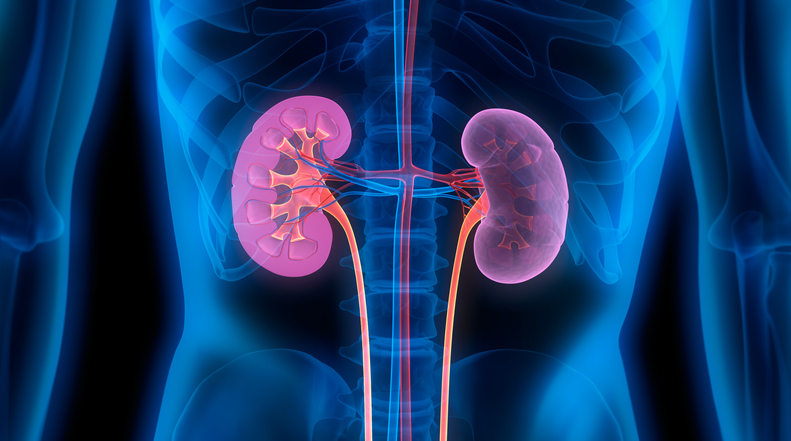
Polycystisk njursjukdom (PKD) causes many fluid-filled sacs (cysts) to develop in the kidneys. The most common type of PKD is an inherited condition called autosomal dominant polycystic kidney disease (ADPKD). Den two common problems that develop are high blood pressure High blood pressure and chronic kidney disease (CKD) Chronic kidney disease..
Patient information leaflet
Kronisk njursjukdom
Chronic kidney disease means that the kidneys are not working as well as would be expected. Narrowing of the artery taking blood to the kidney (renal artery stenosis) Polycystic kidney disease. See the separate leaflet called Polycystic Kidney Disease Polycystic kidney disease. Blockages to the flow of urine, and repeated kidney infections..

Patient information leaflet
Njurinfektion
A kidney infection (pyelonephritis) is an unpleasant illness which is sometimes serious. ... These complications are uncommon but may be more likely if: You become severely ill with the kidney infection. You already have a problem with your kidneys, such as polycystic kidney disease Polycystic kidney disease or chronic kidney disease Chronic.

Patient information leaflet
Diabetes insipidus
This seems to ... Persistently low levels of potassium in the blood. This has the same effect. Other medical conditions, such as sickle cell disease Sickle cell disease or polycystic kidney disease Polycystic kidney disease. Gestational diabetes insipidus This occurs in pregnant women, but is rare. When it does happen, it usually starts in the.
Patient information leaflet
Beräknad glomerulär filtrationshastighet
Den estimated glomerular filtration rate (eGFR) does not diagnose any specific kidney disease but is a test to assess how well your kidneys are working. ...is commonly done as a routine part of monitoring people with kidney diseasesIn England and Wales, the National Institute for Health and Care Excellence (NICE) recommends the Chronic Kidney.

Patient information leaflet
Kardiovaskulär sjukdom
Cardiovascular diseases (CVD) is a general term to describe diseases of the heart or blood vessels. The cause of most cardiovascular disease is a build-up of atheroma - a fatty deposit within the inside lining of arteries. Diabetes Diabetes. Chronic kidney disease Chronic kidney disease causing diminished kidney function. Fixed risk factors - ones.
Vidare läsning och referenser
- Polycystisk njursjukdom; MedlinePlus, National Library of Medicine.
- Adeva M, El-Youssef M, Rossetti S, Kamath PS, Kubly V, Consugar MB, Milliner DM, King BF, Torres VE, Harris PC. Clinical and molecular characterization defines a broadened spectrum of autosomal recessive polycystic kidney disease (ARPKD). Medicine (Baltimore). 2006 Jan;85(1):1-21. doi: 10.1097/01.md.0000200165.90373.9a.
- Boucher C, Sandford R. Autosomal dominant polycystic kidney disease (ADPKD, MIM 173900, PKD1 and PKD2 genes, protein products known as polycystin-1 and polycystin-2). Eur J Hum Genet. 2004 May;12(5):347-54. doi: 10.1038/sj.ejhg.5201162.
- Burgmaier K, Gimpel C, Schaefer F, Liebau M. Autosomal Recessive Polycystic Kidney Disease - PKHD1. 2001 Jul 19 [updated 2024 Apr 4]. In: Adam MP, Bick S, Mirzaa GM, Wallace SE, Amemiya A, editors. GeneReviews(R) [Internet]. Seattle (WA): University of Washington, Seattle; 1993-2026. Available from http://www.ncbi.nlm.nih.gov/books/NBK1326/
- Eccles MR, Stayner CA. Polycystic kidney disease - where gene dosage counts. F1000Prime Rep. 2014 Apr 1;6:24. doi: 10.12703/P6-24. eCollection 2014.
- Harris PC, Torres VE. Polycystic Kidney Disease, Autosomal Dominant. 2002 Jan 10 [updated 2022 Sep 29]. In: Adam MP, Bick S, Mirzaa GM, Wallace SE, Amemiya A, editors. GeneReviews(R) [Internet]. Seattle (WA): University of Washington, Seattle; 1993-2026. Available from http://www.ncbi.nlm.nih.gov/books/NBK1246/
- Hateboer N, v Dijk MA, Bogdanova N, Coto E, Saggar-Malik AK, San Millan JL, Torra R, Breuning M, Ravine D. Comparison of phenotypes of polycystic kidney disease types 1 and 2. European PKD1-PKD2 Study Group. Lancet. 1999 Jan 9;353(9147):103-7. doi: 10.1016/s0140-6736(98)03495-3.
- Horie S. ADPKD: molecular characterization and quest for treatment. Clin Exp Nephrol. 2005 Dec;9(4):282-291. doi: 10.1007/s10157-005-0367-6.
- Igarashi P, Somlo S. Genetics and pathogenesis of polycystic kidney disease. J Am Soc Nephrol. 2002 Sep;13(9):2384-98. doi: 10.1097/01.asn.0000028643.17901.42. No abstract available.
- Lina F, Satlinb LM. Polycystic kidney disease: the cilium as a common pathway in cystogenesis. Curr Opin Pediatr. 2004 Apr;16(2):171-6. doi: 10.1097/00008480-200404000-00010.
- Sweeney WE Jr, Avner ED. Pathophysiology of childhood polycystic kidney diseases: new insights into disease-specific therapy. Pediatr Res. 2014 Jan;75(1-2):148-57. doi: 10.1038/pr.2013.191. Epub 2013 Oct 31.
- Tahvanainen E, Tahvanainen P, Kaariainen H, Hockerstedt K. Polycystic liver and kidney diseases. Ann Med. 2005;37(8):546-55. doi: 10.1080/07853890500389181.
- Wilson PD. Polycystic kidney disease. N Engl J Med. 2004 Jan 8;350(2):151-64. doi: 10.1056/NEJMra022161. No abstract available.
Artikelhistorik
Artikeln finns också på Engelska, Tyska, Spanska, Franska, Italienska, Portugisiska, Hindi, Hebreiska, Arabiska, och Svenska.
16 dec 2024 | Senaste versionen
1 Jun 2006 | Ursprungligen publicerad
Dela dina tankar eller erfarenheter med andra i vår patientgemenskaper.
Enkel tillgång till pålitliga behandlingar och hälsotjänster online.
Common conditions
Get help with common conditions through the NHS, without a GP appointment.





Anmäl dig till Patientens nyhetsbrev
Din veckovisa dos av tydliga, pålitliga hälsoråd - skrivna för att hjälpa dig känna dig informerad, självsäker och i kontroll.
Genom att prenumerera accepterar du våra Sekretesspolicy. Du kan avsluta prenumerationen när som helst. Vi säljer aldrig dina uppgifter.