Milia
Granskad av Dr Hayley Willacy, FRCGP Senast uppdaterad av Dr Philippa Vincent, MRCGPSenast uppdaterad 18 apr 2023
Uppfyller patientens redaktionella riktlinjer
- Ladda nerLadda ner
- Dela
- Language
- Diskussion
- Ask Patient
- Ljudversion
- Lägg till i föredragna källor på Google
Milia are very small, raised, pearly-white or yellowish bumps on the skin. They are most often seen on the skin around the cheeks, nose, eyes and eyelids, forehead and chest. However, they can occur anywhere on the body. Milia are very common in newborn babies but can affect people of any age. In babies, milia clear by themselves and no treatment is needed. In other people, they may take longer to clear. In persistent cases, treatment may be suggested.
Överblick
Milia are tiny, raised, pearly-white or yellowish bumps on the skin.
They are small skin cysts filled with a protein called keratin.
Milia are usually harmless and often clear up on their own without treatment.
There are different types, including neonatal milia in babies and primary or secondary milia in adults.
Do not try to squeeze or treat milia yourself, as this can cause skin damage, scarring, or infection.
If milia are widespread, persistent, or a concern, a dermatologist may suggest treatments.
What are milia?
A milium is a small, raised bump on the skin. It is a type of tiny skin cyst filled with a protein called keratin.
Many are usually found together and so they are called milia (the plural of milium).
What do milia look like?
Milia in a newborn
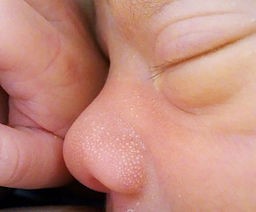
As can be seen in the picture, milia are usually each about 1 or 2 millimetres across and are pearly-white or yellowish. They appear to be small white bumps on the face.
They are most often seen on the skin around the cheeks, nose, eyes and eyelids, forehead and chest but they can occur anywhere on the body.
Types and causes of milia
There are different types of milia.
Neonatal milia
These are milia that are seen in young babies soon after they are born. They are very common and are usually found around the nose area but may also occur on the scalp, cheeks, upper body and inside the mouth. They are thought to arise from sweat glands that aren't fully developed or mature. Around half of all babies develop neonatal milia. In fact, because they are so common, they are actually considered as normal in newborn babies - often they are called "milk spots" although they are nothing to do with milk. They usually disappear by 12 weeks of age.
Primary milia
These are milia that can occur in both children and adults. They occur in an area of skin that has otherwise been normal without any previous damage or injury.
Secondary milia
These are milia that develop in an area of skin, anywhere on the body, that has previously been damaged or injured. For example, after a burn or a blistering rash. The milia develop as the skin heals and it is thought that damage to the sweat glands may be an underlying cause. Secondary milia also sometimes develop after some skin creams have been used.
Milia en plaque
Milia of this type are extremely rare. The milia develop on an inflamed, raised patch of skin known as a plaque which may be several centimetres across. The cause of milia en plaque is not fully understood. It usually occurs behind the ears, on an eyelid or on the cheeks or jaw area. This type of milia tends to particularly affect middle-aged women.
Multiple eruptive milia
The milia appear in crops, or patches, of milia that develop over a period of weeks or months. The crops usually appear on the face, the upper arms and the upper trunk. Milia of this type are also extremely rare.
Milia symptoms
Milia do not usually cause any symptoms but,they can occasionally become itchy.
How are milia diagnosed?
Milia are usually diagnosed by their typical appearance and generally no investigations are needed. However, occasionally, if the diagnosis is uncertain or if milia en plaque are suspected, a skin biopsy might be recommended.
During a skin biopsy, a small piece of skin is removed so that it can be examined under a microscope. There are different ways that a skin biopsy can be carried out. For example, by shaving away a small piece of skin or by using a special instrument to punch a tiny hole in the skin.
How long do milia last?
Milia are harmless and, in most cases, they will eventually clear by themselves. In babies, they clear after a few weeks. However, in some people, milia can persist for months or longer. Secondary milia are sometimes permanent.
Milia treatment
Because they normally clear by themselves, milia do not usually need any treatment. However, some people find them unsightly and so opt for treatment to remove milia.
Milia removal
Milia may be removed using a fine needle and then squeezing, or pricking, out the contents. No anaesthetic is needed. However, it is not recommended to squeeze or try to treat milia yourself. This can lead to skin damage and scarring or infection.
If milia become very widespread and persistent, various other treatments may be suggested, usually by a skin specialist (a dermatologist). They include:
Kryoterapi: a type of treatment that freezes skin lesions. Where a patch of skin has changed in appearance, it is known as a skin lesion.
Laserbehandling.
Dermabrasion: a procedure that removes the topmost layers of the affected skin.
Chemical peeling: a treatment where a chemical is applied to the face to burn off skin lesions.
In the rare type of milia called milia en plaque, certain creams such as isotretinoin or tretinoin are sometimes suggested as treatment, or the antibiotic tablet, minocycline.
Can milia be prevented?
Most milia cannot be avoided, particularly neonatal milia. The risk of developing secondary milia development can be reduced by avoiding excessive sun exposure, only using steroid creams for the length of time they are prescribed and regularly exfoliating and cleansing the skin to remove dead skin cells.
Patientval för Hudutslag

Hud, nagel och hårhälsa
Aktinisk keratos
An actinic keratosis (also known as a solar keratosis) is the most common skin condition caused by sun damage. It is the result of skin being damaged by the sun over many years. Actinic keratoses are usually rough, scaly patches on sun-exposed areas such as the head and face. Actinic keratoses are common, especially in older people, many of whom have more than one. Usually they are harmless but there is a small risk that they may eventually turn into skin cancer and therefore treatment may be advised.
av Dr Doug McKechnie, MRCGP
Hud, nagel och hårhälsa
Hudutslag
Det finns många olika typer av hudutslag och många olika orsaker till hudutslag. Även om de flesta hudutslag är ofarliga, behöver vissa behandling (som kan vara tabletter, krämer eller salvor) från din läkare eller apotekare. Vissa utslag (särskilt mörkröda eller lila utslag som inte bleknar när du trycker på dem) kan till och med behöva akut medicinsk behandling eftersom de kan vara associerade med hjärnhinneinflammation och blodinfektion (sepsis).
av Dr Hayley Willacy, FRCGP
Vanliga frågor
Are milia itchy?
Milia typically do not cause any symptoms. However, on rare occasions, they can become itchy.
How to get rid of milia on eyelids?
It is not recommended to try to treat milia yourself, especially in sensitive areas like the eyelids, as this can lead to skin damage, scarring, or infection. Milia usually clear on their own. If they are persistent and bothersome, a skin specialist may suggest treatments like removal with a fine needle, cryotherapy, laser treatment, dermabrasion, or chemical peeling. For the rare type called milia en plaque, which can affect the eyelid, specific creams or an antibiotic tablet might be suggested.
What causes milia?
Different types of milia have different causes. Neonatal milia in babies are thought to arise from underdeveloped sweat glands. Primary milia in children and adults occur in otherwise normal skin without prior damage. Secondary milia develop in areas where the skin has been previously damaged, for instance, after a burn or blistering rash, and may involve damage to sweat glands. They can also sometimes appear after using certain skin creams. The causes of very rare types like milia en plaque and multiple eruptive milia are not fully understood.
What is the cure for milia?
Most milia do not require a 'cure' as they are harmless and will eventually clear up by themselves. In babies, they typically disappear within a few weeks. However, in some people, milia can last for months or longer, and secondary milia can sometimes be permanent. If you find them unsightly or they are persistent, treatment options are available through a skin specialist.
Vidare läsning och referenser
- O'Connor NR, McLaughlin MR, Ham P; Newborn skin: Part I. Common rashes. Am Fam Physician. 2008 Jan 1;77(1):47-52.
- Milium, milia; DermNet NZ
Om författarenVisa fullständig biografi
Uppdaterad av

Dr Philippa Vincent, MRCGP
Allmänläkare, Medicinsk Författare
MB BS, Bsc, MRCGP (2000), DCH, DFSRH, DRCOG
Dr Philippa Vincent är en NHS-läkare som arbetar i norra London.
Författad av

Dr Michelle Wright, MRCGP
Allmänläkare, Medicinsk Författare
MB, ChB, MRCGP, DCH, DRCOG
Dr Michelle Wright blev kvalificerad 1997 i Storbritannien och arbetade som allmänläkare i London innan hon flyttade till Schweiz. Hon har varit författare för EMIS sedan 2007.
Om recensentenVisa fullständig biografi

Dr Hayley Willacy, FRCGP
Allmänläkare, Medicinsk Författare
MBChB (1992), DRCOG, DFFP, MRCOG (Part 1) MRCGP (2007), DFSRH (2013), MSc - medical education (2020)
Dr Hayley Willacy var en NHS-läkare som arbetade i nordvästra England och gick i pension från klinisk praktik 2022 efter 30 år.
Artikelhistorik
Artikeln finns också på Engelska, Tyska, Spanska, Franska, Italienska, Portugisiska, Hindi, Hebreiska, Arabiska, och Svenska.
Next review due: 16 Apr 2028
18 apr 2023 | Senaste versionen
15 Mar 2012 | Ursprungligen publicerad
Författad av:
Dr Michelle Wright, MRCGP
Dela dina tankar eller erfarenheter med andra i vår patientgemenskaper.
Enkel tillgång till pålitliga behandlingar och hälsotjänster online.
Common conditions
Get help with common conditions through the NHS, without a GP appointment.





Anmäl dig till Patientens nyhetsbrev
Din veckovisa dos av tydliga, pålitliga hälsoråd - skrivna för att hjälpa dig känna dig informerad, självsäker och i kontroll.
Genom att prenumerera accepterar du våra Sekretesspolicy. Du kan avsluta prenumerationen när som helst. Vi säljer aldrig dina uppgifter.