Seborrhoeic warts
Peer reviewed by Dr Doug McKechnie, MRCGPLast updated by Dr Colin Tidy, MRCGPLast updated 19 Jul 2024
Meets Patient’s editorial guidelines
- DownloadDownload
- Share
- Language
- Discussion
- Audio Version
- Add to preferred sources on Google
In this series:Warts and verrucas
Seborrhoeic warts are non-cancerous (benign) warty growths that occur on the skin. They usually do not need any treatment.
At a glance
Seborrhoeic warts are greasy or crusty spots that look like they are stuck on the skin.
They are usually dark brown or black, round, and vary in size.
They commonly appear after age 40 and are not infectious.
Seborrhoeic warts are normally harmless and do not become cancerous.
They can be removed if they itch, interfere with clothing, or are unsightly.
See your doctor if a seborrhoeic wart changes or if many suddenly appear.
What are seborrhoeic warts?
Seborrhoeic warts are also known as seborrhoeic keratoses or basal cell papillomas. In the past they were also called senile warts.
They usually look like greasy or crusty spots which seem to be stuck on to the skin. The colour varies but usually they are darkish brown or black. Seborrhoeic warts can occur almost anywhere on the body, but particularly on the face, chest, scalp, back and groin.
Dermatosis papulosa nigra are multiple, small, 1–5 mm diameter, smooth, firm, black or dark brown papules on face and neck. They common in people with darker skin tones. Their appearance is identical to small seborrhoeic warts.
What do seborrhoeic warts look like?
They are usually round although they can also be oval in shape. Some seborrhoeic warts have an irregular shape. Their size can vary from around one centimetre to several centimetres in diameter.
Black pigmented verrucous lesion
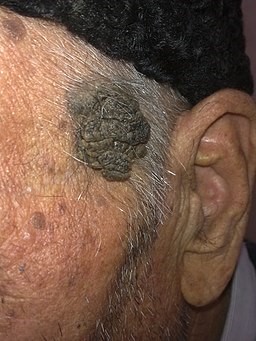
© Alborz Fallah, CC BY-SA 3.0, via Wikimedia Commons
Seborrhoeic keratosis
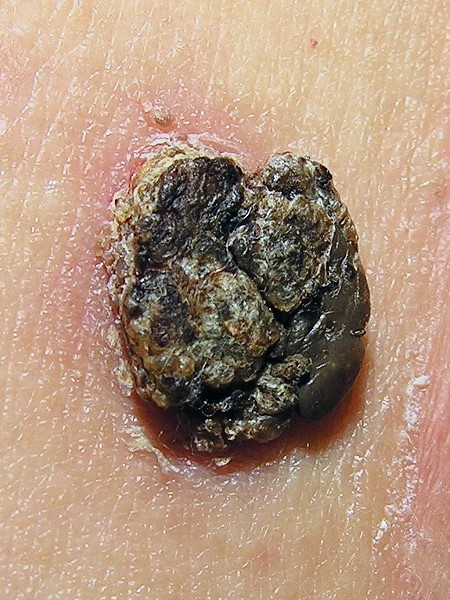
© Lmbuga, Public domain, via Wikimedia Commons
What causes seborrhoeic warts?
Seborrhoeic warts tend first to appear around the age of 40. They can sometimes run in families. The actual cause of seborrhoeic warts is unknown. It can be common to develop several seborrhoeic warts as you become older. Also, as time goes by, each wart tends to grow slightly and become darker. They can occur anywhere on your body, other than on your palms or soles, and there may be multiple lesions.
Are seborrhoeic warts serious?
No. Seborrhoeic warts are always benign. That means they do not spread and they are not cancerous. The main problem is that they can sometimes look unsightly, particularly if they develop on your face.
However, rarely, seborrhoeic warts may be associated with various cancers. The Leser-Trélat sign is rare and refers to the sudden appearance of multiple seborrhoeic warts. This sign is associated with a number of different cancers, particularly bowel, breast, or stomach, and has also been associated with cancers of the liver, kidney and pancreas.
Very rare cases have been reported of a type of skin cancer called melanoma developing within a seborrhoeic wart. It is not known if this is just a coincidence or whether it represents a true cancer change in the seborrhoeic wart. If you do notice a change in a seborrhoeic wart, it is worth asking your doctor to examine it.
Note: although they are called warts, they are not caused by the wart virus. They are not infectious.
How are seborrhoeic warts diagnosed?
Doctors can often diagnose seborrhoeic warts by their appearance. However, if there is any doubt about the diagnosis, especially if the possibility of a more serious diagnosis such as skin cancer is suspected, then dermatoscopy may be used for a closer look at the structure of the lesion.
Dermatoscopy is a technique to examine the skin with a magnifying lens and a light. It can help diagnose skin lesions by accurate assessment of their colour, structures, patterns and borders.
Sometimes a biopsy or removal of the lesion may be needed so that the diagnosis can be confirmed by the detailed structure of the lesion (histology).
What is the treatment for seborrhoeic warts?
If they do not cause any problems then it is best that they be left alone. Without treatment, they usually continue to grow and can become darker and more crusty. However, they do increase in size very slowly.
If required, however, they can be removed quite easily. Seborrhoeic warts are usually removed because they itch, they interfere with clothing or jewellery or they are unsightly.
Two commonly used methods to remove them are:
By using a curette. This involves 'freezing' the surrounding skin with local anaesthetic. The seborrhoeic warts are then scraped off with a sharp surgical instrument called a curette.
Liquid nitrogen treatment. Liquid nitrogen is very cold and anything it touches is killed by the cold. Small amounts of liquid nitrogen can be sprayed on to small seborrhoeic warts. The seborrhoeic warts are killed and drop off a few days later. Normal skin replaces the area left behind. Liquid nitrogen is not suitable for larger warts.
Once seborrhoeic warts have been removed, they usually do not return.
Complications of seborrhoeic warts
Seborrhoeic warts do not become cancerous and are benign, unless there is a sudden appearance of multiple seborrhoeic warts, which may be associated with various cancers (see Leser-Trélat sign above).
Seborrhoeic warts way cause minor local complications such as infection, bleeding or surrounding dermatitis (eczema).
Patient picks for Other skin conditions
Skin, nail and hair health
Pressure sores
A pressure sore is also known as a 'bed sore' or a 'pressure ulcer'. It is a sore or broken (ulcerated) area of skin caused by irritation and continuous pressure on part of your body. Pressure sores are more common over places where your bones are close to your skin (bony prominences) such as your heels, the lower part of your back and your bottom. There are various things that can increase your risk of developing a pressure sore. In particular, risk increases if your mobility is reduced for some reason and you are spending long periods lying in bed or sitting in a chair. There are various measures you can take to prevent most pressure sores developing. These include changing your position as much as possible and also using pressure-relieving devices.
by Dr Hayley Willacy, FRCGP

Skin, nail and hair health
Keratosis pilaris
Keratosis pilaris is a very common skin condition which affects children and teenagers more than adults. It causes rough skin, particularly over the upper arms, outer legs and buttocks.
by Dr Philippa Vincent, MRCGP
Frequently asked questions
Can seborrhoeic warts be confused with other skin conditions?
Yes, doctors often diagnose seborrhoeic warts by their appearance. However, if there is any uncertainty, especially if a more serious condition like skin cancer is suspected, further examination techniques like dermatoscopy or a biopsy might be used to confirm the diagnosis.
What should I do if a seborrhoeic wart changes in appearance?
Although seborrhoeic warts are typically benign, very rarely, a type of skin cancer called melanoma has been reported to develop within them. If you notice any change in a seborrhoeic wart, it is advisable to ask your doctor to examine it.
How long does it take for seborrhoeic warts to grow?
Seborrhoeic warts increase in size very slowly over time. They tend to grow slightly and become darker as you get older.
Are there any natural remedies for seborrhoeic warts?
The article does not discuss natural remedies for seborrhoeic warts. It focuses on medical removal options if the warts are causing problems.
If I have seborrhoeic warts, does it mean I am more likely to get cancer?
No, seborrhoeic warts themselves are benign and do not cause cancer. However, in extremely rare cases, the sudden appearance of multiple seborrhoeic warts (known as the Leser-Trélat sign) can be associated with certain internal cancers. This is a rare occurrence.
If I get a seborrhoeic wart removed, will it leave a scar?
The article states that when liquid nitrogen is used for removal, normal skin replaces the area left behind. It does not specifically mention scarring for either removal method, but the aim of such procedures is generally to minimise cosmetic impact.
Further reading and references
- Seborrheic Keratosis; DermIS (Dermatology Information System)
- Seborrhoeic Keratoses; DermNet NZ
- Seborrhoeic keratosis; Primary Care Dermatology Society
About the authorView full bio

Dr Colin Tidy, MRCGP
General Practitioner, Medical Author
MBBS, MRCGP, MRCP (Paediatrics), DCH
Dr Colin Tidy is an NHS Doctor, based in Oxfordshire.
About the reviewerView full bio

Dr Doug McKechnie, MRCGP
Medical Writer
MA, MBBS, MSc, DRCOG, MRCP(UK), MRCGP(2021), FHEA
Dr Doug McKechnie is an NHS GP working in London. He works full-time clinically and is also the Deputy Lead for the Clinical and Professional Practice module at University College London Medical School.
Article history
The information on this page is written and peer reviewed by qualified clinicians.
Article also available in English, German, Spanish, French, Italian, Portuguese, Hindi, Hebrew, Arabic, and Swedish.
Next review due: 18 Jul 2027
19 Jul 2024 | Latest version
Join the conversation
Share your thoughts or experiences with others in our patient communities.

Ask, share, connect.
Browse discussions, ask questions, and share experiences across hundreds of health topics.

Feeling unwell?
Assess your symptoms online for free
Sign up to the Patient newsletter
Your weekly dose of clear, trustworthy health advice - written to help you feel informed, confident and in control.
By subscribing you accept our Privacy Policy. You can unsubscribe at any time. We never sell your data.
More in skin, nail and hair health
- Alopecia areata
- Boils, carbuncles and furunculosis
- Corns and calluses
- Dog and cat bites
- Eczema herpeticum
- Emollients and eczema creams
- Epidermoid and pilar cysts
- Folliculitis
- Fungal nail infection
- Guttate psoriasis
- Heat rash and prickly heat
- Infected wounds
- Keloid
- Port-wine stain
- Ringworm
- Shingles
- Slapped cheek syndrome
- Sun and sunburn