Smärta i knä och knäskål
Patellofemoralt smärtsyndrom
Granskad av Dr Surangi Mendis, MRCGPSenast uppdaterad av Dr Rachel Hudson, MRCGPSenast uppdaterad 31 okt 2023
Uppfyller patientens redaktionella riktlinjer
- Ladda nerLadda ner
- Dela
- Language
- Diskussion
- Ask Patient
- Ljudversion
- Lägg till i föredragna källor på Google
Most knee conditions cause pain in the front (anterior) of the knee. Patellofemoral pain is the name given to this. Pain at the back of the knee is usually caused by a Baker's cyst (also known as a popliteal cyst). The rest of this leaflet deals with patellofemoral pain syndrome, which is much more common.
Överblick
Patellofemoralt smärtsyndrom orsakar smärta på framsidan av knät, runt knäskålen.
Det är ofta värre när man går upp eller ner för trappor, springer, eller efter långa perioder av sittande.
Det anses bero på ökat tryck mellan knäskålen och lårbenet.
Behandlingen inkluderar att undvika ansträngande användning av knät, smärtstillande medel och fysioterapi.
Kirurgi är vanligtvis inte det första behandlingsalternativet.
Videoval för KnäsmärtaVideobibliotek
What is patellofemoral pain syndrome?
Patellofemoral pain syndrome is the medical term used when pain occurs at the front of the knee, around the kneecap (patella), without signs of any damage or other problems in the knee joint.
Patellofemoral pain syndrome may also be referred to as anterior knee pain, or runner's knee.
Knee cross-section with patella
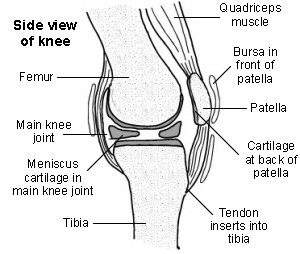
The patella is the kneecap bone. It lies within the quadriceps tendon. This large tendon from the powerful thigh muscles (quadriceps) wraps round the patella and is attached to the top of the lower leg bone (tibia). The quadriceps muscles straighten the knee.
The back of the patella is covered with smooth cartilage. This helps the patella to glide smoothly over the lower part of the thighbone (femur) when you straighten your leg.
Patellofemoral pain is a general term used for pain in the front (anterior) of the knee. However, you might also see some terms referring to specific conditions causing anterior knee pain. These include:
Other causes of knee pain can include:
Knee cartilage injuries (meniscal tears).
Gikt.
Knee pain can also be caused by hip problems.
Patellofemoral pain syndrome symptoms
Symptoms of patellofemoral pain syndrome include:
Pain around the knee. The pain is felt at the front of the knee, around or behind the kneecap (patella). Often, the exact site of the pain cannot be pinpointed; instead the pain is felt vaguely at the front of the knee.
The pain comes and goes.
Both knees are often affected at the same time but one is usually worse than the other.
The pain is typically worse when going up or, in particular, going down stairs.
Running, especially downhill, squatting and certain sports can all set it off - anything that leads to the patella being compressed against the lower part of the thighbone.
The pain may be brought on by sitting still for long periods. For example, after going to the cinema or for a long drive, when it will be worse when starting to move about again.
There may be a grating or grinding feeling, or sounds in your knee when it bends and straightens. This is called crepitus. There may also be a clicking feel or sound.
Sometimes there is puffiness or swelling around the kneecap.
The range of motion of the knee is usually normal.
What causes patellofemoral pain syndrome?
It is probably due to a combination of different factors which increase the pressure between the kneecap (patella) and the lower part of the thighbone (femur). This may happen during running, cycling, squatting and going up and down stairs. It is likely that the cause is not the same in everyone affected.
Situations where this can occur include:
Overuse of the knee, such as in certain sports - particularly at times of increased training.
Cycling when the saddle is too low or too far forward.
Some people may have a slight problem in the alignment of the patella where it moves over the lower femur. This may cause the patella to rub on, rather than glide over, the lower femur (this is known as maltracking). It may be due to the way the knee has developed. Or, it may be due to an imbalance in the muscles around the knee and hip - for example, the large quadriceps muscle above the knee and the muscles that stop the hips from tilting when standing on one leg.
Weak hip muscles may cause patellofemoral pain by causing the thighbone to be slightly turned inwards, leading to the patella being pulled slightly to one side.
Foot problems may also play a part - for example, where the feet do not have strong arches (flat feet). This makes the foot roll inwards (pronate), which means the knee has to compensate for the inward movement. However, it is unclear whether this orsaker the knee problems or may be caused by the knee problems.
Injury to the knee - including repeated small injuries or stresses due to sports, or due to slack ligaments (hypermobile joints).
Having obesity or being overweight, and wearing unsupportive footwear may also contribute to patellofemoral pain.
A combination of an alignment problem (see above) and overuse in sport is thought to be the most common reason for having patellofemoral pain.
How is patellofemoral pain syndrome diagnosed?
The diagnosis is made from your symptoms, the history of the problem, plus a physical examination of your knee.
Tests, such as X-rays or scans, cannot diagnose patellofemoral pain and are often not helpful. However, sometimes they might need to be done to diagnose maltracking or look for other conditions.
If knee pain persists despite treatment, you may wonder whether further investigation or a scan is needed. Find out more about when persistent knee pain may need a scan.
Patellofemoral pain syndrome treatment
In the short term
Avoid strenuous use of the knee - until the pain eases. Symptoms usually improve in time if the knee is not overused. Aim to keep fit but to reduce the activities which cause the pain.
Smärtstillande - paracetamol och/eller anti-inflammatory painkillers såsom ibuprofen.
Physiotherapy:
Improving the strength of the muscles around the knee and hip will ease the stress on the knee.
Specific exercises may help to correct problems with alignment and muscle balance around the knee. For example, you may be taught to do exercises which strengthen the muscles of the hip and buttock.
The physiotherapist can give advice tailored to your individual situation.
Taping of the kneecap (patella) - this is a treatment which may reduce pain, but doesn't appear to have any long-term benefits. It involves adhesive tape being applied over the patella, to alter the alignment or the way the patella moves. Some people find this helpful. Some physiotherapists can offer patellar taping treatment.
In the longer term
Treatment aims to treat some of the underlying causes - for example, by strengthening hip muscles and helping with foot problems:
Physiotherapy - a long-term home exercise programme, for at least one year.
Suitable footwear - for example, arch supports if you have flat feet; suitable shoes if you are running.
Losing weight if your weight is above the recommend weight for your height is likely to help reduce pain.
Surgery is no longer recommended as first-line treatment for patellofemoral syndrome as the evidence suggests that most people do just as well - if not better - with non-surgical (conservative) treatment. However, surgery is still occasionally considered for people with anterior knee pain who do not respond to conservative treatment, depending on the diagnosis.
Vad är utsikterna?
The outlook (prognosis) was thought to be good and that most people got better after 4-6 months with simple treatments such as physiotherapy. However, recent studies suggest that over 50% of people still report pain and difficulties with their knee 5-8 years after physiotherapy treatment. Ongoing research is looking into how this picture can be improved.
Patientval för Knäsmärta

Ben, leder och muskler
Bakers cysta
A Baker's cyst is a swelling that can develop behind the knee. It is filled with the lubricating fluid that is usually found inside the knee joint, known as "synovial fluid". It most commonly occurs if there is an underlying problem with the knee such as osteoarthritis. Symptoms can include pain, swelling and tightness behind the knee. Sometimes, a Baker's cyst can split open (rupture) and cause symptoms in the calf that can be similar to a deep vein thrombosis (DVT). A Baker's cyst often gets better and disappears by itself over time. However, there are various treatments that may help if there are symptoms associated with it.
av Dr Philippa Vincent, MRCGP

Ben, leder och muskler
Hembiträdesknä
Housemaid's knee is also known as prepatellar bursitis. It is caused by inflammation of a small fluid-filled sac (the bursa) in front of the kneecap. It more commonly occurs in people who spend long periods of time kneeling. Treatment is usually supportive and the outlook is generally very good.
av Dr Colin Tidy, MRCGP
Vanliga frågor
Vad är skillnaden mellan patellofemoralt smärtsyndrom och andra typer av knäsmärta?
Patellofemoralt smärtsyndrom avser specifikt smärta på framsidan av knät, runt knäskålen, utan några tecken på skador eller andra problem inom själva knäleden. Andra tillstånd som kondromalacia patellae, bursit eller Osgood-Schlatters sjukdom är specifika typer av främre knäsmärta. Separat kan allmän knäsmärta härröra från problem som ledbandsskador, broskskador, olika former av artrit eller till och med höftproblem, vilket skiljer sig från patellofemoralt smärtsyndrom.
Om mitt knä knäpper eller maler, betyder det att jag har patellofemoralt smärtsyndrom?
En skrapande, malande känsla eller ljud (krepitation) i knät när det böjs och rätas ut, samt klickande ljud, kan vara ett symptom på patellofemoralt smärtsyndrom. Dessa ljud är dock inte tillräckliga för en diagnos. De är en del av en bredare uppsättning symptom som, i kombination med en fysisk undersökning och problemets historia, kan leda till en diagnos av patellofemoralt smärtsyndrom.
Kan cykling bidra till patellofemoralt smärtsyndrom?
Ja, cykling kan bidra till patellofemoralt smärtsyndrom, särskilt om cykelsadeln är placerad för lågt eller för långt fram. Detta kan öka trycket mellan knäskålen och lårbenet, vilket leder till smärta. Att justera din cykelinställning kan hjälpa till att lindra detta problem.
Behöver jag en röntgen eller skanning för att diagnostisera patellofemoralt smärtsyndrom?
Nej, röntgen eller skanningar kan vanligtvis inte diagnostisera patellofemoralt smärtsyndrom och är ofta inte till hjälp för detta specifika tillstånd. Diagnosen ställs vanligtvis baserat på dina symtom, historien om ditt knäproblem och en fysisk undersökning av ditt knä. Dessa tester kan dock ibland användas för att diagnostisera andra tillstånd eller för att undersöka eventuell felspårning av knäskålen.
Kommer fysioterapi att helt bota mitt patellofemorala smärtsyndrom?
Fysioterapi är en viktig behandling för patellofemoralt smärtsyndrom, med fokus på att stärka musklerna runt knä och höft samt korrigera justeringsproblem. Även om det ger betydande lindring och är den rekommenderade förstahandsbehandlingen, tyder senaste studier på att över 50% av människor fortfarande rapporterar viss smärta och svårigheter år efter fysioterapi. Pågående forskning syftar till att förbättra dessa långsiktiga resultat.
Är kirurgi ett alternativ för patellofemoralt smärtsyndrom?
Kirurgi rekommenderas vanligtvis inte som förstahandsbehandling för patellofemoralt smärtsyndrom. Bevis tyder på att konservativa behandlingar, såsom fysioterapi, ofta är lika effektiva, om inte mer. Dock kan kirurgi ibland övervägas för individer vars främre knäsmärta inte förbättras med konservativa behandlingar, beroende på deras specifika diagnos.
Vidare läsning och referenser
- Smith BE, Selfe J, Thacker D, et al; Incidence and prevalence of patellofemoral pain: A systematic review and meta-analysis. PLoS One. 2018 Jan 11;13(1):e0190892. doi: 10.1371/journal.pone.0190892. eCollection 2018.
- Crossley KM, Stefanik JJ, Selfe J, et al; 2016 Patellofemoral pain consensus statement from the 4th International Patellofemoral Pain Research Retreat, Manchester. Part 1: Terminology, definitions, clinical examination, natural history, patellofemoral osteoarthritis and patient-reported outcome measures. Br J Sports Med. 2016 Jul;50(14):839-43. doi: 10.1136/bjsports-2016-096384. Epub 2016 Jun 24.
- McClinton SM, Cobian DG, Heiderscheit BC; Physical Therapist Management of Anterior Knee Pain. Curr Rev Musculoskelet Med. 2020 Dec;13(6):776-787. doi: 10.1007/s12178-020-09678-0. Epub 2020 Oct 30.
- Gaitonde DY, Ericksen A, Robbins RC; Patellofemoral Pain Syndrome. Am Fam Physician. 2019 Jan 15;99(2):88-94.
- Anterior knee pain (patellofemoral dysfunction): physiotherapy exercises; Royal Berkshire NHS Foundation Trust, February 2022
Om författarenVisa fullständig biografi
Uppdaterad av

Dr Rachel Hudson, MRCGP
Allmänläkare och medicinsk författare
MBChB, MRCGP (2008), BSc (Medical Science), DFSRH, DRCOG, DCH
Dr Rachel Hudson är en NHS-läkare som arbetar i nordvästra England.
Om recensentenVisa fullständig biografi

Dr Surangi Mendis, MRCGP
Konsult och medicinsk författare
MBBS, BSc (1st), MRCGP (2014), DFSRH, PGcert otology and audiology
Surangi Mendis är en konsult inom audiovestibulär medicin och neuro-otologi vid The Royal National ENT och Eastman Dental Hospitals, UCLH.
Artikelhistorik
Artikeln finns också på Engelska, Tyska, Spanska, Franska, Italienska, Portugisiska, Hindi, Hebreiska, Arabiska, och Svenska.
Nästa granskning: 29 okt 2028
31 okt 2023 | Senaste versionen
Medicinska yrkesverksamma
Looking for more in-depth clinical detail? Our Professional Reference articles are written for doctors, nurses and other healthcare professionals. They include comprehensive clinical guidance, diagnostic information and UK/European evidence summaries. If you need the clinical version, you can read the Professional Reference article on this topic.
Dela dina tankar eller erfarenheter med andra i vår patientgemenskaper.
Enkel tillgång till pålitliga behandlingar och hälsotjänster online.
Common conditions
Get help with common conditions through the NHS, without a GP appointment.





Anmäl dig till Patientens nyhetsbrev
Din veckovisa dos av tydliga, pålitliga hälsoråd - skrivna för att hjälpa dig känna dig informerad, självsäker och i kontroll.
Genom att prenumerera accepterar du våra Sekretesspolicy. Du kan avsluta prenumerationen när som helst. Vi säljer aldrig dina uppgifter.