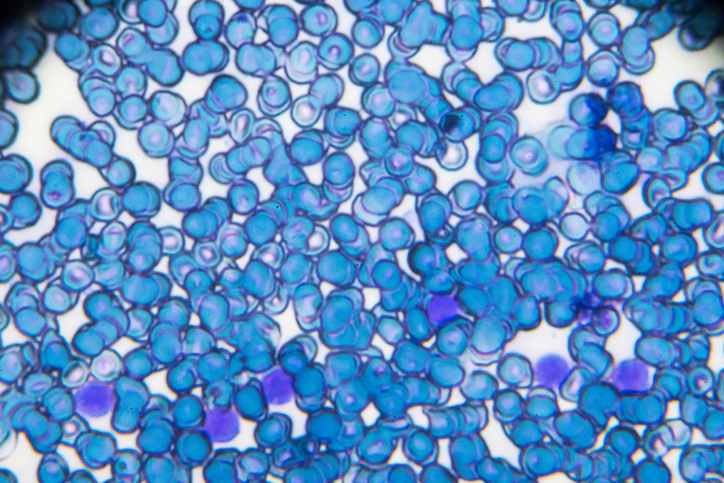
Leukemi
Granskad av Dr Toni Hazell, FRCGPSenast uppdaterad av Dr Hayley Willacy, FRCGP Senast uppdaterad 21 feb 2023
Uppfyller patientens redaktionella riktlinjer
- Ladda nerLadda ner
- Dela
- Language
- Diskussion
- Ask Patient
- Ljudversion
- Lägg till i föredragna källor på Google
I denna serie:Akut lymfatisk leukemiKronisk lymfatisk leukemiAkut myeloisk leukemiKronisk myeloisk leukemi
Leukemi är en cancer i blodbildande celler. Det finns olika typer av leukemi. Om du utvecklar leukemi är det viktigt att veta vilken typ det är. Detta beror på att prognosen och behandlingarna varierar för de olika typerna.
Överblick
Leukaemia is a cancer of cells in the bone marrow that develop into white blood cells.
The main types are acute lymphoblastic, chronic lymphocytic, acute myeloid, and chronic myeloid leukaemia.
Symptoms can include tiredness, breathlessness, easy bruising, bleeding, and serious infections.
Acute leukaemia symptoms develop quickly, while chronic types progress slowly.
Leukaemia is diagnosed with blood tests and a bone marrow sample analysis.
Treatment depends on the type and stage of leukaemia, and may include chemotherapy.
Vad är leukemi?
Leukaemia is a cancer of cells in the bone marrow (the cells which develop into white blood cells).
Cancer is a disease of the cells in the body. There are many types of cancer which arise from different types of cell. What all cancers have in common is that the cancer cells are abnormal and do not respond to normal control mechanisms. Large numbers of cancer cells build up because they multiply 'out of control', or because they live much longer than normal cells, or both.
With leukaemia, the cancerous cells in the bone marrow spill out into the bloodstream. There are several types of leukaemia. Most types arise from cells which normally develop into white blood cells. (The word leukaemia comes from a Greek word which means 'white blood'.)
If you develop leukaemia it is important to know exactly what type it is. This is because the outlook (prognosis) and treatments vary for the different types. Before discussing the different types of leukaemia it may help to know some basics about normal blood cells and how they are made.
The main types of leukaemia
Acute lymphoblastic leukaemia (ALL).
Chronic lymphocytic leukaemia (CLL).
Acute myeloid leukaemia (AML).
Chronic myeloid leukaemia (CML).
There are various 'subtypes' of each of these. In addition there are some other rare types of leukaemia. The word:
'”Akut” betyder att sjukdomen utvecklas och fortskrider ganska snabbt.
'Chronic' means persistent or ongoing. When talking about leukaemia, the word chronic also means that the disease develops and progresses slowly (even without treatment).
'Lymphoblastic' and 'lymphocytic' mean that an abnormal cancerous cell is a cell that originated from a lymphoid stem cell.
'”Myeloid” betyder att en onormal cancercell är en cell som har sitt ursprung i en myeloid stamcell.
Vad orsakar leukemi?
A leukaemia is thought to start first from one abnormal cell. What seems to happen is that certain vital genes which control how cells divide, multiply and die, are damaged or altered. This makes the cell abnormal. If the abnormal cell survives it may multiply 'out of control' or survive a long time, and develop into a leukaemia.
In most cases of leukaemia, the reason why a cell becomes abnormal is not known. There are certain 'risk factors' which increase the chance that certain leukaemias will develop, but these only account for a small number of cases.
Risk factors for some types of leukaemia
Radiation exposure is known to be a risk factor. For example, previous radiotherapy for another condition. Additionally many of the survivors of the atom bomb used in World War II developed leukaemia due to the fall-out of radiation.
Tidigare behandling med kemoterapi eller andra läkemedel som försvagar immunförsvaret.
Certain genetic disorders, of which the most common is Downs syndrom.
Exposure to certain chemicals, such as benzene.
Leukaemia symptoms
När stora mängder onormala blodceller bildas fylls en stor del av benmärgen med dessa celler. Därför får normala celler i benmärgen svårt att överleva och bilda tillräckligt många mogna, normala blodceller. De onormala cellerna läcker också ut i blodomloppet. De huvudsakliga problem som kan uppstå är därför:
Anemi
This occurs as the number of red blood cells in the bloodstream goes down. This can cause tiredness, breathlessness and other symptoms. You may also look pale.
Problem med blodets koagulation
This is due to low levels of platelets in the bloodstream. This can cause easy bruising, bleeding from the gums and other bleeding-related problems.
Allvarliga infektioner
The abnormal white blood cells do not protect against infection. Also, there is a reduced number of normal white blood cells which usually combat infection. Therefore, serious infections are more likely to develop. Depending on the type and site of infection which develops, the symptoms can vary greatly.
How long do leukaemia symptoms take to develop?
Det varierar hur lång tid det tar innan dessa symtom utvecklas efter att sjukdomen har börjat. Vanligtvis handlar det om några veckor vid ALL eller AML. Vid CLL eller CML kan det ta månader eller år innan symtomen utvecklas, eftersom dessa leukemier fortskrider långsamt.
The abnormal cells may also build up in lymph glands and in the spleen. You may therefore develop swollen glands in various parts of the body, and develop an enlarged spleen.
Other symptoms which may develop include pain in the bones or joints (mainly with ALL), persistent raised temperature (fever), och viktnedgång.
How is leukaemia diagnosed and assessed?
Ett blodprov
A blood test can often suggest the diagnosis of leukaemia, as abnormal cells are often detected in the blood test. Further tests are usually done to confirm the diagnosis.
Ett benmärgsprov
For this test, a small amount of bone marrow is removed by inserting a needle into the pelvic bone (or sometimes the breastbone (sternum)). Local anaesthetic is used to numb the area. A small sample of bone may also be taken. The samples are put under the microscope to look for abnormal cells and are also tested in other ways. This can confirm the diagnosis. (See the separate leaflet called Bone Marrow Biopsy and Aspiration for more detail.) A bone marrow test may not be needed to confirm the diagnosis of CLL.
Cell- och kromosomanalys
Detaljerade tester görs ofta på onormala celler som har tagits från ett benmärgsprov eller ett blodprov. Dessa fastställer den exakta typen eller undertypen av den onormala cellen.
Lumbalpunktion
This test collects a small amount of fluid from around the spinal cord - cerebrospinal fluid (CSF). It is done by inserting a needle between the bones (vertebrae) in the lower (lumbar) region of the back. (See the separate leaflet called Lumbar Puncture (Spinal Tap) for more detail.) By examining the fluid for leukaemia cells, it helps to find out if the leukaemia has spread to the brain and spinal cord. This is mainly done when assessing ALL and sometimes AML.
Various other tests
A bröströntgen, blood tests and other tests are usually done to assess your general well-being.
Leukaemia treatment
The treatment advised depends on the exact type of leukaemia and on the stage it is at. For example, ALL is usually treated as soon as possible with intensive chemotherapy. On the other hand, people in the early stages of CLL may not need any treatment. This is because CLL often progresses very slowly and may not need treatment for several years.
For details of treatments for each type of leukaemia, read more about:
Acute lymphoblastic leukaemia.
Acute myeloid leukaemia.
Chronic lymphocytic leukaemia.
Chronic myeloid leukaemia.
What is the outlook for leukaemia?
The outlook (prognosis) varies for each of the different leukaemias. However, the overall outlook may be better than many people imagine. For example, the outlook for ALL has greatly improved over the period of 20 years or so. Most children with ALL can now be cured.
Also, the chronic leukaemias (CLL and CML) often progress slowly - often over several years. Even in those cases which are not cured, treatment with chemotherapy and other treatments can often prolong survival for quite some time.
Some chemotherapy medicines can affect fertility in both men and women. Sometimes this is temporary and sometimes it is permanent. There is also a very small risk that some medicines used to treat leukaemia may cause another form of cancer much later in your life.
The treatment of cancer and leukaemia is a developing area of medicine. New treatments continue to be developed and the information on outlook above is very general. There are some newer medicines that have been introduced in the last few years that show promise to improve the outlook. The specialist who knows your case can give more accurate information about the treatment and outlook for your particular situation.
Patientval för Blodcancer
Cancer
Benmärgsbiopsi och aspiration
A bone marrow biopsy is a procedure where a sample of tissue is taken from the inside of a bone.
av Dr Laurence Knott

Cancer
Hodgkins lymfom
Lymfom delas in i två typer - Hodgkins lymfom och icke-Hodgkins lymfom. Hodgkins lymfom kallas ibland Hodgkins sjukdom.
av Dr Hayley Willacy, FRCGP
Vanliga frågor
Can leukaemia be passed on to children or other family members?
Leukaemia is not contagious nor is it directly inherited like some genetic conditions. While certain genetic disorders can increase the risk, and some risk factors are environmental, leukaemia itself is not passed from person to person or directly from parent to child through genes.
How are the different types of leukaemia distinguished from each other?
The specific type of leukaemia is identified through detailed tests on abnormal cells, usually obtained from a bone marrow sample or blood test. These analyses determine the exact type or subtype of the abnormal cell, leading to a precise diagnosis.
Is it possible for leukaemia to spread to other parts of the body?
Yes, leukaemia cells can spread. The article specifically mentions that a lumbar puncture can be used to check if the leukaemia has spread to the brain and spinal cord, which is mainly done when assessing Acute Lymphoblastic Leukaemia (ALL) and sometimes Acute Myeloid Leukaemia (AML).
If I am diagnosed with leukaemia, will I always need immediate treatment?
Not always. While some types, like Acute Lymphoblastic Leukaemia (ALL), are usually treated as soon as possible with intensive chemotherapy, people in the early stages of Chronic Lymphocytic Leukaemia (CLL) may not need any treatment immediately. This is because CLL often progresses very slowly and treatment might not be necessary for several years.
Can lifestyle changes help prevent leukaemia?
The article states that in most cases, the reason why a cell becomes abnormal and develops into leukaemia is not known. While certain risk factors like radiation exposure or exposure to certain chemicals are mentioned, it doesn't discuss lifestyle changes as a preventative measure for leukaemia.
Vidare läsning och referenser
- Acute lymphoblastic leukaemia in adult patients: ESMO Clinical Practice Guidelines for diagnosis, treatment and follow-up; Europeiska sällskapet för medicinsk onkologi (2016)
- Eichhorst B, Robak T, Montserrat E, et al; Chronic lymphocytic leukaemia: ESMO Clinical Practice Guidelines for diagnosis, treatment and follow-up. Ann Oncol. 2015 Sep;26 Suppl 5:v78-84. doi: 10.1093/annonc/mdv303.
- Chronic myeloid leukaemia: ESMO Clinical Practice Guidelines for diagnosis, treatment and follow-up; European Society for Medical Oncology (2017)
- Heuser M, Ofran Y, Boissel N, et al; Acute myeloid leukaemia in adult patients: ESMO Clinical Practice Guidelines for diagnosis, treatment and follow-up. Ann Oncol. 2020 Jun;31(6):697-712. doi: 10.1016/j.annonc.2020.02.018. Epub 2020 Mar 17.
Om författarenVisa fullständig biografi
Uppdaterad av

Dr Hayley Willacy, FRCGP
Allmänläkare, Medicinsk Författare
MBChB (1992), DRCOG, DFFP, MRCOG (Part 1) MRCGP (2007), DFSRH (2013), MSc - medical education (2020)
Dr Hayley Willacy var en NHS-läkare som arbetade i nordvästra England och gick i pension från klinisk praktik 2022 efter 30 år.
Om recensentenVisa fullständig biografi

Dr Toni Hazell, FRCGP
MBBS, BSc, FRCGP, DFSRH, Dip GU med, DRCOG, DCH (London, UK, 2000)
Dr. Toni Hazell tog examen från St. Mary’s Hospital Medical School och genomförde sin VTS vid Northwick Park Hospital.
Artikelhistorik
Artikeln finns också på Engelska, Tyska, Spanska, Franska, Italienska, Portugisiska, Hindi, Hebreiska, Arabiska, och Svenska.
Nästa granskning: 20 feb 2028
21 feb 2023 | Senaste versionen
Dela dina tankar eller erfarenheter med andra i vår patientgemenskaper.
Enkel tillgång till pålitliga behandlingar och hälsotjänster online.
Common conditions
Get help with common conditions through the NHS, without a GP appointment.





Anmäl dig till Patientens nyhetsbrev
Din veckovisa dos av tydliga, pålitliga hälsoråd - skrivna för att hjälpa dig känna dig informerad, självsäker och i kontroll.
Genom att prenumerera accepterar du våra Sekretesspolicy. Du kan avsluta prenumerationen när som helst. Vi säljer aldrig dina uppgifter.