Bronkiektasi
Granskad av Dr Krishna Vakharia, MRCGPSenast uppdaterad av Dr Hayley Willacy, FRCGP Senast uppdaterad 30 jan 2023
Uppfyller patientens redaktionella riktlinjer
- Ladda nerLadda ner
- Dela
- Language
- Diskussion
- Ask Patient
- Ljudversion
- Lägg till i föredragna källor på Google
Bronchiectasis is a problem with the lungs, where you cough up lots of phlegm, (sputum): far more than usual. It is usually caused by something that has already affected the lungs, like a bad infection; but sometimes no cause is found. It generally affects older people. There are some good treatments available to keep it under control.
Överblick
Bronkiektasi är ett tillstånd i lungorna där luftvägarna blir onormalt bredare än vanligt.
Denna vidgning orsakar att slem samlas, vilket leder till symtom som en daglig våt hosta och andfåddhet.
Det kan orsakas av svåra infektioner, problem med immunsystemet eller tillstånd som påverkar slemrensning.
Diagnos innebär vanligtvis symtom och en CT-skanning av lungorna.
Behandlingen fokuserar på att hantera symtom, såsom att rensa slem och ta antibiotika för infektioner.
Bronkiektasi kan inte återställas, men behandling kan förhindra att det förvärras.
Videoval för Lung conditionsVideobibliotek
Understanding the airways
Usually air travels from our windpipes down into our lungs through small tubes. The tubes that come off the windpipe are called bronchi; then they split into bronchioles which are a bit smaller. Finally the small bronchioles split into tiny tubes called alveoli. In a normal person all these tubes are fairly small: up to 2 cm in diameter at the windpipe, all the way down to just a few millimetres for the alveoli. Our airways are a bit like a tree: the tree trunk is the biggest bit, but it gradually splits off into branches, then twigs.
What is bronchiectasis?
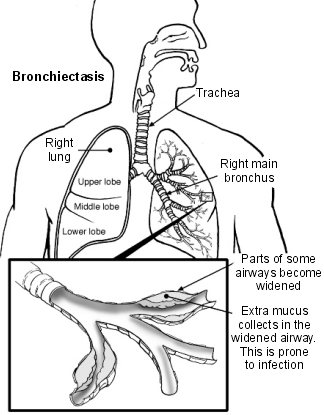
In bronchiectasis the airways gradually become bigger than they are meant to be. So instead of the tiny alveoli being just a few millimetres in diameter, they might be a centimetre wide. And instead of bronchioles being about a centimetre wide, they become 1.5 centimetres in diameter.
The problem then is that mucus, which we all have in our lungs to some degree, can pool and collect in the airways. And because the airways aren't meant to be that wide in the first place, they produce more mucus than usual. Mucus is the same as sputum, or phlegm: sticky, slightly thick liquid that can be white, clear, green or yellow. It can usually be coughed up.
This picture shows what happens in bronchiectasis:
Lungs and airways - bronchiectasis
What causes bronchiectasis?
Generally the cause is something that has created infection or inflammation in the lungs:
A bad infection with tuberkulos.
A bad case of lunginflammation.
A blood clot in the lungs, called a pulmonary embolus.
A bad infection with whooping cough (pertussis) as a child.
Or it could be from a problem with the immune system:
Att ha HIV.
Having a low immune system from birth.
Or a problem with how the lungs clear away mucus already, such as occurs with:
Cystisk fibros from childhood.
Some other type of rare condition like Kartagener's syndrome.
There are other rare conditions that can cause bronchiectasis, such as:
Alpha-1 antitrypsin deficiency.
Yellow nail syndrome.
Allergic bronchopulmonary aspergillosis.
These problems could have occurred in childhood, but it's only in adulthood or even older that you develop bronchiectasis.
In at least a third of cases of bronchiectasis, no cause is found.
How common is bronchiectasis?
Bronchiectasis is not particularly common: most family doctors in the UK will have some patients with the condition but will not see new cases very often. Around 1% of people have been diagnosed with bronchiectasis in the general population; but people with a chronic lung condition like astma, cystisk fibros eller kroniskt obstruktiv lungsjukdom (KOL) will have a higher rate of bronchiectasis. The condition gets more common with old age.
It seems to be getting more common lately but that is probably because lung scans are more detailed and picking up on the lung changes of bronchiectasis more easily.
What are the symptoms of bronchiectasis?
The symptoms are caused by there being too much mucus inside the lungs:
A wet cough every day, despite taking antibiotics.
Coughing up lots of sputum (also called phlegm or mucus).
Feeling slightly breathless or unable to do as much exercise as you used to.
Frequent chest infections, particularly with a bug called Pseudomonas aeruginosa.
As a child: asthma that is difficult to control; or having recurrent chest or ear infections.
How is bronchiectasis diagnosed?
Bronchiectasis is usually diagnosed by a lung specialist rather than a family doctor. It is usually diagnosed by:
The general clinical picture of someone with a long-term cough that produces large amounts of sputum.
A CT-skanning of the lungs that shows enlargement (or what is often called 'dilatation') of the airways and usually thickening of the wall of the airways.
How to treat bronchiectasis
Once bronchiectasis sets in, it can't ever be reversed. However, it can be prevented from getting worse by:
Taking regular tränings.
Using 'airways clearance techniques' that help to drain off mucus from the lungs. This usually involves seeing a physiotherapist who is trained in treating the lungs: what is usually termed a respiratory physiotherapist or 'chest physio'. The patient can also be taught how to use postural drainage techniques themself, along with special breathing techniques to bring up the mucus.
Nebulised saline can help to make the sputum thinner and easier to cough up.
Nebulised bronchodilators can help the mucus to drain away too.
Long-term macrolide antibiotics such as azithromycin, can help to prevent infections and dampen down inflammation in the lungs.
Treating any underlying cause, like tuberkulos eller cystisk fibros, is also important.
Inhaled steroids or nebulised steroids do not seem to help.
If the bronchiectasis is confined to just one area of the lungs (which is unusual) then surgery can be considered.
Vad är utsikterna?
Most people with bronchiectasis (with no underlying cause) have a good outlook (prognosis). Symptoms in many affected people do not become severe. Treatment, in particular with antibiotics when an infection occurs, or regularly when needed, keeps most people reasonably well.
The condition becomes worse in some cases and breathing problems may develop. In a small number of cases the condition becomes gradually worse over time as more and more of the airways become affected.
A life-threatening bleed from a damaged airway may also occur but is rare.
The outlook for people where bronchiectasis is part of another condition depends on the underlying cause. Generally it gets a little bit worse as you get older, but if you follow treatment plans then you should be able to stop it getting much worse.
Patientval för Lung conditions
Bröst och lungor
Kolmonoxidförgiftning
Carbon monoxide is an odourless poisonous gas. Even small amounts can deprive the body of oxygen, and can lead to brain damage in severe cases. This leaflet describes the symptoms of carbon monoxide and advises on how to protect yourself from carbon monoxide poisoning.
av Dr Philippa Vincent, MRCGP
Bröst och lungor
Pulmonell fibros
Pulmonary fibrosis is a serious lung disease where the tiny air sacs of the lungs (the alveoli) and the lung tissue next to the alveoli become damaged and scarred, resulting in lung fibrosis. The main symptom is shortness of breath that gradually gets worse. The cause is often not known but pulmonary fibrosis can be caused by a variety of underlying conditions. Treatments include treating any underlying cause in addition to steroids and other medicines. Increasingly lung transplantation may be considered.
av Dr Toni Hazell, FRCGP
Vanliga frågor
Vilken är den typiska åldersgruppen för att utveckla bronkiektasi?
Bronkiektasi kan utvecklas från problem som uppstod i barndomen, men symtom kan bara visa sig i vuxen ålder eller till och med senare i hög ålder. Det noteras också att tillståndet blir vanligare i äldre ålder.
Om jag har bronkiektasi, kommer jag alltid att ha en våt hosta och producera mycket slem?
Ja, en ihållande våt hosta varje dag, även när man tar antibiotika, och att hosta upp mycket slem (sputum eller slem) beskrivs som nyckelsymptom på bronkiektasi. Dessa symptom orsakas av det överflödiga slemmet i lungorna.
Finns det några specifika övningar eller aktiviteter jag bör undvika om jag har bronkiektasi?
Artikeln specificerar inte aktiviteter att undvika, men den rekommenderar att regelbundet motionera som ett sätt att förhindra att tillståndet förvärras. Den nämner också att känna sig lätt andfådd eller oförmögen att träna lika mycket som tidigare kan vara ett symptom.
Hur hjälper tekniker för luftvägsrensning vid bronkiektasi?
Luftrensningstekniker är metoder som hjälper till att dränera slem från lungorna. Detta innebär ofta att arbeta med en andningsfysioterapeut som kan lära ut specifika andningstekniker och postural dränering för att hjälpa till att få upp slemmet, vilket kan göras tunnare och lättare att hosta upp med nebuliserad saltlösning.
Vad är egentligen en 'andningsfysioterapeut' och vad gör de?
En andningsfysioterapeut, även känd som en 'bröstfysio', är en specialist utbildad i att behandla lungsjukdomar. De spelar en nyckelroll i att lära patienter 'luftvägsrensningstekniker' och specifika andningsmetoder för att hjälpa till att dränera slem från lungorna.
Är det möjligt för bronkiektasi att endast påverka en lunga eller en del av en lunga?
Även om det är ovanligt, är det möjligt att bronkiektasi är begränsad till endast ett område av lungorna. I sådana sällsynta fall kan kirurgi övervägas som en behandlingsalternativ.
Vad betyder en 'utvidgning av luftvägarna' i samband med en CT-skanning diagnos?
Vidgning av luftvägarna, som ses på en CT-skanning, avser förstoringen av luftvägarna, vilket är ett karakteristiskt drag för bronkiektasi. Det indikerar att rören i lungorna har blivit bredare än deras normala storlek.
Vidare läsning och referenser
- Bronkiektasi; NICE CKS, mars 2024 (endast tillgängligt i Storbritannien)
- Snell N, Gibson J, Jarrold I, et al; Epidemiology of bronchiectasis in the UK: Findings from the British lung foundation's 'Respiratory health of the nation' project. Respir Med. 2019 Oct-Nov;158:21-23. doi: 10.1016/j.rmed.2019.09.012. Epub 2019 Sep 17.
- Hill AT, Sullivan AL, Chalmers JD, et al; British Thoracic Society Guideline for bronchiectasis in adults. Thorax. 2019 Jan;74(Suppl 1):1-69. doi: 10.1136/thoraxjnl-2018-212463.
- Lee AL, Burge AT, Holland AE; Positive expiratory pressure therapy versus other airway clearance techniques for bronchiectasis. Cochrane Database Syst Rev. 2017 Sep 27;9(9):CD011699. doi: 10.1002/14651858.CD011699.pub2.
Om författarenVisa fullständig biografi
Uppdaterad av

Dr Hayley Willacy, FRCGP
Allmänläkare, Medicinsk Författare
MBChB (1992), DRCOG, DFFP, MRCOG (Part 1) MRCGP (2007), DFSRH (2013), MSc - medical education (2020)
Dr Hayley Willacy var en NHS-läkare som arbetade i nordvästra England och gick i pension från klinisk praktik 2022 efter 30 år.
Om recensentenVisa fullständig biografi

Dr Krishna Vakharia, MRCGP
Medicinsk chef för hälsa, Optum UK
MBChB, MRCGP(2013), BMedSci (hons), DFSRH, DRCOG, PGDipDerm (Distn)
Dr Krishna Vakharia är en NHS-läkare. Hon är också en regelbunden examinator för den postgraduate Diplom i Praktisk Dermatologi vid Cardiff University samt Chief Medical Officer för hälsa på Optum UK.
Artikelhistorik
Artikeln finns också på Engelska, Tyska, Spanska, Franska, Italienska, Portugisiska, Hindi, Hebreiska, Arabiska, och Svenska.
Nästa granskning förfaller: 29 jan 2028
30 jan 2023 | Senaste versionen
Medicinska yrkesverksamma
Looking for more in-depth clinical detail? Our Professional Reference articles are written for doctors, nurses and other healthcare professionals. They include comprehensive clinical guidance, diagnostic information and UK/European evidence summaries. If you need the clinical version, you can read the Professional Reference article on this topic.
Dela dina tankar eller erfarenheter med andra i vår patientgemenskaper.
Enkel tillgång till pålitliga behandlingar och hälsotjänster online.
Common conditions
Get help with common conditions through the NHS, without a GP appointment.





Anmäl dig till Patientens nyhetsbrev
Din veckovisa dos av tydliga, pålitliga hälsoråd - skrivna för att hjälpa dig känna dig informerad, självsäker och i kontroll.
Genom att prenumerera accepterar du våra Sekretesspolicy. Du kan avsluta prenumerationen när som helst. Vi säljer aldrig dina uppgifter.