Kawasakis sjukdom
Granskad av Dr Doug McKechnie, MRCGPSenast uppdaterad av Dr Colin Tidy, MRCGPSenast uppdaterad 13 nov 2024
Uppfyller patientens redaktionella riktlinjer
- Ladda nerLadda ner
- Dela
- Language
- Diskussion
- Ask Patient
- Ljudversion
- Lägg till i föredragna källor på Google
Kawasaki disease is a rare condition that affects small to medium-sized blood vessels in the body. Kawasaki disease causes the the walls of the blood vessels to become inflamed and swollen (vasculitis). Kawasaki disease mainly affects children less than 5 years old. The exact cause of Kawasaki disease remains unknown. Kawasaki disease causes a high temperature (fever), a rash, and other typical symptoms (listed below).
The most serious complication of Kawasaki disease occurs when the arteries supplying the heart (coronary arteries) are affected. This occurs in about 1 in 4 children with untreated Kawasaki disease. Treatment with intravenous immunoglobulin and aspirin has greatly reduced the proportion of children with Kawasaki disease who develop coronary artery problems.
The outcome for children diagnosed with Kawasaki disease is mainly based on the extent and severity of coronary artery involvement. Kawasaki disease is fatal in less than 1 in 500 of those affected.
Överblick
Kawasakis sjukdom är ett ovanligt tillstånd som främst drabbar barn under 5 år.
Det orsakar hög feber i minst fem dagar, med olika andra symtom i hela kroppen.
There is no specific test; diagnosis relies on typical symptoms.
Orsaken är okänd, men den är inte smittsam.
Utan behandling kan upp till 1 av 4 barn utveckla hjärtkomplikationer.
Behandling med immunoglobulin och aspirin minskar risken för hjärtkomplikationer.
Kontakta en läkare om ditt barn har feber i fem dagar eller mer.
What is Kawasaki disease and who gets it?
It is an uncommon condition that mainly affects children aged under 5 years. It most commonly affects children aged 18-24 months. It causes various symptoms throughout the body (listed below). Kawasaki disease was first described in the 1960s by a Japanese doctor named Tomisaku Kawasaki. Since then cases have been reported in many countries.
Kawasaki disease is also occasionally known as mucocutaneous lymph node syndrome.
It is much more common in some countries than it is in others. It seems to be particularly common in Japan. It is less common in Europe and the USA. It affects boys more often than it affects girls. It seems to run in families. So it is more common in siblings or children of people who have had the disease in the past.
Kawasaki disease symptoms
A high temperature (fever) which lasts at least five days is usual. If your child has a fever for five days or more, you should see your doctor, who should assess them to see if they might have Kawasaki disease. In addition, at least four of the following normally develop:
Bloodshot eyes
Redness of the eyes (conjunctivitis) without sticky discharge.
Strawberry tongue
Changes in the mouth such as a red throat or tongue, or dry and cracked lips.
Strawberry tongue
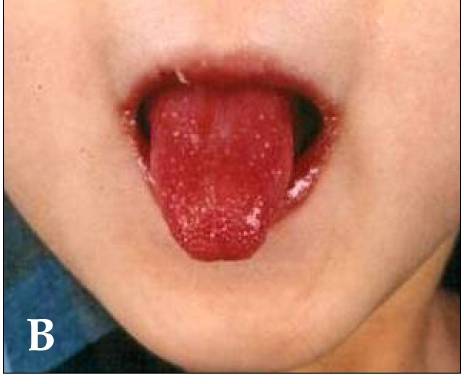
Kawasaki rash
A rash. This normally fades within a week. There is no specific 'Kawasaki rash' - the appearance may be different in different children. Most often there are raised red blotchy areas. It tends to affect a lot of the body, particularly the chest, tummy, back, groins, hands and feet.
Peeling of fingers
Changes in the hands or feet such as mild swelling or redness. The skin on some of the fingers or toes often peels after about 2-3 weeks.
Svullna lymfkörtlar
One or more lymph glands in the neck become swollen.
It's important to remember that some of these symptoms may settle. That means you need to tell your doctor if your child has had any of these symptoms, even if they have gone away on their own.
Children under 1 year old may not have as many other features of Kawasaki disease apart from fever. However, it is very important that they are checked out and referred for tests if the doctor thinks they may have Kawasaki disease.
Also, affected children are commonly very irritable. The diagnosis is based on the above typical group of symptoms. There is no test to confirm the disease. Tests may be done to rule out other diseases that cause similar symptoms, such as mässling, scarlet fever, etc.
Other symptoms may develop in addition to the above. These are less common and include:
Diarré.
Kräkningar.
Magont (buksmärta).
Being off food.
Joint swelling and pains.
Skin going yellow (jaundice).
Typically, fever develops first and then the other symptoms (listed above) develop after a few days. Often, the symptoms that develop after the high temperature (fever) has started develop one after each other rather than all coming on at the same time. This is why the diagnosis may take several days to make after the initial fever starts. In total, symptoms tend to last up to 10 days before easing and going, although complications sometimes develop (see below).
During the illness, some children become very unwell, but others have a mild illness. This may be similar to many common infections that are caused by a virus. However, any child suspected of having Kawasaki disease is normally admitted to hospital, even if they appear to have a mild illness.
What causes Kawasaki disease?
The cause is not known. The symptoms seem rather like many common infections. However, it is not catching (contagious). It is rare for contacts of affected children also to become affected at the same time. This means that the cause is unlikely to be just an infection with a germ such as a bacterium or virus. It may be an unusual or severe reaction to a common virus that usually causes little or no harm to most people. However, no virus or other germ has been proved to cause this disease.
There seems to be some genetic tendency that increases the risk of developing the condition. For example, parents of children with Kawasaki disease are more likely to have had the condition themselves during childhood. Also, brothers and sisters have an increased risk of developing the condition. So, a theory is that affected children may have a genetic make-up that makes them 'overreact' to a common viral infection that does not cause problems in most children.
Kawasaki disease diagnosis
There is no specific test. So it is usually diagnosed on the basis of the typical features. Blood tests may point towards the diagnosis, or be used to rule out other possible diagnoses.
En hjärtscanning (echocardiogram, or echo) is normally done to look for complications (see below). If complications do occur, they usually develop a week or so after the symptoms listed above. If heart complications occur, other types of scans may be used to monitor these over time.
Kawasaki disease treatment
Aspirin. This is one of the few times aspirin is given to children. Aspirin helps to reduce the inflammation in the coronary arteries. It also helps to prevent clots in the blood. The flu jab (influenza vaccination) is usually given to children who have had aspirin treatment if they have not yet had their annual vaccination. This prevents some of the complications which can be caused by aspirin in children.
Immunoglobulin. This is an antibody mixture obtained from human blood. It is given by a slow injection over a few hours (infusion) into the bloodstream. You may see it referred to as IVIg - intravenous immunoglobulin. It is not clear how it works. It may modify the response of the immune system in some way to prevent inflammation in the arteries.
Treatment with immunoglobulin given within 10 days of the onset reduces the chance of heart complications (see below). Without treatment, about 25 in 100 affected children develop an aneurysm. With treatment, this is reduced to fewer than 5 in 100. In some cases the immunoglobulin treatment is not effective and other options are tried.
Other treatments aim to make the child comfortable, such as giving lots to drink and nursing them through the acute feverish illness.
Research continues to search for better treatments. Some treatments which have been tried or are being studied are:
Further research is needed to confirm the role of these medicines in the treatment of Kawasaki disease.
If aneurysms have developed (see complications section below), a specialist heart doctor for children (a paediatric cardiologist) will be involved. In this situation, treatment is needed to prevent heart attacks or other heart problems developing. The child will have regular heart scans to keep an eye on what is happening. He or she may need another medicine to stop a blood clot. Very occasionally an operation is needed on the heart.
Some vaccines - particularly mässling, påssjuka och röda hund (MMR) - may need to be delayed for some months after IVIg treatment, which may cause them to be less effective.
Komplikationer
Hjärtrelaterade problem
Without treatment, up to 1 in 4 children who have Kawasaki disease develop inflammation of the blood vessels to the heart (coronary arteries). This can cause a swelling of a section of a coronary artery, which is called an aneurysm.
A coronary artery aneurysm usually causes no symptoms. Over time it often goes away and the artery returns to normal. However, the wall of an aneurysm is weakened and abnormal. Serious problems may develop in some children with an aneurysm. The most serious is that a clot (thrombosis) may develop in the aneurysm. The muscle of the heart is supplied with oxygen, carried in the blood of these arteries. If a clot develops, the muscle does not get enough oxygen. The heart muscle can then be damaged, causing a heart attack. Currently fewer than 1 in 100 children with Kawasaki disease die of heart problems.
An aneurysm can be detected by a heart scan (an echocardiogram, or echo). If an aneurysm does occur, it starts to develop a week or more after the fever and other acute symptoms begin. Treatment within 10 days of symptoms starting often prevents an aneurysm developing.
Other complications
The aneurysm of a coronary artery is caused by inflammation of the artery (a 'vasculitis'). This swelling can occur in other arteries in various parts of the body, causing aneurysms elsewhere - but this is very rare. Various other rare problems have also been reported in some children with Kawasaki disease.
Kawasaki disease in adults
Kawasaki disease usually affects children. However in rare cases, it can occur in adults. Also, children who have had heart complications due to Kawasaki disease may continue to be affected by these when they reach adulthood. For example, women who had Kawasaki disease as children may not be able to have certain contraceptive pills, and may need specialist advice about whether it is safe for them to become pregnant.
Patientval för General health conditions

Barnhälsa
Pediatrisk vulvovaginit
Paediatric vulvovaginitis is a common cause of soreness or irritation of the genital area of young girls before puberty. It is usually caused by a combination of a natural lack of oestrogen and not wiping properly after going to the toilet. It can usually be alleviated by some simple hygiene and bathing changes. See the separate leaflets called Vulval Problems and Vulvitis (in adults).
av Dr Rachel Hudson, MRCGP
Barnhälsa
Andningssvårigheter hos barn
Children often have coughs and colds which are usually harmless and get better quickly. Children can sometimes also have more serious breathing difficulties that need urgent treatment.
av Dr Hayley Willacy, FRCGP
Vanliga frågor
Varför är det så viktigt att inte fördröja behandlingen av Kawasakis sjukdom inom 10 dagar?
Att få behandling, särskilt med immunoglobulin, inom 10 dagar från symtomens början minskar avsevärt risken för att utveckla hjärtkomplikationer, såsom en aneurysm i kranskärlen. Utan behandling utvecklar cirka 25 av 100 drabbade barn en aneurysm, men med snabb behandling minskas detta till färre än 5 av 100.
Vad händer om ett aneurysm utvecklas i hjärtat på grund av Kawasakis sjukdom?
Om ett aneurysm utvecklas i en kranskärl, orsakar det vanligtvis inga symtom initialt och löser ofta sig själv över tid. Men den försvagade och onormala artärväggen kan leda till allvarliga problem, framför allt en blodpropp som bildas inom aneurysmet. Denna propp kan begränsa blodflödet till hjärtmuskeln, vilket potentiellt kan orsaka skador och en hjärtattack. Om ett aneurysm upptäcks, kommer en barnkardiolog att vara involverad för att hantera tillståndet, vilket kan inkludera regelbundna hjärtskanningar och medicinering för att förhindra blodproppar. I mycket sällsynta fall kan hjärtkirurgi vara nödvändig.
Kan Kawasakis sjukdom smittas från andra människor?
Nej, Kawasakis sjukdom är inte smittsam. Det är sällsynt att personer i nära kontakt med ett drabbat barn också utvecklar sjukdomen. Även om symtomen liknar vanliga infektioner, orsakas det inte direkt av en bakterie eller ett virus som kan överföras från person till person.
Vad är mukokutant lymfkörtelsyndrom?
Mukokutant lymfkörtelsyndrom är ett annat namn som ibland används för Kawasakis sjukdom. Det hänvisar till inblandningen av slemhinnor (som i munnen och ögonen) och lymfkörtlar, vilket är karakteristiska symtom på tillståndet.
Vilka andra behandlingar kan övervägas om den initiala behandlingen med immunoglobulin inte är effektiv?
Om behandling med immunoglobulin inte är effektiv, inkluderar andra alternativ som har prövats eller för närvarande studeras steroider som prednisolon, infliximab, etanercept och metotrexat. Dock behövs ytterligare forskning för att bekräfta dessa läkemedels roll vid behandling av Kawasakis sjukdom.
Vad är den typiska tidsramen för symtom på Kawasakis sjukdom att vara?
Vanligtvis varar symtomen på Kawasakis sjukdom i upp till 10 dagar innan de börjar avta och försvinna. Dock kan komplikationer ibland utvecklas efter denna inledande period.
Vidare läsning och referenser
- Owens AM, Plewa MC; Kawasaki Disease. StatPearls, Jan 2024.
- Kuo HC; Diagnosis, Progress, and Treatment Update of Kawasaki Disease. Int J Mol Sci. 2023 Sep 11;24(18):13948. doi: 10.3390/ijms241813948.
- Rife E, Gedalia A; Kawasaki Disease: an Update. Curr Rheumatol Rep. 2020 Sep 13;22(10):75. doi: 10.1007/s11926-020-00941-4.
- Green J, Wardle AJ, Tulloh RM; Corticosteroids for the treatment of Kawasaki disease in children. Cochrane Database Syst Rev. 2022 May 27;5(5):CD011188. doi: 10.1002/14651858.CD011188.pub3.
- Feber hos barn under 5 år: bedömning och initial hantering; NICE-riktlinjer (senast uppdaterad november 2021)
Om författarenVisa fullständig biografi
Uppdaterad av

Dr Colin Tidy, MRCGP
Allmänläkare, Medicinsk Författare
MBBS, MRCGP, MRCP (Paediatrics), DCH
Dr Colin Tidy är en NHS-läkare, baserad i Oxfordshire.
Om recensentenVisa fullständig biografi

Dr Doug McKechnie, MRCGP
Medicinsk skribent
MA, MBBS, MSc, DRCOG, MRCP(UK), MRCGP(2021), FHEA
Dr Doug McKechnie är en NHS-läkare som arbetar i London. Han arbetar kliniskt på heltid och är också biträdande ansvarig för modulen Klinisk och Professionell Praxis vid University College London Medical School.
Artikelhistorik
Artikeln finns också på Engelska, Tyska, Spanska, Franska, Italienska, Portugisiska, Hindi, Hebreiska, Arabiska, och Svenska.
Nästa granskning ska göras senast: 12 nov 2027
13 nov 2024 | Senaste versionen
Medicinska yrkesverksamma
Looking for more in-depth clinical detail? Our Professional Reference articles are written for doctors, nurses and other healthcare professionals. They include comprehensive clinical guidance, diagnostic information and UK/European evidence summaries. If you need the clinical version, you can read the Professional Reference article on this topic.
Dela dina tankar eller erfarenheter med andra i vår patientgemenskaper.
Enkel tillgång till pålitliga behandlingar och hälsotjänster online.
Common conditions
Get help with common conditions through the NHS, without a GP appointment.





Anmäl dig till Patientens nyhetsbrev
Din veckovisa dos av tydliga, pålitliga hälsoråd - skrivna för att hjälpa dig känna dig informerad, självsäker och i kontroll.
Genom att prenumerera accepterar du våra Sekretesspolicy. Du kan avsluta prenumerationen när som helst. Vi säljer aldrig dina uppgifter.