Vad är ashwagandha? Hälsofördelar, användningar och biverkningar
Granskad av Dr Colin Tidy, MRCGPFörfattad av Heather AinsworthUrsprungligen publicerad 6 Nov 2025
Uppfyller patientens redaktionella riktlinjer
- Ladda nerLadda ner
- Dela
- Language
- Diskussion
- Ljudversion
- Lägg till i föredragna källor på Google
Ashwagandha (Withania somnifera) is a centuries-old herb that’s gaining popularity in today’s wellness world. Also known as Indian ginseng or winter cherry, it’s traditionally been used to help people feel calmer and more energised.
Here we look at what it is used for, evidence-backed benefits, and the side effects you should know about.
With so many of us juggling busy lives and looking for natural ways to support our health, it’s no surprise that ashwagandha is getting a lot of attention for its potential benefits - from easing stress to boosting energy and supporting overall wellbeing.
This ancient herb has been a key part of Ayurvedic medicine for thousands of years, and today, thanks to new scientific research, it is being rediscovered for its wide range of potential health effects.
Whether taken as a supplement, powder, or tea, ashwagandha is now one of the most talked-about herbs in modern wellness circles.
What is ashwagandha used for?
Ashwagandha is known as an adaptogen. This means it helps your body handle physical and mental stress better.
People use ashwagandha to feel calmer, more balanced, and better able to cope with ångest och depression1. Studies also show it may help improve sleep quality2, lower cortisol levels1 (our main stress hormone), and even support muscle recovery after workouts.
Ashwagandha is available as capsules, powders, or liquid extracts, and can be mixed into teas, smoothies, and water, or taken in tablet form.
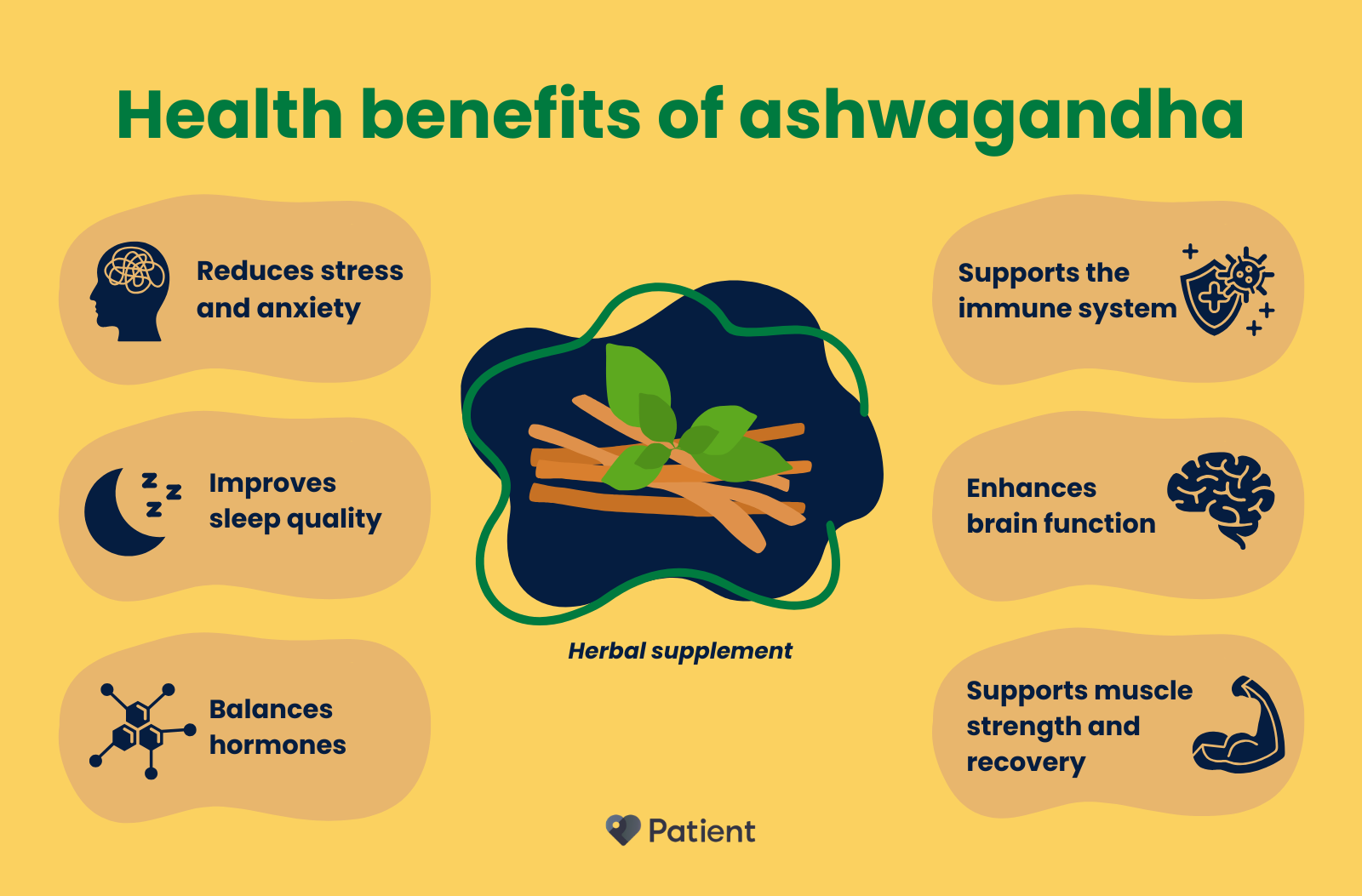
© Patient / Heather Ainsworth
What are the health benefits of ashwagandha?
Ashwagandha has earned its reputation as a powerhouse herb thanks to its wide range of potential health benefits, many of which are now supported by scientific research.
1. Helps reduce stress and anxiety
One of its most well-known effects is its ability to reduce stress and anxiety. As an adaptogen, ashwagandha helps regulate cortisol levels1 leading to a calmer mind and improved emotional balance.
2. Improves sleep
Further research suggests that it can help with sömnlöshet by calming the nervous system and promoting relaxation2. Ashwagandha may not only help people fall asleep faster but also improve the overall quality of sleep.
3. Supports physical performance and muscle recovery
Ashwagandha has been shown to enhance sports performance in athletes and fitness enthusiasts by increasing muscle strength, improving endurance, and promoting faster recovery3.
4. Enhances brain function
Ashwagandha may enhance memory, attention, and overall brain function by reducing oxidative stress and supporting the health of nerve cells4.
5. Balances hormones
Further studies show that it may help boost testosterone levels and fertility, particularly in men, by supporting hormone balance and reproductive health5.
6. Helps maintain a healthy immune system
Ashwagandha’s anti-inflammatory and antioxidant properties contribute to overall immune support6 and may help reduce some inflammation-related conditions over time7.
What are the side effects of ashwagandha?
While ashwagandha is generally considered safe for most people to take short-term (up to 3 months), it’s important to be aware of potential side effects - especially if you're new to using herbal supplements or have taken a large dose.
Common side effects of ashwagandha are:
Diarré.
Känner dig illamående (nausea)
Kräkningar.
Sömnighet.
If side effects continue or worsen, stop taking ashwagandha immediately and contact a healthcare professional for advice.
Note: the long-term safety of ashwagandha is currently unknown and therefore it is advised to only be used short-term.
Who should not take ashwagandha?
Gravida kvinnor – Ashwagandha may stimulate the uterus and potentially cause miscarriage.
Breastfeeding women – There is insufficient research on its safety during breastfeeding and therefore it is advised that breastfeeding women do not take ashwagandha.
People with autoimmune diseases – Ashwagandha can stimulate the immune system, which may worsen autoimmune conditions such as reumatoid artrit, lupus, och multipel skleros.
People taking medications for thyroid, blood pressure, anxiety, or sedatives – ashwagandha may interact with certain medicines, affecting their effectiveness.
As with any supplement, it is best to consult with a healthcare professional before starting ashwagandha - especially if you're on medication, have underlying health conditions, or are unsure about the proper dosage for your needs.
Sammanfattning
Ashwagandha is a traditional Ayurvedic herb known for reducing stress, boosting mental clarity, enhancing physical performance, and supporting sleep and immune health. Studies suggest it can also improve muscle strength, endurance, and recovery.
While generally safe for short-term use, it may cause side effects such as diarrhoea or drowsiness and isn’t suitable for everyone - so it’s important to check with a healthcare professional before trying it.
More research is needed to fully understand its benefits and risks. In the meantime, you might find our article Stresslindrande tips att prova varje dag helpful - it offers expert advice and science-backed strategies to manage stress and anxiety.
Vidare läsning
1. Salve et al: Adaptogenic and Anxiolytic Effects of Ashwagandha Root Extract in Healthy Adults
6. Tharakan et al: Immunomodulatory Effect of Withania somnifera (Ashwagandha) Extract
Patientval för Vitaminer och kosttillskott
Kost och näring
Är svampkaffe verkligen bra för dig?
Svampkaffe har skapat en storm i wellnessvärlden. Känd för sina potentiella fördelar jämfört med vanligt kaffe, innehåller svampkaffe en blandning av tillskottssvampar, var och en påstår sig erbjuda unika hälsofördelar. Men vad är egentligen svampkaffe? Hur tillverkas det? Och lever dess fördelar upp till hypen?
av Victoria Raw
Kost och näring
Vitamin D toxicitet: 5 tecken på att du har tagit för mycket
With the days getting shorter and sunlight in short supply, many of us reach for vitamin D supplements to stay healthy and avoid deficiency. However, taking more than you should isn't good for you and can lead to vitamin D toxicity. Here’s how to recognise the signs of excess vitamin D and how to keep your levels safe.
av Heather Ainsworth
Om författarenVisa fullständig biografi

Heather Ainsworth
SEO Manager
BA (Hons) Business and Marketing, IDM Cert DDM, MHFAider®
Heather is the SEO Manager at Patient and a trained Mental Health First Aider. She is also a regular health writer, covering a wide range of topics with a particular interest in mental wellbeing, women's health, and holistic health.
Om recensentenVisa fullständig biografi

Dr Colin Tidy, MRCGP
Allmänläkare, Medicinsk Författare
MBBS, MRCGP, MRCP (Paediatrics), DCH
Dr Colin Tidy är en NHS-läkare, baserad i Oxfordshire.
Artikelhistorik
Informationen på denna sida är granskad av kvalificerade kliniker.
Artikeln finns också på Engelska, Tyska, Spanska, Franska, Italienska, Portugisiska, Hindi, Hebreiska, Arabiska, och Svenska.
Next review due: 6 Nov 2028
6 Nov 2025 | Ursprungligen publicerad
Författad av:
Heather AinsworthGranskad av
Dr Colin Tidy, MRCGP

Fråga, dela, anslut.
Bläddra i diskussioner, ställ frågor och dela erfarenheter inom hundratals hälsorelaterade ämnen.

Känner du dig sjuk?
Bedöm dina symtom online gratis
Anmäl dig till Patientens nyhetsbrev
Din veckovisa dos av tydliga, pålitliga hälsoråd - skrivna för att hjälpa dig känna dig informerad, självsäker och i kontroll.
Genom att prenumerera accepterar du våra Sekretesspolicy. Du kan avsluta prenumerationen när som helst. Vi säljer aldrig dina uppgifter.
Mer om kost och näring
- 5 värmande sopprecept
- 7 livfulla höstrecept - håll det säsongsbetonat
- Kan röd jästris sänka ditt kolesterol?
- Främjar probiotika hälsosamt hår?
- Fetleverdiet: mat att äta och undvika
- Hälsosamma pannkaksrecept för din diet
- Hur AI kan ge dig idéer för hälsosamma måltider
- UppdateradHow diet affects your heart
- Hur kost kan minska din risk för stroke och hjärtinfarkt
- Hur man undviker att småäta när man är uttråkad
- Hur man blir av med instängd gas: huskurer som fungerar
- Hur man hanterar skuldkänslor kring mat under julen
- Storleken har betydelse: varför våra överdimensionerade portioner bidrar till fetmakrisen
- Hälsofördelarna med kaffe och te
- Den senaste supermaten - vad är uppståndelsen kring mikrogrönt?
- Vad är den antiinflammatoriska kosten?
- Vad är The Fast 800-dieten?
- Vilka vitaminer behöver jag?
- Vad skulle din mage välja i mataffären?
- Varför för mycket socker är dåligt för barn