
Vad är Eatwell-guiden? En förklaring av en balanserad kost
Granskad av Dr Krishna Vakharia, MRCGPFörfattad av Victoria RawUrsprungligen publicerad 25 Oct 2024
Uppfyller patientens redaktionella riktlinjer
- Ladda nerLadda ner
- Dela
- Language
- Diskussion
- Ljudversion
- Lägg till i föredragna källor på Google
Den brittiska regeringens National Diet and Nutrition Survey (NDNS) fann en oroande minskning i människors intag av viktiga näringsämnen i Storbritannien. Även med tillgång till en mängd information om ämnet är många fortfarande osäkra på vad som utgör en balanserad kost. Men om du känner dig överväldigad av kostråd, erbjuder Eatwell Guide en enkel och lättföljd ram för hälsosam kost.
The Eatwell Guide is a useful way of knowing how much of each food group you should eat to stay healthy. The Health and Food Supplement Information Service (HSIS) says that including each of these groups in your diet can help reduce your chance of developing some serious health conditions such as heart disease, diabetes and stroke.
What is the Eatwell Guide?
The Eatwell Guide - created by Public Health England - is a tool that shows the recommended amounts of different food groups needed for a healthy diet. It breaks down the perfect proportions of these groups in a simple, visual way.
Isabelle Spellissy, registered associate nutritionist, Innermost, London, UK explains: "The Eatwell Guide acts as a general framework for a balanced diet, and is designed to be adaptable for the UK population. Its recommendations are broader than some diets - such as the Mediterranean diet - though it still emphasises the importance of eating fruits, vegetables, whole grains and lean protein sources."
Sebnem Unluisler, Chief Longevity Officer and Genetic Engineer, London Regenerative Institute says that the Eatwell Guide provides guidance on the types and amounts of foods you should eat to make sure your body receives all the necessary nutrients.
These foods are divided into five main groups:
Fruits and vegetables - these should make up more than one third of your daily food intake, and include the recommended five portions of fruit and veg a day.
Starchy carbohydrates - such as whole grain bread, brown rice, and potatoes, which should also make up one third.
Proteins - such as beans, pulses, fish, eggs, and lean cuts of meat and mince, with a focus on variety, including plant-based sources.
Dairy or dairy alternatives - should be low-fat or lower-sugar options.
Oils and spreads - to be used in small amounts, prioritising unsaturated fats over saturated and trans fats.
"The Guide advises that you reduce your intake of foods high in fat, sugar, and salt - such as sweets, fried foods, and sugary drinks," says Unluisler. "It encourages you to drink water as your go-to beverage, suggesting low-fat milk or unsweetened drinks as alternatives."
The Eatwell Guide
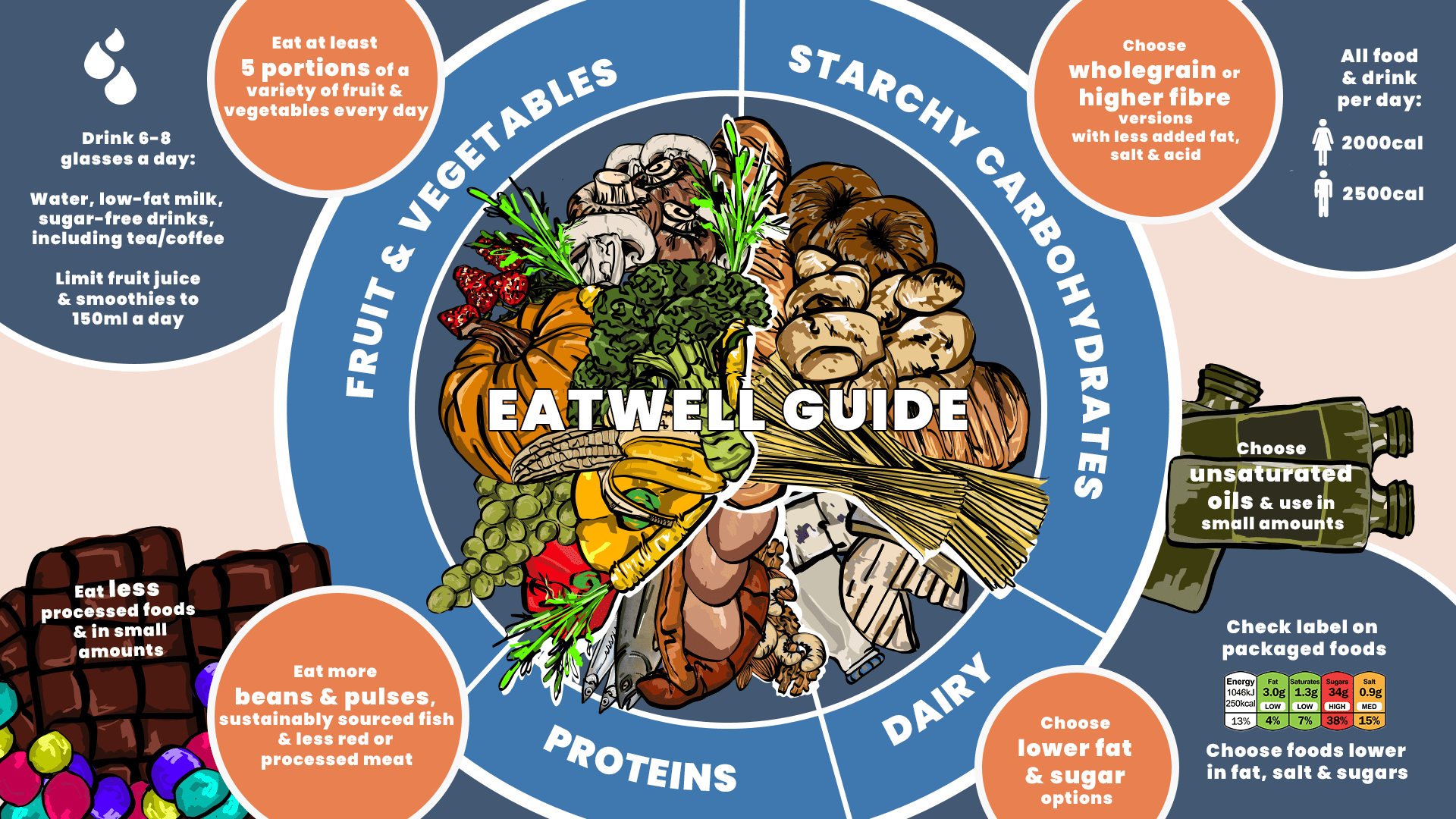
Source: Public Health England in association with the Welsh Government, Food Standards Scotland and the Food Standards Agency in Northern Ireland
Graphic: Ben Hudson
How can the Eatwell Guide help you?
A nutritious diet is crucial for your wellbeing. A balanced intake of nutrients can boost energy, maintain a healthy weight, and keep your body functioning well.
Spellissy says: "By focusing on a variety of food groups, the Eatwell Guide ensures you're getting all the necessary vitamins, minerals, fibre and healthy fats needed for overall wellness."
Healthy ageing plays a crucial role in maintaining cellular health, and reducing your chance of age-related conditions.
Unluisler says: "A high intake of fruits and vegetables - rich in vitamins, minerals and antioxidants - will protect your skin, and reduce the signs of ageing."
According to Unluisler, a balanced intake of proteins, healthy fats and carbohydrates can:
Support heart health.
Lower cholesterol and blood pressure.
Protect your brain against cognitive decline.
Improve mood and mental well-being.
Reduce symptoms of anxiety and depression.
She adds that by encouraging the consumption of whole grains and limiting sugary foods, following the Eatwell Guide can contribute to stable blood sugar levels, reducing the likelihood of insulin resistance and type 2 diabetes.
Who should follow the Eatwell Guide?
The Eatwell Guide is designed to serve a wide range of the UK population, making it a suitable dietary model for most people - including children over two years of age, and older adults.
Spellissy says, that people with specific dietary needs may need to modify certain aspects of the Eatwell Guide to fit their personal nutritional requirements.
People with the following conditions may need to adjust their portions or food choices:
Food allergies or intolerances - such as lactose intolerance.
Medical conditions - such as coeliac disease, kidney disease, diabetes.
"Adjustments might also be required if you're pregnant, an athlete, older, or following a vegetarian or vegan diet," adds Spellissy.
How to use the Eatwell Guide
The Eatwell Guide - Source: Public Health England
Planning meals and controlling portion sizes help make the Eatwell Guide easier to follow, and ensure you're following its daily recommendations.
Spellissy advises you start by filling half your plate with fruits and vegetables - a quarter with starchy carbohydrates, preferably whole grains, and the remaining quarter with protein.
An example of a healthy, well-balanced plate might include:
Seasoned or spiced grilled chicken - protein.
Wholegrain rice - starch.
A colourful variety of roasted vegetables - such as broccoli, carrots and bell peppers.
A glass of water, milk, or a sugar-free drink.
Unluisler recommends the following tips for incorporating healthier foods:
Go for healthy snacks - such as fruit, nuts or yoghurt.
Cut down your intake of processed foods.
Choose healthier cooking methods - such as baking, grilling or steaming.
Try new recipes that incorporate different food groups - these could include stir-fries or salads that combine various vegetables and proteins.
If you have specific dietary needs you should work with a registered dietitian to customise the Eatwell Guide to your requirements. This will ensure you're meeting your nutritional goals, while addressing any health concerns.
Patientval för Kost

Kost och näring
Reducetarian-dieten: hur man äter mindre kött
Om du överväger att minska ditt köttintag - vare sig det är av hälsoskäl, miljöskäl eller etiska skäl - är reducetarian-metoden ett bra sätt att börja. Den uppmuntrar till gradvisa, hållbara minskningar av konsumtionen av animaliska produkter, vilket gör att du kan göra meningsfulla förändringar i din egen takt. Vi pratade med olympisk cykelmedaljör och tidigare världsrekordhållare Switch4Good-grundaren Dotsie Bausch om hennes personliga resa med att äta mindre kött - och hennes praktiska tips för att minska ditt eget intag.
av Victoria Raw

Kost och näring
Vad är Ornish-dieten och kan den förändra din hälsa?
Ornish-dieten är en växtbaserad plan, ursprungligen utvecklad av Dr Dean Ornish som ett sätt att förebygga och vända hjärtsjukdomar. Den främjar en kost låg på fett och hög på fiber, tillsammans med betydande livsstilsförändringar. Den uppmuntrar dig att minska ditt intag av socker och bearbetade livsmedel, samtidigt som du införlivar regelbunden motion och hanterar stress.
av Victoria Raw
Om författarenVisa fullständig biografi

Victoria Raw
Featureförfattare
BA (Hons), Engelsk litteratur
Victoria är en innehållsskribent hos Patient vars specialintressen fokuserar på mentalt välbefinnande, samhälleliga trender och teknikens påverkan på vår hälsa.
Om recensentenVisa fullständig biografi

Dr Krishna Vakharia, MRCGP
Medicinsk chef för hälsa, Optum UK
MBChB, MRCGP(2013), BMedSci (hons), DFSRH, DRCOG, PGDipDerm (Distn)
Dr Krishna Vakharia är en NHS-läkare. Hon är också en regelbunden examinator för den postgraduate Diplom i Praktisk Dermatologi vid Cardiff University samt Chief Medical Officer för hälsa på Optum UK.
Artikelhistorik
Informationen på denna sida är granskad av kvalificerade kliniker.
Artikeln finns också på Engelska, Tyska, Spanska, Franska, Italienska, Portugisiska, Hindi, Hebreiska, Arabiska, och Svenska.
Next review due: 25 Oct 2027
25 Oct 2024 | Ursprungligen publicerad
Författad av:
Victoria RawGranskad av
Dr Krishna Vakharia, MRCGP

Fråga, dela, anslut.
Bläddra i diskussioner, ställ frågor och dela erfarenheter inom hundratals hälsorelaterade ämnen.

Känner du dig sjuk?
Bedöm dina symtom online gratis
Anmäl dig till Patientens nyhetsbrev
Din veckovisa dos av tydliga, pålitliga hälsoråd - skrivna för att hjälpa dig känna dig informerad, självsäker och i kontroll.
Genom att prenumerera accepterar du våra Sekretesspolicy. Du kan avsluta prenumerationen när som helst. Vi säljer aldrig dina uppgifter.
Mer om kost och näring
- 7 järnrika livsmedel att lägga till i din kost
- Är artificiella sötningsmedel verkligen så dåliga för oss?
- Är pumpafrön bra för dig?
- Kan en växtbaserad kost förbättra dina migrän?
- Kan kosttillskott hjälpa till att hantera diabetes?
- Hjälper det att äta kryddstark mat för att gå ner i vikt?
- Linfrön: ett hemligt vapen för kvinnors hälsa?
- Hälsosamma lunchidéer för skolan
- Hur AI kan ge dig idéer för hälsosamma måltider
- UppdateradHur kosten påverkar ditt hjärta
- Hur mycket kött bör vi äta?
- Hur du kan förbättra ditt immunförsvar genom kost och livsstil
- Är gurkmeja bra för dig?
- Äter ditt barn för mycket socker?
- PCOS-diet: Vad man ska äta för att hantera symtom
- Vitamin A-rika livsmedel kan skydda mot hudcancer
- Vad är den nordiska kosten?
- Vad är det rekommenderade kaloriintaget för kvinnor?
- Why keep a food diary?
- Varför ultraprocessad mat är så beroendeframkallande - och hur man minskar konsumtionen