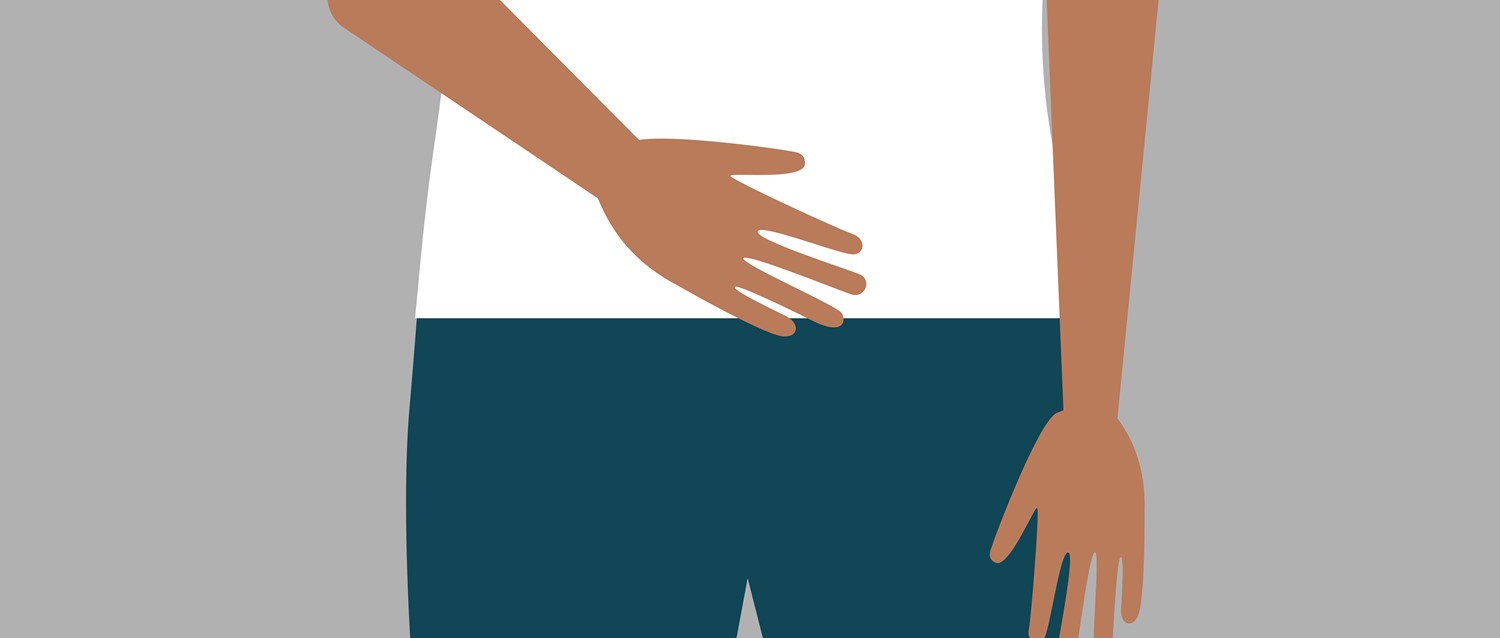
How to treat bowel incontinence
Granskad av Dr Sarah JarvisFörfattad av Abi MillarUrsprungligen publicerad 24 Jan 2018
Uppfyller patientens redaktionella riktlinjer
- Ladda nerLadda ner
- Dela
- Language
- Diskussion
- Ask Patient
- Ljudversion
- Lägg till i föredragna källor på Google
Bowel incontinence (or faecal incontinence) is undeniably a difficult subject to talk about. Despite being very common, the problem tends to be stigmatised, with many sufferers failing to mention it to their medical practitioner. Nearly half of all people with incontinence wait at least five years before seeking help.
Videoval för TarmproblemVideobibliotek
Perhaps because of this secrecy, it is hard to determine exactly how many people are affected. However, one 2014 studie interviewed 500 irritabel tarm (IBS) outpatients about their symptoms. Of these, 285 patients (57%) reported some level of faecal incontinence, with 91 of them stating it happened once a week or more. The study authors concluded: "[Faecal incontinence] is a major problem in IBS and … patients are not necessarily going to disclose it without being specifically asked."
Among patients living with inflammatorisk tarmsjukdom (IBD), the prevalence of incontinence may be even higher. One large study found that ‘at least a quarter, and up to three quarters’ of people with IBD are likely to experience the issue.
"Probably if you actually probed people, around a third of people with IBS and IBD have moments of incontinence," says Dr Simon Smale, a consultant gastroenterologist and medical adviser at IBS-nätverket. "I see people on an almost daily basis who have episodes. But I think it's something that doctors, as a group, don't ask enough about."
For people dealing with accidental bowel leakage, there can be a serious knock-on effect on quality of life. Sufferers often become withdrawn, with implications for their personal and intimate relationships.
"It's a big problem for people," says Dr Smale. "If you're out with friends, you don't want to be in a position where you're having to nip off to the toilet to change a pad - people find that very difficult."
Andra orsaker
Of course, gut troubles aren't the only reason someone might suffer from faecal incontinence. The issue can also be due to nerve damage or damage to the anal sphincters. Since this damage is often sustained during childbirth, women are more commonly affected than men. It is also very common in elderly people, with many associated issues (such as impaired rectal sensation or even neurological damage) becoming more likely as we age.
Many children also experience soiling problems (encopresis), which can be a result of chronic constipation. James Parkin, who suffered from encopresis until the age of 11, has written books for children in this position. He says that, although his bowel issues did not restrict his activities as a child, they undoubtedly damaged his self-esteem.
"Being cleaned up after an accident was a humiliating experience, which only got worse as I got older," he says. "I truly thought that I was the only school-aged child in the whole world who still soiled his pants, and this made me feel increasingly unhappy about the situation."
He adds that he would like to see an end to the stigma around bowel leakage, whatever its causes.
"Parents do not seem to have a problem these days discussing bedwetting, and we should also be able to discuss bowel problems in children," he says. "Ultimately, I would like to see every health professional, teacher and parent, and even children, aware of soiling problems so that sufferers get the help they need."
Dealing with the problem
If you (or your child) are dealing with incontinence, it is important to discuss the situation with your doctor. They will typically conduct a physical examination, and may refer you for further tests such as endoscopy. This will help them pinpoint the cause, determine the most appropriate treatment and rule out more serious problems such as tarmcancer.
For many patients, the solution is a combination of dietary changes, certain exercises, and medications that bulk up the stool. If this fails, you may be a candidate for surgery to repair the anal sphincter, with a colostomy operation being very much a last resort. Children with encopresis may be treated with 'bowel retraining' strategies, and possibly psychotherapy.
If your incontinence is linked to IBS or IBD, a range of strategies may prove useful.
"There are drugs people can use to slow the bowel down, and they're often helpful," says Dr Smale. "For people whose incontinence is clearly precipitated by certain situations, such as eating out, it's about recognising those triggers and finding ways you can manage them, as well as using pads if appropriate. You also need to know where the toilets are - I have patients who plan their shopping around the toilet stops."
The NHS provides continence clinics, which you can visit without referral from a GP. These provide continence pads and products and can give you a clearer idea about your options. You can also purchase a Radar NKS Key från Disability Rights UK och IBS-nätverket, which gives you access to more than 9,000 accessible toilets for disabled people around the UK.
The most important point is not to be ashamed. Bowel incontinence can affect anyone and is an extremely manageable issue if properly tackled.
Patientval för Tarmproblem

Matsmältningshälsa
Hur det är att ha en osynlig funktionsnedsättning
In the UK, there are approximately 13.9 million people living with a disability. But only a small percentage have illnesses that can actually be seen. Those living with an invisible disability, like Crohn's disease or multiple sclerosis, suffer from symptoms every day and, because these aren't visible, they're often subjected to discrimination and misunderstanding when they use disabled bathrooms, parking spaces or priority seats.
av Karen Gordon
Matsmältningshälsa
Kostplan för celiaki
Coeliac disease is a condition that causes inflammation in the lining of part of the gut (called the small intestine). The lining of the gut contains millions of tiny tube-shaped structures called villi. These help food and nutrients to be digested more effectively into the body. But in people with coeliac disease, the villi become flattened as a result of the inflammation. This means that food and nutrients are not so readily digested by the body.
av Dr Colin Tidy, MRCGP
Om författarenVisa fullständig biografi
Författad av

Abi Millar
Frilansjournalist
BA (Hons), MA
Abi är en frilansjournalist med ett särskilt intresse för att skriva om hälsa och medicin.
Om recensentenVisa fullständig biografi

Dr Sarah Jarvis
Klinisk konsult
MA (Cantab), BM, BCh (Oxon), DRCOG, FRCGP, MBE
Efter att ha utbildat sig i medicin vid Cambridge och Oxford blev Dr Sarah Jarvis MBE allmänläkare.
Artikelhistorik
Artikeln finns också på Engelska, Tyska, Spanska, Franska, Italienska, Portugisiska, Hindi, Hebreiska, Arabiska, och Svenska.
24 Jan 2018 | Ursprungligen publicerad
Författad av:
Abi MillarGranskad av
Dr Sarah Jarvis
Dela dina tankar eller erfarenheter med andra i vår patientgemenskaper.
Anmäl dig till Patientens nyhetsbrev
Din veckovisa dos av tydliga, pålitliga hälsoråd - skrivna för att hjälpa dig känna dig informerad, självsäker och i kontroll.
Genom att prenumerera accepterar du våra Sekretesspolicy. Du kan avsluta prenumerationen när som helst. Vi säljer aldrig dina uppgifter.