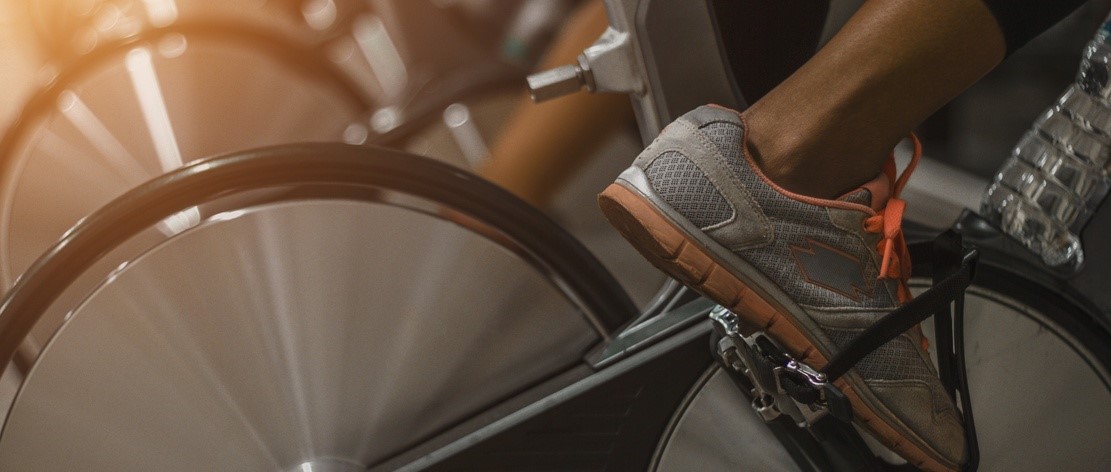
Vad gör spinning med din kropp?
Granskad av Dr Sarah JarvisFörfattad av Amberley DavisUrsprungligen publicerad 14 dec 2021
Uppfyller patientens redaktionella riktlinjer
- Ladda nerLadda ner
- Dela
- Language
- Diskussion
- Ask Patient
- Ljudversion
- Lägg till i föredragna källor på Google
Spinning is currently one of the most popular fitness workouts in the UK. The muscles you use on a spinning bike are some of the largest in your body, making for high-intensity exercise that's also low impact.
Videoval för Träning och fysisk aktivitetVideobibliotek
What is spinning?
These days, walking into a gym expecting to see at least a few spinning bikes is a safe bet. These stationary bikes may look like the indoor equivalent of cycling, but they can offer a far more intense workout in many ways. Forskning suggests that spinning may be even more beneficial than ordinary bicycling for fysisk kondition, blood constituents, and body composition.
While you can choose to cycle on your own, most gyms also offer spinning classes. Typically, these classes last up to an hour, and an instructor sets the pace. You can adjust the tension to make pedalling use more energy, which imitates the uphill or downhill motions of outdoor cycling.
Many people enjoy spinning classes for the motivation provided by the instructor. Classes are normally set to music, and it's also not uncommon for people to go primarily for the fun atmosphere.
Whatever your motivation, spinning can be an effective way to improve your fitness and build your leg muscles. It can also help you to manage your weight if this is your goal.
What happens to your body during spinning?
"Spinning is an effective, low-impact way of improving fitness and helping to manage weight," says personal trainer Laura Williams.
"Your lower body muscles (quadriceps, hamstrings and glutes) all work hard during a spinning session, while standing during a session means your upper body and core all play a role too."
Your lower body muscles
Quadriceps (commonly called 'quads') - the muscles on the fronts of your thighs. Pushing the bike pedals down engages these muscles.
Hamstrings - the muscles on the backs of your thighs. Pushing the bike pedals up engages these muscles.
'Glutes' - the three muscles in your hips and butt (gluteus maximus, gluteus medius and gluteus minimus). You engage these muscles while pedalling and particularly when you accelerate hard.
These leg muscles are some of the largest in your body, which means you're exerting a lot of energy. This kind of high-intensity workout burns a lot of calories and builds up these muscles, which can result in legs that have less fat and are more toned.
Other muscles you engage
Calves - the muscles at the back of your lower legs. These are engaged for the complete rotation of the pedals.
Back and upper body muscles - these muscles support your torso during spinning.
Core - includes both your upper and lower abdominal muscles. Correct posture that holds tension in your core (pulling your belly button in and a straight back) and setting high resistance on the spin bike can engage your core.
Hjärta - this muscular organ also gets a workout during spinning. The heart must work harder to pump enough blood through the body to supply the tissues with nutrients and oxygen.
Exercise bikes also have a weighted disc called a flywheel attached to each pedal. As you pedal, this speeds up and stores the rotational energy that you generate, which gives you momentum. Heavier flywheels require an exertion of energy to get them moving quickly, increasing the workout intensity.
Williams points out the added benefits of spinning with weights: "Even small weights can add to intensity, helping to strengthen upper and lower body muscles even more. They will also help elevate the heart rate further, which will continue to increase cardiovascular fitness over time."
What are the main benefits of spinning?
Spinning builds muscle
The most obvious benefit of spinning is toned leg muscles. This happens as our body composition improves and the ratio of fat decreases and muscle mass increases. As we exercise, our engaged muscles get micro-tears. A natural process called muscle protein synthesis then occurs, repairing and rebuilding the muscles to better adapt them which increases muscle mass.
Spinning may also help to tone your back and upper body because the position you need to maintain on a spin bike creates some exertion on the muscles in these regions.
Spinning decreases fat mass
Engaging these muscles means we use a lot of energy during spinning. Many spin classes incorporate high-intensity interval training (HIIT) which is believed to increase how many calories you burn. This involves alternating between heavy and less heavy resistance pedalling, so your heart rate changes throughout the class.
Losing weight isn't synonymous with being healthy. However, if you have a lot of excess body fat you might be at greater risk of developing health complications such as typ 2 diabetes.
Spinning improves heart health
Spinning can be a great cardiovascular workout. That is to say, our hearts have to work harder during a spinning session which can improve our overall heart health. With regular spinning, our muscles become more efficient at drawing oxygen from our blood, which decreases the physical demand on the heart over time.
Forskning has found that people who cycle are less likely to have heart problems than those who don't, including hjärtattacker och hjärtsjukdom.
This is because regular spinning can lower blodtryck, lower stress hormones and raise our 'good' kolesterol. This decreases the risk of inflammation in the body and reduces our chance of developing type 2 diabetes.
En studie has also found that one hour of spinning triggers the release of blood chemicals associated with heart stress or changes. The research suggests that these could lead to blood vessel renewal and repair.
Patientval för Träning och fysisk aktivitet
Hälsosamt liv
Do 30-day fitness challenges actually work?
30-day fitness challenges have rocketed in popularity over recent years, becoming more accessible thanks to social media and platforms such as YouTube. But is it possible to change your body in just 30 days and do these challenges offer other benefits?
av Emily Jane Bashforth
Hälsosamt liv
Hur man springer 10 km utan erfarenhet
At the beginning of the year, I was clinging on to my New Year's resolution of getting in shape and somehow signed myself up for a 10 kilometre race around Kew Gardens in London. What could go wrong? For one, I had no experience and no idea where to start. Luckily, I sought advice from some experts. Pairing this with my own training experience, here are a few tips to see you through your first 10k.
by Georgia Gallant
Om författarenVisa fullständig biografi
Författad av

Amberley Davis
Seniorförfattare
BA (Hons), CPD
Amberley är en senior skribent hos Patient och har skrivit omfattande om en rad olika hälso- och välbefinnandeämnen.
Om recensentenVisa fullständig biografi

Dr Sarah Jarvis
Klinisk konsult
MA (Cantab), BM, BCh (Oxon), DRCOG, FRCGP, MBE
Efter att ha utbildat sig i medicin vid Cambridge och Oxford blev Dr Sarah Jarvis MBE allmänläkare.
Artikelhistorik
Artikeln finns också på Engelska, Tyska, Spanska, Franska, Italienska, Portugisiska, Hindi, Hebreiska, Arabiska, och Svenska.
14 dec 2021 | Ursprungligen publicerad
Författad av:
Amberley DavisGranskad av
Dr Sarah Jarvis
Dela dina tankar eller erfarenheter med andra i vår patientgemenskaper.
Anmäl dig till Patientens nyhetsbrev
Din veckovisa dos av tydliga, pålitliga hälsoråd - skrivna för att hjälpa dig känna dig informerad, självsäker och i kontroll.
Genom att prenumerera accepterar du våra Sekretesspolicy. Du kan avsluta prenumerationen när som helst. Vi säljer aldrig dina uppgifter.