What is exfoliation, and why is it important?
Granskad av Dr Colin Tidy, MRCGPSenast uppdaterad av Lynn StephenSenast uppdaterad 24 Aug 2026
Uppfyller patientens redaktionella riktlinjer
- Ladda nerLadda ner
- Dela
- Language
- Diskussion
- Ljudversion
- Lägg till i föredragna källor på Google
Nowadays, a skincare routine can contain a lot of steps, but skin gurus still consider 'cleanse, exfoliate, moisturise' to be the essential mantra if you are seeking a healthy complexion. What exactly is exfoliation, and should everyone be doing it?
What does exfoliating do?
Dr Osman Bashir Tahir, Medical Director at Halcyon Aesthetics, London, explains that exfoliation means removing dead skin cells from the surface of your skin, using either a chemical, granular substance, or exfoliation tool.
"Your skin does shed dead skin cells," he says. "But it doesn't always get rid of them all."
No matter your skin type, shedding these cells can improve the appearance and health of your skin. According to Tahir, exfoliating will help your skin to look brighter, but it also helps absorption of topical skin care products - ones you apply directly on to your skin - which will make them more effective.
Dull-looking skin is something that we're all more susceptible to as we age. Exfoliating can help your skin look younger for longer.
Is exfoliating good for acne?
"Yes, it can be," says Tahir. "Exfoliating can help prevent breakouts by unclogging pores. However, it can also exacerbate akne if performed too vigorously or with incorrect methods."
He advises choosing a product that is gentle but also effective if you have acne-prone skin.
Physical versus chemical exfoliation
Not all products that exfoliate are created equal, and it's helpful to know which are more gentle, particularly if you have acne-prone skin. This is where physical versus chemical exfoliation comes in.
A physical exfoliant - also known as mechanically exfoliating products. Many face and body scrubs contain exfoliating particles that give them a grainy texture. These 'grains' physically slough off dead skin cells on your skin's outermost surface (epidermis). Likewise, brushes and sponges designed with rough bristles work in a similar way, manually lifting off dead skin cells as you rub.
A chemical exfoliant - relies on chemicals to break the bonds between dead skin cells in order to loosen and remove them. Chemical ingredients can be included in facial cleansers, toners, gels, peels, and masks.
If you have acne or sensitive skin, Tahir recommends using a chemical exfoliant.
"Physical exfoliants may do more harm than good as they may irritate your skin," he says.
Topical exfoliants
Massaging an exfoliant in a circular motion directly on to your skin is by far the most common and budget-friendly option. If cost is a factor, many affordable high street brands offer physical exfoliators in the form of scrubs, brushes, and sponges.
In contrast, topical chemical products are smooth in texture and come in a range of price tags. But you needn't pay an arm and a leg for a good product. The key is to check the label for the star exfoliating ingredients - alpha hydroxy acids (AHAs) and beta hydroxy acids (BHAs). These aren't as scary as they sound.
AHAs - is glycolic acid an exfoliant?
AHAs are water-soluble acids derived from plants and work well as natural exfoliants. Glycolic acid is the most popular AHA in skincare, gently dissolving bonds between cells while allowing your skin to stay moisturised. It also boosts collagen production, creating a smoother surface, and reducing signs of ageing.
BHAs - is salicylic acid an exfoliant?
Also extracted from plants, BHAs are oil-soluble acids that exfoliate the skin in a similar way to AHAs. They also unclog dirt and oil (sebum) from pores, making them great for tackling oily skin and acne. Salicylic acid is a BHA that's used in many skincare products. Its antibacterial and anti-inflammatory properties make it an ideal choice for acne-prone skin.
Facial peels
Exfoliating your skin needn't break the bank, but facial peels may be a good choice if you have certain skin issues and if you have the money to spend.
Chemical peels
Chemical peeling is usually carried out by a skincare professional (dermatologist) who applies a chemical solution to remove the top layer of skin cells. This penetrates deeper than topical products, making it a super exfoliant that can address a number of skin imperfections.
"Face peels can be used to offer very light rejuvenation right through to effectively treating acne scarring and patches of darker skin (pigmentation)," says Tahir. It all depends on the level of depth you choose:
Which depth is right for you?
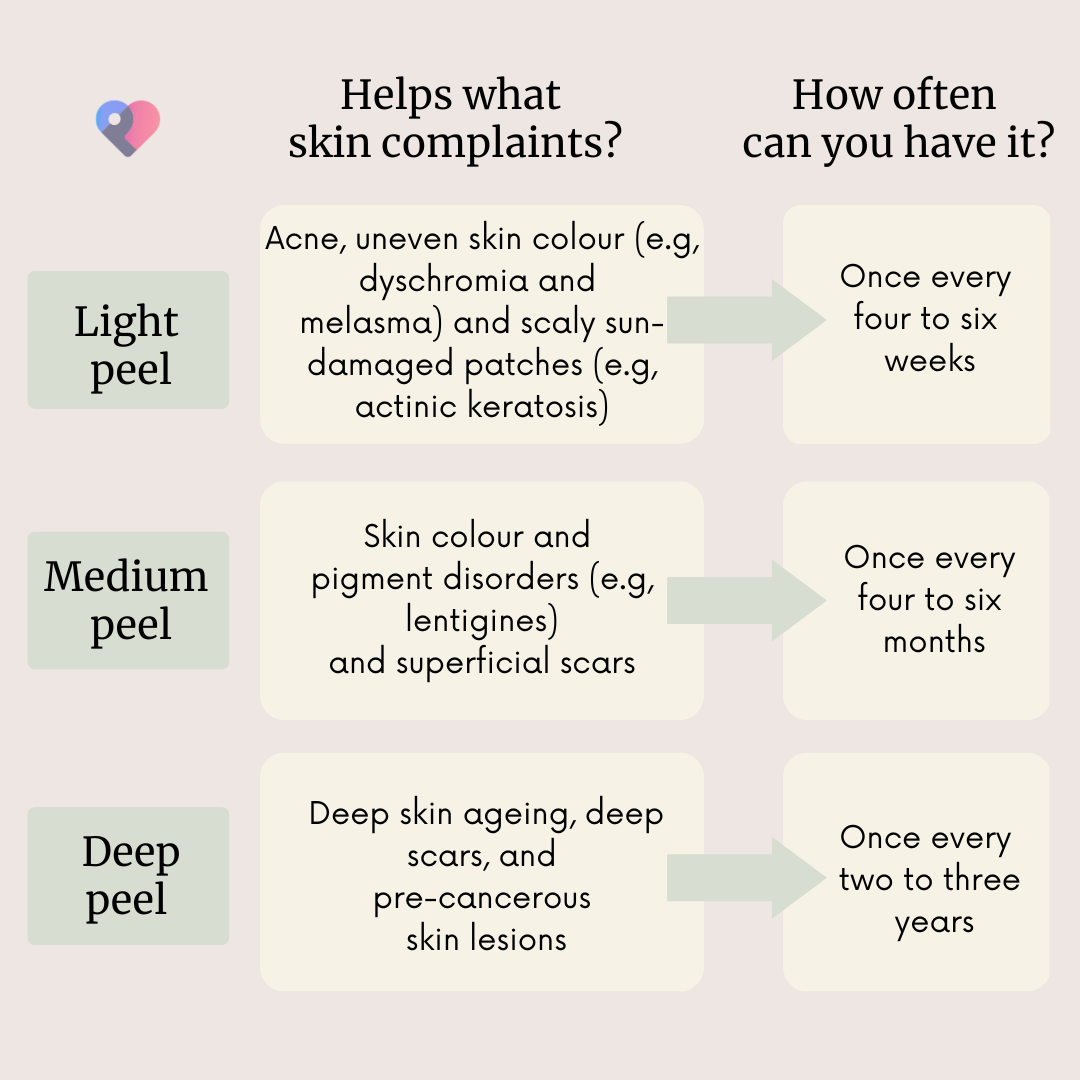
According to Tahir, depending on the type and strength of each chemical peel, you can expect to experience redness and swelling which can last anywhere from just a couple of hours to two weeks.
As chemical peels can irritate your skin, it's important that your dermatologist finds the right peel for you. There are many factors they should consider, including your medical history and skin tone. For example, if you have a dark skin tone you are more likely to experience inflammation and should avoid deep chemical peels.
Laser peels
Tahir says that there is some degree of overlap between laser and chemical peels but there are also major differences. For example, recovery following laser peels is often quicker because there is no chance of adverse chemical reactions.
"Technological advancements with laser peel treatments can now leave people with no downtime and no pain," he notes.
This said, the decision to have a laser or chemical peel will ultimately come down to the skin issues you want to address. Chemical peels may be more appropriate for uneven skin colour and other surface-level issues. Tahir explains that laser peels are better at improving your overall skin texture as well as treating deeper skin damage - such as wrinkles, scars, redness, melasma, spider veins, acne, and acne scarring.
Facial peel side effects
A word of caution - because they expose new skin, all facial peels leave you more vulnerable to sun damage from ultraviolet (UV) rays. Be sure to apply a high sun protection factor (SPF) sunscreen when out and about.
Peels that are tailored to your skin are generally considered safe. However, there can sometimes be complications.
Dessa inkluderar:
Infektion.
Patches of darker skin (hyperpigmentation).
Patches of lighter skin (hypopigmentation).
Scarring.
How to exfoliate - Tahir's tips
How often should I exfoliate?
If you exfoliate with topical products such as scrubs, Tahir does not recommend exfoliating more than once or twice a week. You should use facial peels even less frequently, as noted in the table above.
How to exfoliate your face
Tahir says: "For your face, I do recommend chemical and laser peels as the best option, but these are of course not always affordable.
"If you're using a scrub at home, the key is not to rub it in too harshly. You want to massage your skin gently in small circular motions, otherwise it will hurt. Scrubs have the potential to create small tears in the skin."
How to exfoliate legs with ingrown hairs
Tahir says: "Keeping skin exfoliated can help prevent ingrown hairs by ensuring hair doesn't grow sideways into your skin. For legs, I would recommend using an exfoliating glove to wash away dead skin and clear out pores before you shave."
How to exfoliate your scalp
Tahir says: "If you want to exfoliate your scalp, I recommend doing it on wet, shampooed hair. However, you shouldn't exfoliate your scalp more than once or twice a week as it removes oil, and it may lead to an overproduction of oil."
Patientval för Hudvård
Hud, nagel och hårhälsa
Retinol: skincare benefits, side effects and more
Oavsett din ålder, om du någonsin har funderat på hudvård, har du förmodligen hört talas om retinol. Men om du är osäker på exakt vad det är - eller varför du kanske behöver veta - är du inte ensam. För att förvirra saker ytterligare används termen 'retinol' i liknande sammanhang som 'retinoid' och 'retinsyra' bland andra. Här är en översikt över retinol, dess fördelar för huden och saker att tänka på innan du lägger till det i din hudvårdsrutin.
av Lynn Stephen

Hud, nagel och hårhälsa
Vad gör C-vitaminserum?
A good quality vitamin C serum can be a great addition to your skincare routine. With so many on the market, here's how to pick one with the most effective, scientifically-backed ingredients.
av Victoria Raw
Om författarenVisa fullständig biografi
Uppdaterad av

Lynn Stephen
Innehållsutvecklare
MA (Hons)
Lynn joined Patient in 2023 and her role includes checking all the professional leaflets, patient information leaflets and medicine leaflets, to ensure consistency of spelling, grammar, reference material and brand style, working with the medical authors and clinical director to coordinate the authoring and peer reviewing of the leaflets.
Författad av

Amberley Davis
Seniorförfattare
BA (Hons), CPD
Amberley är en senior skribent hos Patient och har skrivit omfattande om en rad olika hälso- och välbefinnandeämnen.
Om recensentenVisa fullständig biografi

Dr Colin Tidy, MRCGP
Allmänläkare, Medicinsk Författare
MBBS, MRCGP, MRCP (Paediatrics), DCH
Dr Colin Tidy är en NHS-läkare, baserad i Oxfordshire.
Artikelhistorik
Artikeln finns också på Engelska, Tyska, Spanska, Franska, Italienska, Portugisiska, Hindi, Hebreiska, Arabiska, och Svenska.
Nästa granskning: 24 aug 2027
24 Aug 2026 | Senaste versionen
9 Aug 2022 | Ursprungligen publicerad
Författad av:
Amberley Davis
Delta i konversationen
Dela dina tankar eller erfarenheter med andra i vår patientgemenskaper.

Fråga, dela, anslut.
Bläddra i diskussioner, ställ frågor och dela erfarenheter inom hundratals hälsorelaterade ämnen.

Känner du dig sjuk?
Bedöm dina symtom online gratis
Anmäl dig till Patientens nyhetsbrev
Din veckovisa dos av tydliga, pålitliga hälsoråd - skrivna för att hjälpa dig känna dig informerad, självsäker och i kontroll.
Genom att prenumerera accepterar du våra Sekretesspolicy. Du kan avsluta prenumerationen när som helst. Vi säljer aldrig dina uppgifter.