Age-related hearing loss
Senast uppdaterad 8 Sept 2020
Uppfyller patientens redaktionella riktlinjer
- Ladda nerLadda ner
- Dela
- Language
- Diskussion
- Ljudversion
- Lägg till i föredragna källor på Google
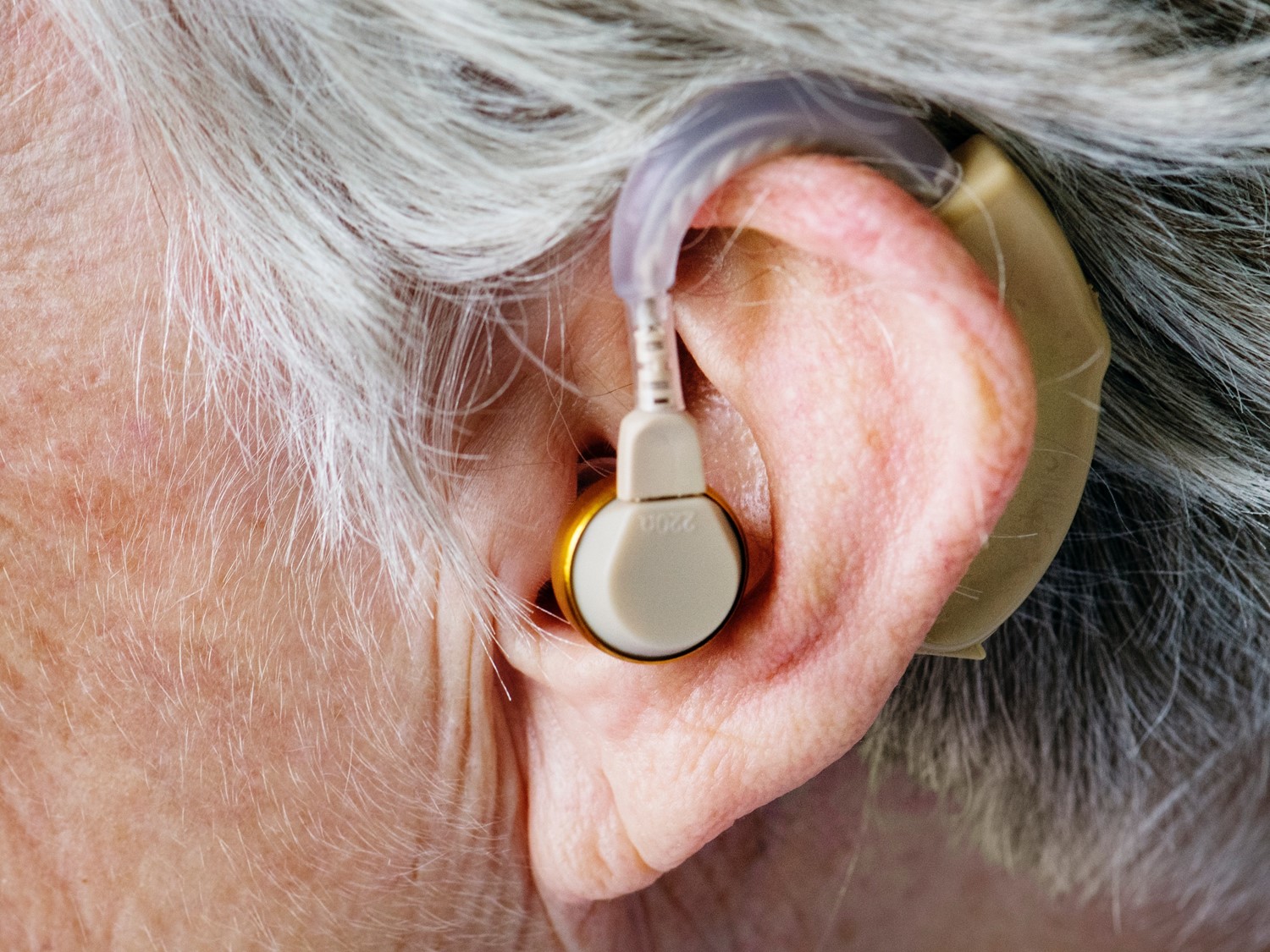
Age-related hearing loss (also known as presbycusis) is a decrease in hearing ability that happens with age. In most cases, the hearing loss affects both ears. It can begin as early as a person's thirties or forties and worsens gradually over time.
Beskrivning
Age-related hearing loss (also known as presbycusis) is a decrease in hearing ability that happens with age. In most cases, the hearing loss affects both ears. It can begin as early as a person's thirties or forties and worsens gradually over time.
Age-related hearing loss first affects the ability to hear high-frequency sounds, such as speech. Affected people find it increasingly difficult to understand what others are saying, particularly when there is background noise (such as at a party). However, because the hearing loss is gradual, many people do not realize they cannot hear as well as they used to. They may turn up the television volume or start speaking louder without being aware of it.
As the hearing loss worsens, it affects more frequencies of sound, making it difficult to hear more than just speech. Determining where a sound is coming from (localization) and identifying its source become more challenging. Some affected individuals also experience a ringing sensation in the ears (tinnitus) or dizziness and problems with balance (presbystasis).
Age-related hearing loss often impacts a person's quality of life. Because affected individuals have trouble understanding speech, the condition affects their ability to communicate. It can contribute to social isolation, depression, and loss of self-esteem. Age-related hearing loss also causes safety issues if individuals become unable to hear smoke alarms, car horns, and other sounds that alert people to dangerous situations.
Inheritance patterns
The source lists the following possible inheritance patterns: Pattern unknown. More than one pattern can apply in different cases.
Related genes
Other names
Age-related hearing impairment
Deafness due to old age
Hearing loss, age-related
Old-aged sensorineural hearing impairment
Presbyacusia
Presbycusis
Related patient information and medicines
Patient information leaflet
Hörselnedsättning
In this article we talk about the different causes of hearing loss, their different characteristics and what you can do about them. See the separate leaflet called Otosclerosis for more details Causes of sensorineural hearing loss: the cochlea Hearing loss affecting ... Most people over the age of 60 develop hearing loss to some degree. A hearing.

Patient information leaflet
Hörselnedsättning hos äldre personer
Most people over the age of 60 develop some hearing loss. The severity can vary greatly from person to person. If you are concerned about your hearing, don't suffer in silence - discuss this with your doctor. What is presbyacusis. Presbyacusis (sometimes written presbycusis) is the medical term for hearing loss that occurs in older people as they.

Patient information leaflet
Öronvärk
This leaflet provides an overview of some of the more common problems related to the ears. It will direct you towar... The most common cause for this is age-related changes in the ear. This occurs commonly along with age-related hearing loss. Sometimes it is caused by another condition, such as Ménière's disease , noise damage or ear infections..

Patient information leaflet
Tinnitus
Tinnitus is a noise such as a ringing or buzzing that you can hear, but the noise is not caused by anything outside your ear. What is tinnitus. The most common situation is that it often comes as an unwanted 'added extra' when you develo... Common causes of tinnitus include age-related hearing loss, or by being exposed to a noise - like working in.

Patient information leaflet
Otosclerosis
Otosclerosis is a condition of the middle ear and mainly affects the tiny stirrup (stapes) bone. It causes gradual hearing loss. Otosclerosis is a common cause of hearing loss. Hearing loss Hearing loss is the main symptom of otosclerosis. Without treatment, in time, the affected ears often become totally deaf. The hearing loss is usually of lower.

Patient information leaflet
Hörseltester
There are various different ways to test hearing, depending on the age of the person involved and the type of hearing loss. The medical term for hearing tests is audiometry. Note : the information below is a general guide only. Different variations of this reward-based test are used as a child becomes older and finds it easier to communicate..
Vidare läsning och referenser
- Age-related hearing loss; MedlinePlus, National Library of Medicine.
- Atcherson SR, Nagaraj NK, Kennett SE, Levisee M. Overview of Central Auditory Processing Deficits in Older Adults. Semin Hear. 2015 Aug;36(3):150-61. doi: 10.1055/s-0035-1555118.
- Bottger EC, Schacht J. The mitochondrion: a perpetrator of acquired hearing loss. Hear Res. 2013 Sep;303:12-9. doi: 10.1016/j.heares.2013.01.006. Epub 2013 Jan 27.
- Ciorba A, Hatzopoulos S, Bianchini C, Aimoni C, Skarzynski H, Skarzynski PH. Genetics of presbycusis and presbystasis. Int J Immunopathol Pharmacol. 2015 Mar;28(1):29-35. doi: 10.1177/0394632015570819.
- Falah M, Farhadi M, Kamrava SK, Mahmoudian S, Daneshi A, Balali M, Asghari A, Houshmand M. Association of genetic variations in the mitochondrial DNA control region with presbycusis. Clin Interv Aging. 2017 Mar 3;12:459-465. doi: 10.2147/CIA.S123278. eCollection 2017.
- Gates GA, Mills JH. Presbycusis. Lancet. 2005 Sep 24-30;366(9491):1111-20. doi: 10.1016/S0140-6736(05)67423-5.
- Kidd Iii AR, Bao J. Recent advances in the study of age-related hearing loss: a mini-review. Gerontology. 2012;58(6):490-6. doi: 10.1159/000338588. Epub 2012 Jun 15.
- Manche SK, Jangala M, Putta P, Koralla RM, Akka J. Association of oxidative stress gene polymorphisms with presbycusis. Gene. 2016 Nov 30;593(2):277-83. doi: 10.1016/j.gene.2016.08.029. Epub 2016 Aug 22.
- Uchida Y, Sugiura S, Sone M, Ueda H, Nakashima T. Progress and prospects in human genetic research into age-related hearing impairment. Biomed Res Int. 2014;2014:390601. doi: 10.1155/2014/390601. Epub 2014 Jul 22.
- Yamasoba T, Lin FR, Someya S, Kashio A, Sakamoto T, Kondo K. Current concepts in age-related hearing loss: epidemiology and mechanistic pathways. Hear Res. 2013 Sep;303:30-8. doi: 10.1016/j.heares.2013.01.021. Epub 2013 Feb 16.
Artikelhistorik
Artikeln finns också på Engelska, Tyska, Spanska, Franska, Italienska, Portugisiska, Hindi, Hebreiska, Arabiska, och Svenska.
8 Sept 2020 | Senaste versionen
1 Oct 2017 | Ursprungligen publicerad
Delta i konversationen
Dela dina tankar eller erfarenheter med andra i vår patientgemenskaper.

Fråga, dela, anslut.
Bläddra i diskussioner, ställ frågor och dela erfarenheter inom hundratals hälsorelaterade ämnen.
Anmäl dig till Patientens nyhetsbrev
Din veckovisa dos av tydliga, pålitliga hälsoråd - skrivna för att hjälpa dig känna dig informerad, självsäker och i kontroll.
Genom att prenumerera accepterar du våra Sekretesspolicy. Du kan avsluta prenumerationen när som helst. Vi säljer aldrig dina uppgifter.