Aldosterone-producing adenoma
Senast uppdaterad 1 feb. 2023
Uppfyller patientens redaktionella riktlinjer
- Ladda nerLadda ner
- Dela
- Language
- Diskussion
- Ljudversion
- Lägg till i föredragna källor på Google
An aldosterone-producing adenoma is a noncancerous (benign) tumour that develops in an adrenal gland, which is a small hormone-producing gland located on top of each kidney. In most cases, individuals develop a single tumour in one of the adrenal glands. The adrenal tumour produces too much of the hormone aldosterone, which is a condition known as primary hyperaldosteronism. Aldosterone helps regulate the body's fluid levels and blood pressure by controlling the amount of salt retained by the kidneys. Excess aldosterone causes the kidneys to retain more salt than normal, which increases the body's fluid levels and blood pressure. People with an aldosterone-producing adenoma may develop severe high blood pressure (hypertension), and they have an increased risk of heart attack, stroke, or an irregular heart beat (atrial fibrillation).
Beskrivning
An aldosterone-producing adenoma is a noncancerous (benign) tumour that develops in an adrenal gland, which is a small hormone-producing gland located on top of each kidney. In most cases, individuals develop a single tumour in one of the adrenal glands. The adrenal tumour produces too much of the hormone aldosterone, which is a condition known as primary hyperaldosteronism. Aldosterone helps regulate the body's fluid levels and blood pressure by controlling the amount of salt retained by the kidneys. Excess aldosterone causes the kidneys to retain more salt than normal, which increases the body's fluid levels and blood pressure. People with an aldosterone-producing adenoma may develop severe high blood pressure (hypertension), and they have an increased risk of heart attack, stroke, or an irregular heart beat (atrial fibrillation).
Inheritance patterns
The source lists the following possible inheritance patterns: Not inherited. More than one pattern can apply in different cases.
Related genes
Other names
Aldosterone-secreting adenoma
Aldosteronoma
Conn adenoma
Primary aldosteronism due to Conn adenoma
Related patient information and medicines
Patient information leaflet
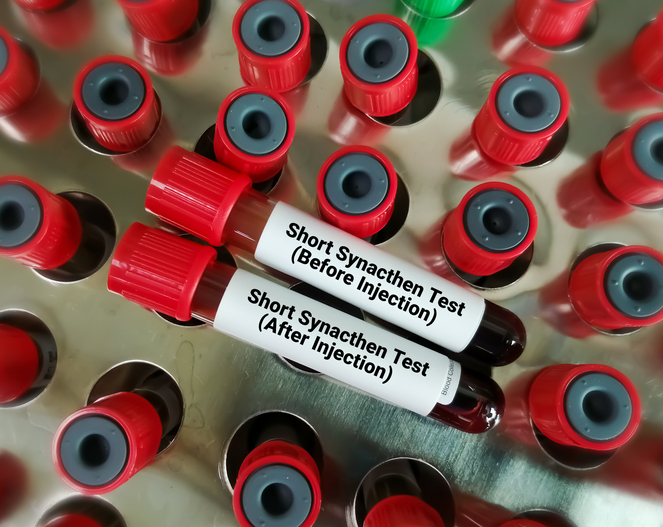
Synacthen-test
A synacthen test checks the function of the adrenal glands. Note : the information below is a general guide only. Cells in the outer part of the adrenal glands (the adrenal cortex) make the chemicals (hormones) cortisol, aldosterone and androgens. Cortisol is a steroid hormone and is vital for health. Helping to balance insuli... Aldosteron is a.

Patient information leaflet
Cushings syndrom
Cushing's syndrome is caused by too high a level of glucocorticoid in the body. There are a number of causes of Cushing's syndrome. These include the following: Pituitary adenoma - Cushing's disease A pituitary adenoma is a small, non-cancerous (benign) tumour in the pituitary gland. It is usually less than 1 cm in size and is made of abnormal.

Patient information leaflet
Kongenital binjurebarkshyperplasi
Congenital adrenal hyperplasia (CAH) is a condition affecting the level of cortisol, a hormone produced by the adrenal gland. Cells in the outer part of the adrenals (the adrenal cortex) make the hormones cortisol and aldosterone. One of these is testosterone, a male hormone, which causes the male-like (virilising) features seen in the condition..
Patient information leaflet
Akromegali
What is acromegaly. It is crucial to recognise and treat this disease early to prevent serious health issues. What causes acromegaly. In nearly everyone with acromegaly, the excess hormone comes from a small growth (tumour) in the pituitary gland (a pea-sized gland below the brain). This is a non-cancerous (benign) growth called a pituitary.
Patient information leaflet
Addisons sjukdom
Treatment is with replacement hormone tablets which you need to take every day. A hormone is a chemical which is made in one part of the body but passes into the bloodstream and has effects on other parts of the body. Cells in the outer layer of the adrenal gland (adrenal cortex) make the hormones cortisol, aldosterone, and androgens. The amount.
Patient information leaflet
Binjureutmattning
They are s... The adrenal glands produce hormones, of which the most important ones are: Cortisol, which has lots of very important functions, such as controlling blood sugar, controlling salt levels in the blood, and affecting the function of the immune function. Aldosterone, which is very important for controlling salt (sodium and potassium).
Vidare läsning och referenser
- Aldosterone-producing adenoma; MedlinePlus, National Library of Medicine.
- Akerstrom T, Maharjan R, Sven Willenberg H, Cupisti K, Ip J, Moser A, Stalberg P, Robinson B, Alexander Iwen K, Dralle H, Walz MK, Lehnert H, Sidhu S, Gomez-Sanchez C, Hellman P, Bjorklund P. Activating mutations in CTNNB1 in aldosterone producing adenomas. Sci Rep. 2016 Jan 27;6:19546. doi: 10.1038/srep19546.
- Azizan EA, Poulsen H, Tuluc P, Zhou J, Clausen MV, Lieb A, Maniero C, Garg S, Bochukova EG, Zhao W, Shaikh LH, Brighton CA, Teo AE, Davenport AP, Dekkers T, Tops B, Kusters B, Ceral J, Yeo GS, Neogi SG, McFarlane I, Rosenfeld N, Marass F, Hadfield J, Margas W, Chaggar K, Solar M, Deinum J, Dolphin AC, Farooqi IS, Striessnig J, Nissen P, Brown MJ. Somatic mutations in ATP1A1 and CACNA1D underlie a common subtype of adrenal hypertension. Nat Genet. 2013 Sep;45(9):1055-60. doi: 10.1038/ng.2716. Epub 2013 Aug 4.
- Beuschlein F, Boulkroun S, Osswald A, Wieland T, Nielsen HN, Lichtenauer UD, Penton D, Schack VR, Amar L, Fischer E, Walther A, Tauber P, Schwarzmayr T, Diener S, Graf E, Allolio B, Samson-Couterie B, Benecke A, Quinkler M, Fallo F, Plouin PF, Mantero F, Meitinger T, Mulatero P, Jeunemaitre X, Warth R, Vilsen B, Zennaro MC, Strom TM, Reincke M. Somatic mutations in ATP1A1 and ATP2B3 lead to aldosterone-producing adenomas and secondary hypertension. Nat Genet. 2013 Apr;45(4):440-4, 444e1-2. doi: 10.1038/ng.2550. Epub 2013 Feb 17.
- Choi M, Scholl UI, Yue P, Bjorklund P, Zhao B, Nelson-Williams C, Ji W, Cho Y, Patel A, Men CJ, Lolis E, Wisgerhof MV, Geller DS, Mane S, Hellman P, Westin G, Akerstrom G, Wang W, Carling T, Lifton RP. K+ channel mutations in adrenal aldosterone-producing adenomas and hereditary hypertension. Science. 2011 Feb 11;331(6018):768-72. doi: 10.1126/science.1198785.
- Fernandes-Rosa FL, Williams TA, Riester A, Steichen O, Beuschlein F, Boulkroun S, Strom TM, Monticone S, Amar L, Meatchi T, Mantero F, Cicala MV, Quinkler M, Fallo F, Allolio B, Bernini G, Maccario M, Giacchetti G, Jeunemaitre X, Mulatero P, Reincke M, Zennaro MC. Genetic spectrum and clinical correlates of somatic mutations in aldosterone-producing adenoma. Hypertension. 2014 Aug;64(2):354-61. doi: 10.1161/HYPERTENSIONAHA.114.03419. Epub 2014 May 27.
- Lenzini L, Rossitto G, Maiolino G, Letizia C, Funder JW, Rossi GP. A Meta-Analysis of Somatic KCNJ5 K(+) Channel Mutations In 1636 Patients With an Aldosterone-Producing Adenoma. J Clin Endocrinol Metab. 2015 Aug;100(8):E1089-95. doi: 10.1210/jc.2015-2149. Epub 2015 Jun 11.
- Savard S, Amar L, Plouin PF, Steichen O. Cardiovascular complications associated with primary aldosteronism: a controlled cross-sectional study. Hypertension. 2013 Aug;62(2):331-6. doi: 10.1161/HYPERTENSIONAHA.113.01060. Epub 2013 Jun 10.
- Scholl UI, Goh G, Stolting G, de Oliveira RC, Choi M, Overton JD, Fonseca AL, Korah R, Starker LF, Kunstman JW, Prasad ML, Hartung EA, Mauras N, Benson MR, Brady T, Shapiro JR, Loring E, Nelson-Williams C, Libutti SK, Mane S, Hellman P, Westin G, Akerstrom G, Bjorklund P, Carling T, Fahlke C, Hidalgo P, Lifton RP. Somatic and germline CACNA1D calcium channel mutations in aldosterone-producing adenomas and primary aldosteronism. Nat Genet. 2013 Sep;45(9):1050-4. doi: 10.1038/ng.2695. Epub 2013 Aug 4.
- Scholl UI, Lifton RP. New insights into aldosterone-producing adenomas and hereditary aldosteronism: mutations in the K+ channel KCNJ5. Curr Opin Nephrol Hypertens. 2013 Mar;22(2):141-7. doi: 10.1097/MNH.0b013e32835cecf8.
Artikelhistorik
Artikeln finns också på Engelska, Tyska, Spanska, Franska, Italienska, Portugisiska, Hindi, Hebreiska, Arabiska, och Svenska.
1 feb. 2023 | Senaste versionen
1 Jul 2017 | Ursprungligen publicerad
Delta i konversationen
Dela dina tankar eller erfarenheter med andra i vår patientgemenskaper.

Fråga, dela, anslut.
Bläddra i diskussioner, ställ frågor och dela erfarenheter inom hundratals hälsorelaterade ämnen.
Anmäl dig till Patientens nyhetsbrev
Din veckovisa dos av tydliga, pålitliga hälsoråd - skrivna för att hjälpa dig känna dig informerad, självsäker och i kontroll.
Genom att prenumerera accepterar du våra Sekretesspolicy. Du kan avsluta prenumerationen när som helst. Vi säljer aldrig dina uppgifter.