Träningstoleranstest
ETT
Granskad av Dr Toni Hazell, FRCGPSenast uppdaterad av Dr Philippa Vincent, MRCGPSenast uppdaterad 29 dec 2024
Uppfyller patientens redaktionella riktlinjer
- Ladda nerLadda ner
- Dela
- Language
- Diskussion
- Ask Patient
- Ljudversion
- Lägg till i föredragna källor på Google
An exercise tolerance test (ETT) records the electrical activity of the heart whilst exercising. It is most useful in patients who experience bröstsmärta on exertion. It is also used to detect whether heart rhythm abnormalities can be brought on by exercise.
Överblick
An exercise tolerance test (ETT) checks your heart's response to exercise.
It can help clarify the cause of chest pain, such as from coronary heart disease.
During the test, you exercise on a treadmill or bike while your heart's electrical activity is monitored.
You should wear comfortable clothes and shoes, and avoid a heavy meal beforehand.
The test is not 100% accurate and other heart scans are now often used.
There is a small risk of serious heart problems during the test for some people.
The ETT can be used to investigate coronary heart disease (sometimes called coronary artery disease). This disease is due to narrowing of the coronary arteries. It can cause a type of chest pain called angina as well as other problems. People who develop bröstsmärta may be advised to have an ETT to help clarify the cause. However, newer investigations (eg, coronary angiography eller myocardial perfusion scintigraphy) are now often used to diagnose coronary heart disease so exercise tolerance tests are less common, though they are still used.
Many people with coronary heart disease have a normal ECG at rest. During exercise the heart beats faster and needs more oxygen. If one or more of the coronary arteries are narrowed reducing the blood flow, some areas of the heart muscle do not get enough oxygen. This can cause the ECG tracing to become abnormal on exercising. A positive ETT (an abnormal reading) suggests that coronary heart disease is likely.
In people with known coronary heart disease, the degree of abnormality on the ECG tracing from the ETT can give an idea of the severity of the disease.
How is an exercise tolerance test done?
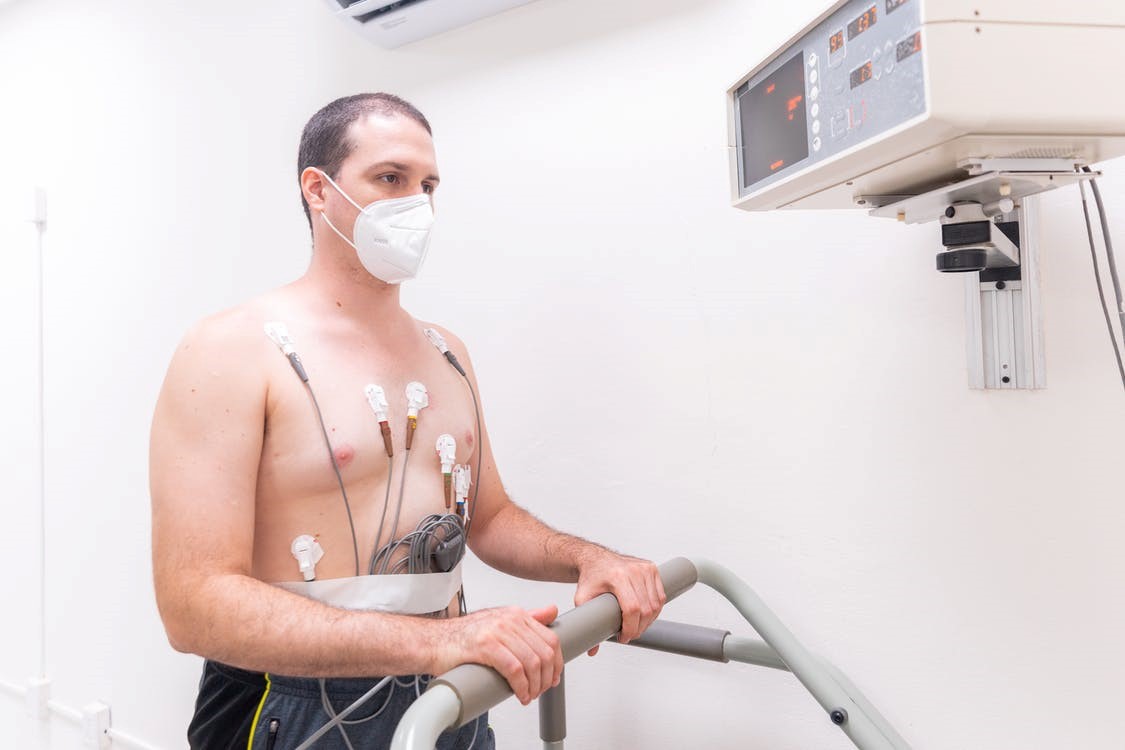
Small electrodes are stuck on to the chest. Wires from the electrodes are connected to the electrocardiogram (ECG) machine. A treadmill or an exercise bike is then used. The exercise starts at a very easy pace, and is gradually made more strenuous by increasing the speed and incline of the treadmill, or by putting some resistance on the bike wheel.
Whilst walking on the treadmill or cycling on the bike, ECG tracings are made and blood pressure will also be measured from time to time. The test lasts about 15-20 minutes.
What should I do to prepare for the test?
It is best to avoid a heavy meal within one hour of the test. Otherwise, there is no special preparation needed. For the test, wear loose-fitting clothes and shoes that are comfortable to walk in. Usual medication should be continued unless advised otherwise.
Limitations
An exercise tolerance test (ETT) is a valuable investigation but it is not 100% accurate. Sometimes tracings show changes during exercise, even though the person has a completely normal heart. Also, some people with coronary heart disease have a normal ETT with no changes on the tracing. Cardiologists are aware of this and use the results of the test in conjunction with other information such as symptoms and other test results.
Nowadays it is common for scans of the heart to be done rather than an ETT. The scans that can be done for the heart include:
A cardiac magnetic resonance imaging (MRI) scan of the heart.
A computerised tomography (CT) coronary scan - also called CT coronary angiography.
A dobutamine stress echocardiogram, where a drug is used to mimic the effects of exercise and a scan of the heart can be done at the same time.
Risker
An ETT is done without any problems in the vast majority of cases. In people without coronary heart disease, complications are rare. However, serious complications can occur in a small number of people who have coronary heart disease. There is a small risk of developing a heart attack (myocardial infarction) or a serious heart irregularity (an arrhythmia) during the test. Medical help is near to hand to deal with possible problems
Patientval för Hjärtundersökningar
Tester och undersökningar
Elektrokardiogram
An electrocardiogram (ECG) records the electrical activity of the heart. The heart produces tiny electrical impulses which spread through the heart muscle to make the heart contract. These impulses can be detected by the ECG machine. An ECG may be used to help find the cause of symptoms such as the feeling of a 'thumping heart' (palpitations) or chest pain. Sometimes it is done as part of routine tests - for example, for high blood pressure, or before an operation. The ECG test is painless and harmless. (The ECG machine records electrical impulses coming from the body - it does not put any electricity into the body.)
av Dr Colin Tidy, MRCGP
Tester och undersökningar
Myokardscintigrafi
A myocardial perfusion scan uses a small amount of a radioactive chemical to see how well blood flows to the muscles of the heart (the myocardium). Often this scan is performed after gentle exercise to see how the heart muscle responds under stress.
av Dr Colin Tidy, MRCGP
Vanliga frågor
What is the main purpose of an Exercise Tolerance Test (ETT)?
An ETT is used to investigate coronary heart disease (narrowing of the coronary arteries), which can cause chest pain (angina) and other issues. It helps to clarify the cause of new chest pain symptoms. For people already diagnosed with coronary heart disease, the test can also indicate the severity of their condition.
What does an abnormal (positive) ETT result mean?
A positive ETT result, which shows abnormal changes on the ECG tracing during exercise, suggests that coronary heart disease is likely. This happens because during exercise, if coronary arteries are narrowed, parts of the heart muscle don't receive enough oxygen, leading to these changes.
Are there any specific safety measures in place during the ETT, given the potential risks?
Yes, during an ETT, medical help is always readily available to manage any potential problems that might arise. While complications are rare, particularly in those without coronary heart disease, this precaution is crucial because a small number of people with existing coronary heart disease could experience a heart attack or a serious heart rhythm issue during the test.
If I'm taking regular medication, should I continue it before an ETT?
Unless you are specifically advised otherwise by a medical professional, you should continue with your usual medication as prescribed before undergoing an ETT. There's no general instruction to stop medication for this test.
Vidare läsning och referenser
- Bröstsmärta av nyligen debut; NICE Klinisk Riktlinje (Mars 2010, uppdaterad Nov 2016)
Om författarenVisa fullständig biografi
Uppdaterad av

Dr Philippa Vincent, MRCGP
Allmänläkare, Medicinsk Författare
MB BS, Bsc, MRCGP (2000), DCH, DFSRH, DRCOG
Dr Philippa Vincent är en NHS-läkare som arbetar i norra London.
Om recensentenVisa fullständig biografi

Dr Toni Hazell, FRCGP
MBBS, BSc, FRCGP, DFSRH, Dip GU med, DRCOG, DCH (London, UK, 2000)
Dr. Toni Hazell tog examen från St. Mary’s Hospital Medical School och genomförde sin VTS vid Northwick Park Hospital.
Artikelhistorik
Artikeln finns också på Engelska, Tyska, Spanska, Franska, Italienska, Portugisiska, Hindi, Hebreiska, Arabiska, och Svenska.
Nästa granskning: 28 dec 2027
29 dec 2024 | Senaste versionen
Dela dina tankar eller erfarenheter med andra i vår patientgemenskaper.
Enkel tillgång till pålitliga behandlingar och hälsotjänster online.
Common conditions
Get help with common conditions through the NHS, without a GP appointment.





Anmäl dig till Patientens nyhetsbrev
Din veckovisa dos av tydliga, pålitliga hälsoråd - skrivna för att hjälpa dig känna dig informerad, självsäker och i kontroll.
Genom att prenumerera accepterar du våra Sekretesspolicy. Du kan avsluta prenumerationen när som helst. Vi säljer aldrig dina uppgifter.