Trigger finger
Granskad av Dr Colin Tidy, MRCGPSenast uppdaterad av Dr Hayley Willacy, FRCGP Senast uppdaterad 10 apr 2025
Uppfyller patientens redaktionella riktlinjer
- Ladda nerLadda ner
- Dela
- Language
- Diskussion
- Ask Patient
- Ljudversion
- Lägg till i föredragna källor på Google
I denna serie:Tendinopati och tenosynovitBelastningsskadaTennisarmbåge
A trigger finger does not straighten easily. The cause is not clear. Sometimes it settles and goes away without treatment. An injection of steroid will usually cure the problem. A small operation is needed in a small number of cases.
Överblick
Triggerfinger är ett tillstånd som gör att ditt finger eller din tumme låser sig eller klickar när du försöker räta ut det.
Det orsakas av inflammation och förtjockning av en sena eller dess skida i det drabbade fingret.
Symtom inkluderar smärta vid basen av fingret, stelhet och en knäppande eller låsande känsla.
Det är vanligare hos kvinnor över 40 och kan kopplas till upprepade handrörelser eller andra hälsotillstånd.
Behandlingsalternativ inkluderar vila, skenor, steroidinjektioner eller kirurgi om andra behandlingar misslyckas.
What is trigger finger?
Trigger finger (also known as stenosing tenosynovitis) is a condition that affects the tendons in your fingers or thumb, causing them to become inflamed and thickened. This can lead to difficulty in straightening or bending the affected finger, often resulting in it "locking" or "catching" in a bent position, like a trigger being pulled and released. It is difficult to straighten out without pulling on it by the other hand. When the finger "snaps" back into place, it can be painful.
You may hear a popping or clicking sound when it is pulled straight. This clicking may be worse in the morning. Sometimes there is mild pain and/or a small swelling at the base of the affected finger or thumb.
One or more fingers may be affected. Trigger finger most commonly affects your little finger, ring finger or thumb. It is actually more common in the right hand.
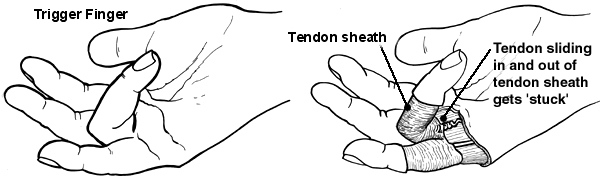
Diagram: trigger finger
What causes trigger finger?
The cause is often not clear. It is thought to be due to some inflammation which causes swelling of a tendon or the covering of the tendon (tendon sheath).
A tendon is a strong tissue that attaches a muscle to a bone. In this case the tendon comes from a muscle in the forearm. It passes through the palm and attaches to the finger bone. The muscle pulling on this tendon bends (flexes) the finger towards the palm.
A tendon sheath is like a tunnel that covers and protects parts of a tendon. Normally, the tendon slides easily in and out of the sheath as you bend and straighten the finger. In trigger finger the tendon can slide out of the sheath when you bend your finger. However, it cannot easily slide back in due to the swelling. The finger then remains bent (flexed) unless you pull it straight with your other hand.
Most cases occur for no apparent reason in healthy people. Around 2 in 100 people develop trigger finger. It is more common if you are aged over 40 and if you are female. It may also be more likely to develop if you have had a previous injury to your palm or finger.
In some cases it occurs after you have used your palm a lot - for example, it can happen:
After jobs which involve a lot of screwdriver use.
After working with tools that press on the palm.
These may cause some inflammation in the palm.
Sometimes trigger finger occurs as a feature of another disease. For example, trigger finger is more common in people with reumatoid artrit, amyloidosis, diabetes, underaktiv sköldkörtel gland, Dupuytrens kontraktur och carpal tunnel syndrome and in people on dialysis. In these situations you will have other symptoms of the condition and the trigger finger is just one feature.
Notera: most people with trigger finger do inte have any of these conditions.
What are the symptoms of trigger finger?
Symptoms can vary from mild to severe and typically affect one finger or the thumb. They may include:
Pain or tenderness: Pain is often felt at the base of the finger or thumb, particularly when bending or straightening the finger.
Stiffness: The finger may feel stiff, especially in the morning.
Snapping or clicking sensation: The finger may make a snapping or clicking sound as it moves, particularly when it is being straightened after being bent.
Locking or catching: The finger may "lock" in a bent position and may need help to straighten it. This can be painful.
Swelling: The affected area may be swollen or appear thicker than usual.
How is trigger finger diagnosed?
Your doctor will diagnose trigger finger based on your medical history, symptoms, and a physical examination. During the exam, they may ask you to move your fingers in different ways to assess for pain, stiffness, or clicking. In some cases, your doctor may use an ultrasound or an X-ray to rule out other conditions.
What is the treatment for trigger finger?
Not treating is an option at first
Around one in five people will improve without any treatment. Simply resting the hand and fingers, allowing any inflammation to settle, may resolve the problem without the need for treatment. You may be advised to take a painkiller (for example, paracetamol or ibuprofen) to relieve the pain.
Splinting
Your symptoms may improve if your finger (or trigger thumb) is strapped to a plastic splint so that it is completely straight. Some people wear a splint just at night.
A steroid injection
A steroid injection into the tendon sheath is one treatment if the condition does not settle. The steroid is combined with a local anaesthetic to make the injection less painful.
Steroids work by reducing inflammation. A finger splint may be advised for a few days after the injection to rest the finger. This treatment works in about 9 in 10 cases. A second injection may be needed if the first does not work.
Kirurgi
An operation done under local anaesthetic may be advised if the above does not work. A small cut is usually made at the base of the finger and the tendon sheath is widened. The surgical treatment of trigger finger is usually very successful.
An alternative operation is a percutaneous trigger finger release. A needle is used to release the tight mouth of the tunnel so an open operation is avoided.
If you have rheumatoid arthritis, these types of surgery may not be suitable for you. If you do need surgery, you may be offered an operation to remove part of the tendon sheath instead.
However, with an operation there is a small risk of damaging the tiny finger nerve and causing some numbness to the finger. Also, as with any operation, there is a small risk of any wound becoming infected.
Preventing trigger finger
While trigger finger may not always be preventable, you can reduce your risk by:
Taking breaks from repetitive hand movements.
Stretching your fingers and wrists regularly if you do activities that involve gripping or bending.
Using ergonomic tools that reduce strain on your hands.
Maintaining a healthy lifestyle to reduce the risk of conditions such as diabetes and arthritis, which can contribute to trigger finger.
Outlook for trigger finger (prognosis)
In most cases, trigger finger improves with treatment. Non-surgical treatments, such as rest, splinting, and corticosteroid injections, are often effective in reducing symptoms. Surgery is rarely necessary and is typically only recommended if other treatments fail. Most people recover fully and regain normal hand function.
Patientval för Bindvävssjukdomar

Ben, leder och muskler
Dupuytrens kontraktur
Dupuytrens kontraktur orsakar förtjockning av vävnader (fascia) i handflatan. En fascia är ett band eller ark av vävnad under huden. Om Dupuytrens kontraktur fortskrider, böjs ett eller flera fingrar (kontraheras) in i handflatan och du kan inte räta ut fingret/fingrarna. Orsaken är okänd. I många fall förblir det lindrigt och kräver ingen behandling. Om tillståndet blir allvarligare eller handens funktion påverkas kan en specialist rekommendera behandling. Dupuytrens kontraktur är uppkallad efter Baron Dupuytren som beskrev tillståndet (och uppfann en operation för det) år 1831.
av Dr Toni Hazell, FRCGP

Ben, leder och muskler
Hypermobilitetsspektrumstörningar
Hypermobility spectrum disorders include all people with what used to be called joint hypermobility syndrome, and before that benign joint hypermobility syndrome. Anyone who has symptoms as a result of having hypermobile joints, but who does not have all the features of Ehlers-Danlos syndrome, has a hypermobility spectrum disorder. These problems mainly affect children and young adolescents with extra-flexible (hypermobile) joints who develop pain on exercise, which persists when they rest. These conditions can have a major impact on school and sporting life. Whilst they do not usually cause long-term harm, they can be associated with injuries and can sometimes persist into adulthood. Treatment is aimed at increasing muscle strength and joint resilience without causing injury.
av Dr Colin Tidy, MRCGP
Vanliga frågor
Kan triggerfinger påverka mer än ett finger?
Ja, en eller flera fingrar kan påverkas av triggerfinger. Det drabbar oftast lillfingret, ringfingret eller tummen, och ses ofta i höger hand.
Orsakar triggerfinger svullnad i det drabbade området?
Ja, svullnad är ett möjligt symptom på triggerfinger. Det drabbade området kan verka svullet eller tjockare än vanligt vid basen av fingret eller tummen.
Hur diagnostiserar en läkare triggerfinger?
Din läkare kommer att diagnostisera triggerfinger genom att granska din medicinska historia, bedöma dina symtom och genomföra en fysisk undersökning. Under undersökningen kan de be dig att röra dina fingrar för att kontrollera smärta, stelhet eller klickljud. Ibland kan en ultraljudsundersökning eller röntgen användas för att utesluta andra tillstånd.
Finns det några risker med operation för triggerfinger?
Ja, det finns små risker förknippade med operation för triggerfinger. Dessa inkluderar en liten risk för att skada en liten nerv i fingret, vilket kan leda till viss domning i fingret. Dessutom, som med alla kirurgiska ingrepp, finns det en liten risk att såret blir infekterat.
Hur kan jag minska risken för att utveckla triggerfinger?
Du kan minska risken för att utveckla triggerfinger genom att ta pauser från repetitiva handrörelser, regelbundet stretcha dina fingrar och handleder om dina aktiviteter innebär grepp eller böjning, använda ergonomiska verktyg för att minska handbelastning, och upprätthålla en hälsosam livsstil för att sänka risken för tillstånd som diabetes och artrit som kan bidra till triggerfinger.
Vidare läsning och referenser
- Peters-Veluthamaningal C, van der Windt DA, Winters JC, et al; Corticosteroid injection for trigger finger in adults. Cochrane Database Syst Rev. 2009 Jan 21;(1):CD005617. doi: 10.1002/14651858.CD005617.pub2.
- Jeanmonod R, Harberger S, Waseem M; Trigger Finger. StatPearls.
- Fiorini HJ, Tamaoki MJ, Lenza M, et al; Surgery for trigger finger. Cochrane Database Syst Rev. 2018 Feb 20;2:CD009860. doi: 10.1002/14651858.CD009860.pub2.
- Merry SP, O'Grady JS, Boswell CL; Trigger Finger? Just Shoot! J Prim Care Community Health. 2020 Jan-Dec;11:2150132720943345. doi: 10.1177/2150132720943345.
- Ferrara PE, Codazza S, Maccauro G, et al; Physical therapies for the conservative treatment of the trigger finger: a narrative review. Orthop Rev (Pavia). 2020 Jun 26;12(Suppl 1):8680. doi: 10.4081/or.2020.8680. eCollection 2020 Jun 29.
- Abdulsalam AJ, Mezian K, Ricci V, et al; Injecting the Trigger Finger: Target (With Ultrasound), Then Shoot! J Prim Care Community Health. 2021 Jan-Dec;12:21501327211000237. doi: 10.1177/21501327211000237.
Om författarenVisa fullständig biografi
Uppdaterad av

Dr Hayley Willacy, FRCGP
Allmänläkare, Medicinsk Författare
MBChB (1992), DRCOG, DFFP, MRCOG (Part 1) MRCGP (2007), DFSRH (2013), MSc - medical education (2020)
Dr Hayley Willacy var en NHS-läkare som arbetade i nordvästra England och gick i pension från klinisk praktik 2022 efter 30 år.
Om recensentenVisa fullständig biografi

Dr Colin Tidy, MRCGP
Allmänläkare, Medicinsk Författare
MBBS, MRCGP, MRCP (Paediatrics), DCH
Dr Colin Tidy är en NHS-läkare, baserad i Oxfordshire.
Artikelhistorik
Artikeln finns också på Engelska, Tyska, Spanska, Franska, Italienska, Portugisiska, Hindi, Hebreiska, Arabiska, och Svenska.
Next review due: 9 Apr 2028
10 apr 2025 | Senaste versionen
Dela dina tankar eller erfarenheter med andra i vår patientgemenskaper.
Enkel tillgång till pålitliga behandlingar och hälsotjänster online.
Common conditions
Get help with common conditions through the NHS, without a GP appointment.





Anmäl dig till Patientens nyhetsbrev
Din veckovisa dos av tydliga, pålitliga hälsoråd - skrivna för att hjälpa dig känna dig informerad, självsäker och i kontroll.
Genom att prenumerera accepterar du våra Sekretesspolicy. Du kan avsluta prenumerationen när som helst. Vi säljer aldrig dina uppgifter.