Bråck
Granskad av Dr Colin Tidy, MRCGPSenast uppdaterad av Dr Toni Hazell, FRCGPSenast uppdaterad 22 Jan 2023
Uppfyller patientens redaktionella riktlinjer
- Ladda nerLadda ner
- Dela
- Language
- Diskussion
- Ljudversion
- Lägg till i föredragna källor på Google
A hernia occurs when an internal part of the body pushes through a weak spot in the surrounding muscle or tissue wall. This leaflet deals with abdominal hernias which occur when a weakness in the wall of the tummy (abdominal wall) results in some of the contents in the abdominal cavity bulging through. Some hernias need treating by performing an operation. There are now various different types of operation, which are usually very successful.
Överblick
Ett bråck är när vävnad trycker genom en svaghet i din bukvägg, vilket ofta orsakar en knöl.
De är vanligtvis inte smärtsamma men kan värka, särskilt efter aktivitet, och knölen kan försvinna när man ligger ner.
Behandling rekommenderas vanligtvis eftersom bråck kan bli större eller innehållet kan bli instängt eller strypt.
Kirurgi rekommenderas för reparation, ofta som ett dagfall med användning av ett nät för att stärka området.
Återhämtning efter bråckoperation är ofta snabb, och vissa personer återgår till arbetet inom två veckor.
What are the symptoms of a hernia ?
Sometimes a hernia is noticed after a strain - for example, after lifting a heavy object. Sometimes one may develop for no good reason and you may simply notice a small lump, usually in the groin area. Usually, at first, the lump can be pushed back but may pop out after straining again. Coughing is a common strain that brings them out. The swelling often disappears when you lie down.
Hernias are not usually painful but many people feel an ache over a hernia, which worsens after doing any activity. In time, they might become bigger as the gap in their muscle or ligament tissue becomes larger. Sometimes, in men, they track down into the scrotum.
Why do they need treatment?
Although having a hernia is not usually a serious condition, treatment to fix it is usually advised for two reasons:
It may gradually become bigger and more uncomfortable.
The contents of the hernia may become trapped in the weak point in the abdominal wall. This can cause bowel obstruction with severe pain, nausea and vomiting (incarcerated hernia).
There is a small chance the hernia might strangulate:
This happens when the bowel (intestine) that comes through the gap in the weak spot becomes squeezed. This can cut off the blood supply to the portion of intestine in the hernia.
This can lead to severe pain and some damage to the part of the intestines in the hernia.
A strangulated hernia is uncommon and is usually dealt with by emergency surgery.
The risk of strangulation is greater with a femoral hernia than with an inguinal hernia. The risk is also greater with smaller hernias. In some areas, NHS funding for hernia repair is not automatically given and your GP or surgeon may need to apply for this.
How are hernias repaired?
A small operation is recommended. Wearing a support (truss) was a method used in the past but is now not recommended.
The operation is one of the most common operations performed by surgeons. The repair can usually be performed as a day case so that there is no need to stay overnight in hospital. A hernia can either be repaired under a local or a general anaesthetic. This will depend on the actual type of operation needed.
There are now various different ways of repairing a hernia, which will depend on many factors. For example, the type of hernia, the size of the hernia, and your general health. Your surgeon will be able to discuss the type of operation with you in more detail.
Inguinal hernia repair
This can be done by opening the tummy (abdomen) or by a 'keyhole' operation. The keyhole option is becoming more popular with surgeons as the recovery is quicker compared to having an open operation. However, research suggests that there is little difference in complication rates between the two procedures. The keyhole operation is performed through three tiny cuts, the largest of which is only around 1.5 cm in size.
It is more common that inguinal hernias be repaired by using a mesh. This is a thin sheet of material which is usually stitched or glued over the hole of the hernia. This has been shown to be stronger and more effective than sewing the edges of the hole together. With time, the mesh safely becomes incorporated into the muscle layer, which results in a very strong, permanent repair.
Femoral hernia repair
As the hole through which a femoral hernia has to pass is very tight, there is a significant chance that any bowel that passes into it will become strangulated. This means that a femoral repair should be repaired early. Femoral hernias are usually repaired using a mesh although some surgeons favour open repair.
Incisional hernia repair
Incisional hernias vary enormously in size. Again, a mesh is usually used, especially for larger hernias.
Umbilical and paraumbilical hernia repair
Smaller hernias are usually repaired by an operation which simply closes the defect with stitches. However, umbilical and paraumbilical hernias over 2 cm in length are usually repaired by using a mesh.
Epigastric hernia repair
The operation dissects out the contents of the hernia and closes the gap in the linea alba (a fibrous structure that runs down the front of the abdomen) so that the hernia can't happen again.
Newer techniques mean that people tend to be off work for much shorter periods than in the past. Even workers in heavy work can often be back in two weeks. The operation is usually very successful. However, hernias can return (recur) in a small number of people, when a further operation may be advised.
What are the types of hernia?
The most common types are listed here:
Bråck
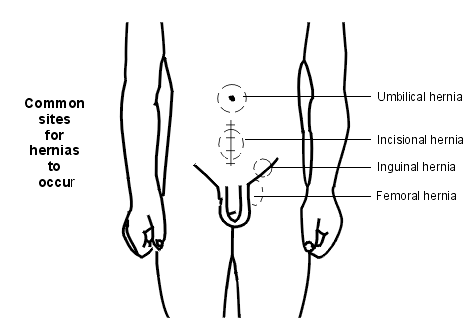
Inguinal hernia
This is the most common type. They are more likely in males, as they have a small tunnel in the tissues of their groins which occurred when they were developing as a baby. This tunnel allowed the testicles (testes) to come down from the tummy (abdomen) into the scrotum. Tissue from the intestines can also pass into this tunnel, forming an inguinal hernia.
There are two main types:
Indirect, which are usually congenital and common in boys.
Direct, which are more common in adult men.
They can occur in both sides of the body.
Hernias in groin areas
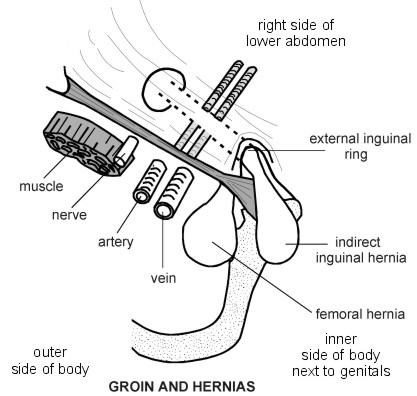
Femoral hernia
This also occurs when some tissue pushes through in the groin. It occurs a little lower down than where an inguinal hernia occurs, and it tends to be smaller. It occurs more commonly in women.
Incisional hernia
This occurs when tissue pushes through a previous scar or wound. It is more common if you have had a scar in the past that has not healed well. For example, if the wound had an infection after the operation. It usually occurs within two years of having an operation.
Epigastric hernia
These present with a lump in the middle of the body, usually between the belly button and the sternum (breastbone). Presentation is usually between the ages of 20 and 50 and they are more common in men than in women. They are usually repaired surgically because small epigastric hernias are at risk of strangulation, and large ones are uncomfortable.
Umbilical and paraumbilical hernias
These occur when some tissue pushes through the abdomen near to the belly button (umbilicus). Umbilical hernias can be present from birth and in most cases the hernia goes back in and the muscles re-seal on their own before the baby is 1 year old. They will generally be repaired if they persist beyond 5 years of age or if they are very large.
Umbilical hernias may develop in adults with being overweight (obesity) and excessive accumulation of fluid within the peritoneum of the abdomen. The peritoneum is a lining of the abdomen and consists of two layers, one which lines the abdominal wall and the other which covers the organs in the abdomen.
Paraumbilical hernias occur in adults and appear above the umbilicus. Although they are generally small, they usually need repairing because there is a risk of intestines contained within them becoming strangulated.
Who develops hernias?
They may occur in adults as a result of the strain which raises the pressure in the tummy (abdomen), causing a weakness or tear in the abdominal wall. This can be caused by:
Being overweight or pregnant.
Lifting, carrying or pushing heavy loads.
Straining on the toilet.
Patientval för Other digestive conditions

Matsmältningshälsa
Kronisk pankreatit
Chronic pancreatitis can cause tummy (abdominal) pain, poor digestion, diabetes and other complications. Alcohol is the common cause. Treatment includes painkillers, other medication and, most importantly, stopping alcohol drinking for good. Surgery is sometimes needed.
av Dr Doug McKechnie, MRCGP

Matsmältningshälsa
Eosinofil esofagit
The oesophagus is the gullet, or food pipe, that connects the mouth to the stomach. Inflammation of the oesophagus is known as oesophagitis. Commonly, the inflammation is caused by acid leaking up from the stomach (a condition known as acid reflux). In some people, however, it can be caused by a condition known as eosinophilic oesophagitis. In eosinophilic oesophagitis, particular types of white blood cells (called eosinophils) gather in large numbers in the lining of the oesophagus, causing inflammation. It occurs in children and in adults. The condition can be controlled by making changes to your diet and/or taking steroids. Occasionally, an operation to stretch the oesophagus through a telescope (endoscope) may be needed.
av Dr Rachel Hudson, MRCGP
Vanliga frågor
Kan bråck någonsin försvinna av sig själva utan operation?
För de flesta typer av bråck, särskilt hos vuxna, försvinner de inte av sig själva. Dock kan navelbråck som finns från födseln hos bebisar ofta gå tillbaka och musklerna återförslutas innan bebisen är 1 år gammal.
Vad är återhämtningstiden efter en bråckoperation?
Nyare kirurgiska tekniker innebär att människor tenderar att vara borta från arbetet under mycket kortare perioder än tidigare. Även de som har tungt arbete kan ofta återvända inom två veckor. Operationen är vanligtvis mycket framgångsrik.
Finns det några långsiktiga komplikationer om ett bråck inte behandlas?
Om en bråck inte behandlas kan det gradvis bli större och mer obekvämt. Innehållet kan också fastna, vilket leder till tarmobstruktion med svår smärta, illamående och kräkningar (inkarcererat bråck). Det finns också en liten risk för strangulering, där blodtillförseln till den fastnade tarmen avbryts, vilket kan leda till svår smärta och skador.
Är det möjligt för ett bråck att återkomma efter att det har opererats?
Ja, bråck kan återkomma hos ett litet antal personer, även efter en lyckad operation. Om detta händer kan en ytterligare operation rekommenderas för att åtgärda återfallet.
Vad betyder det om ett bråck beskrivs som 'inkarcererat'?
En inkarcererad bråck innebär att innehållet i bråcket, såsom en tarmögla, har fastnat i den svaga punkten i bukväggen. Detta kan leda till allvarliga symtom som tarmobstruktion, svår smärta, illamående och kräkningar.
Vidare läsning och referenser
- Castorina S, Luca T, Privitera G, et al; An evidence-based approach for laparoscopic inguinal hernia repair: lessons learned from over 1,000 repairs. Clin Anat. 2012 Sep;25(6):687-96. doi: 10.1002/ca.22022. Epub 2012 Jan 24.
- Lockhart K, Dunn D, Teo S, et al; Mesh versus non-mesh for inguinal and femoral hernia repair. Cochrane Database Syst Rev. 2018 Sep 13;9:CD011517. doi: 10.1002/14651858.CD011517.pub2.
- International guidelines for groin hernia management. Hernia. 2018 Feb;22(1):1-165. doi: 10.1007/s10029-017-1668-x. Epub 2018 Jan 12.
- Kockerling F, Simons MP; Current Concepts of Inguinal Hernia Repair. Visc Med. 2018 Apr;34(2):145-150. doi: 10.1159/000487278. Epub 2018 Mar 26.
Om författarenVisa fullständig biografi

Dr Toni Hazell, FRCGP
MBBS, BSc, FRCGP, DFSRH, Dip GU med, DRCOG, DCH (London, UK, 2000)
Dr. Toni Hazell tog examen från St. Mary’s Hospital Medical School och genomförde sin VTS vid Northwick Park Hospital.
Om recensentenVisa fullständig biografi

Dr Colin Tidy, MRCGP
Allmänläkare, Medicinsk Författare
MBBS, MRCGP, MRCP (Paediatrics), DCH
Dr Colin Tidy är en NHS-läkare, baserad i Oxfordshire.
Artikelhistorik
Informationen på denna sida är skriven och granskad av kvalificerade kliniker.
Artikeln finns också på Engelska, Tyska, Spanska, Franska, Italienska, Portugisiska, Hindi, Hebreiska, Arabiska, och Svenska.
Next review due: 21 Jan 2028
22 Jan 2023 | Senaste versionen

Fråga, dela, anslut.
Bläddra i diskussioner, ställ frågor och dela erfarenheter inom hundratals hälsorelaterade ämnen.

Känner du dig sjuk?
Bedöm dina symtom online gratis
Anmäl dig till Patientens nyhetsbrev
Din veckovisa dos av tydliga, pålitliga hälsoråd - skrivna för att hjälpa dig känna dig informerad, självsäker och i kontroll.
Genom att prenumerera accepterar du våra Sekretesspolicy. Du kan avsluta prenumerationen när som helst. Vi säljer aldrig dina uppgifter.
Mer om matsmältningshälsa
- Acid reflux och esofagit
- Anal fistel
- Antacida
- Tjocktarmscancer
- Tjocktarmscancerscreening
- Kolecystit
- Clostridioides difficile
- Celiaki
- Förstoppning
- Funktionell dyspepsi
- H2-blockerare
- Hepatit B
- Hiatusbråck
- Invagination och volvulus hos barn
- Leversvikt
- Leverfunktionstester
- Mesenterisk lymfadenit
- Bukspottkörtelcancer
- Right lower quadrant pain
- Smärta i övre högra kvadranten