Barium lavemangsundersökning
Granskad av Dr Toni Hazell, FRCGPSenast uppdaterad av Dr Colin Tidy, MRCGPSenast uppdaterad 23 Aug 2023
Uppfyller patientens redaktionella riktlinjer
- Ladda nerLadda ner
- Dela
- Language
- Diskussion
- Ask Patient
- Ljudversion
- Lägg till i föredragna källor på Google
Medicinska yrkesverksamma
Professionella referensartiklar är utformade för att användas av vårdpersonal. De är skrivna av brittiska läkare och baserade på forskningsbevis, brittiska och europeiska riktlinjer. Du kan hitta Bariumlavemang artikel mer användbar, eller en av våra andra hälsoartiklar.
Bakgrund
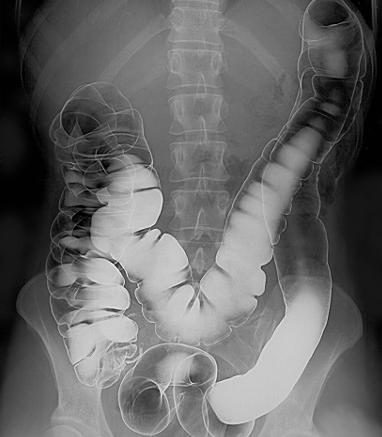
A barium enema is a rectal injection of barium contrast. This coats the lining of the colon and rectum and X-ray films are obtained under fluoroscopic control. Air introduced into the large bowel may be used to give a double-contrast technique. Barium enemas are performed much less often than in the past because of the increasing use of colonoscopy and CT colonography.
A small bowel barium enema refers to the use of a specially designed tube passed nasally and into the duodenojejunal flexure under fluoroscopic control, after which dilute barium is infused via the tube until it reaches the terminal ileum in continuous flow. It is used to investigate suspected small bowel disease (eg, Crohns sjukdom, lymphoma) and malabsorption (eg, celiaki). It is an unpleasant procedure for the patient and is often now replaced by CT or ultrasound where possible.
This rest of this article refers to barium enema as used in the large bowel.
Intestinal tract barium enema
Indikationer
To assess the anatomy of the large bowel and occasionally the terminal ileum.
Abnormalities detected include large bowel obstruction, tumours, ulcers, divertikelsjukdom, inflammatory bowel disease, tarminvagination, Hirschsprungs sjukdom and thickening of the lining of the colon or rectum.
A barium enema is not reliable for the diagnosis of rectal pathology.
Therapeutic uses
Conservative treatment with barium, air or saline enema is often effective in children who present with intussusception, unless diagnosis and treatment are delayed.
Barium enema may be effective in reducing large bowel volvulus in children but resection of the involved segment and primary anastomosis is the definitive treatment.
Refractory bleeding colonic diverticulae: high-dose barium enema is as effective as endoscopic haemostasis for the prevention of recurrent diverticular bleeding.1
Cautions and possible complications
Barium enema is uncomfortable for the patient and requires good patient mobility and co-operation. More patients find the procedure embarrassing than do patients having colonoscopy or CT colonography.2 It should not be requested for frail elderly patients unless there is a clear indication.
A rectal examination or sigmoidoscopy is essential to avoid missing abnormalities.
Radiation exposure is relatively low.
The barium enema is a relatively safe procedure. Rare complications include:3
Bowel perforation:
Occurs in between 2-4/10,000 patients, usually related to iatrogenic trauma from catheter placement.
Pre-existing diseased bowel is more likely to perforate than normal healthy bowel.4
The mortality rate associated with intraperitoneal perforation is high due to the combination of barium and bacterial load which causes acute peritonitis and shock.
Barium impaction - causes large bowel obstruction.
Water intoxication.
Allergic reactions.
Cardiac arrhythmias.
Prevention of endocarditis
Currently, antibacterial prophylaxis is inte recommended for the prevention of endokardit in those undergoing radiological procedures involving their lower gastrointestinal tract.5 Any infection in patients at risk of endocarditis should be investigated and treated promptly to reduce the risk of endocarditis. Patients at risk of endocarditis should be educated as to the signs of infective endocarditis and told to seek expert advice if these occur.
Kontraindikationer
Allergy to the latex balloon on the tip of enema tube (rare).
Severe rectal inflammation or recent rectal biopsy (delay for seven days after a full-thickness biopsy). Patients with active colitis should not have a barium enema.
Acute gastrointestinal bleeding (precludes the use of angiography).
Pregnancy: X-rays of the abdomen and pelvis should be avoided.
Preparation and procedure
Low-residue diet for three days prior to the procedure and laxatives 24 hours before.
Nil by mouth after midnight.
Bowel washout immediately prior to procedure.
Antispasmodic (eg, hyoscine butylbromide) may be given to minimise spasm.
The patient lies on their side and an enema tube is inserted into the rectum.
Barium is run into the colon under gravity and radiographs are taken. Air is also then introduced into the rectum for a double-contrast barium enema.
Exklusiva uppdateringar för vårdpersonal
Håll dig informerad med de senaste kliniska uppdateringarna, professionella insikter och evidensbaserad vägledning. Patient Pro-nyhetsbrevet sammanställer viktigt innehåll för vårdpersonal—levererat direkt till din inkorg.
Genom att prenumerera accepterar du våra Sekretesspolicy. Du kan avsluta prenumerationen när som helst. Vi säljer aldrig dina uppgifter.
Vidare läsning och referenser
- Fujimoto A, Sato S, Kurakata H, et al; Effectiveness of high-dose barium enema filling for colonic diverticular bleeding. Colorectal Dis. 2011 Aug;13(8):896-8. doi: 10.1111/j.1463-1318.2010.02350.x. Epub 2010 Jun 10.
- Von Wagner C, Knight K, Halligan S, et al; Patient experiences of colonoscopy, barium enema and CT colonography: a Br J Radiol. 2009 Jan;82(973):13-9. Epub 2008 Sep 29.
- de Feiter PW, Soeters PB, Dejong CH; Rectal perforations after barium enema: a review. Dis Colon Rectum. 2006 Feb;49(2):261-71.
- Yasar NF, Ihtiyar E; Colonic perforation during barium enema in a patient without known colonic Cases J. 2009 Aug 14;2:6716.
- Prophylaxis against infective endocarditis: Antimicrobial prophylaxis against infective endocarditis in adults and children undergoing interventional procedures; NICE Clinical Guideline (March 2008 - last updated July 2016)
Om författarenVisa fullständig biografi
Uppdaterad av

Dr Colin Tidy, MRCGP
Allmänläkare, Medicinsk Författare
MBBS, MRCGP, MRCP (Paediatrics), DCH
Dr Colin Tidy är en NHS-läkare, baserad i Oxfordshire.
Om recensentenVisa fullständig biografi

Dr Toni Hazell, FRCGP
MBBS, BSc, FRCGP, DFSRH, Dip GU med, DRCOG, DCH (London, UK, 2000)
Dr. Toni Hazell tog examen från St. Mary’s Hospital Medical School och genomförde sin VTS vid Northwick Park Hospital.
Artikelhistorik
Artikeln finns också på Engelska, Tyska, Spanska, Franska, Italienska, Portugisiska, Hindi, Hebreiska, Arabiska, och Svenska.
Next review due: 21 Aug 2028
23 Aug 2023 | Senaste versionen
Enkel tillgång till pålitliga behandlingar och hälsotjänster online.
Common conditions
Get help with common conditions through the NHS, without a GP appointment.





Mer inom gastroenterologi
- Abdominella massor
- Onormala leverfunktionstester
- Akut pankreatit
- Gallvägsatresi
- Bröstsmärta
- Kolangit
- Kronisk pankreatit
- Kryptosporidios
- Cyklist kräkssyndrom
- Cystisk fibros
- Tand- och tandköttssjukdomar
- Dermatitis herpetiformis
- Gastrointestinala stromatumörer
- Intra-abdominell sepsis och abscesser
- Gulsot
- Knölar i ljumsken och pungen
- Multipel endokrin neoplasi typ 1
- Enkel bukröntgen
- Rotavirus och rotavirusvaccination
- Shigellos