Ljumskbråck
Granskad av Dr Toni Hazell, FRCGPSenast uppdaterad av Dr Philippa Vincent, MRCGPSenast uppdaterad 1 Oct 2026
Uppfyller patientens redaktionella riktlinjer
- Ladda nerLadda ner
- Dela
- Language
- Diskussion
- Ask Patient
- Ljudversion
- Lägg till i föredragna källor på Google
Medicinska yrkesverksamma
Professionella referensartiklar är utformade för att användas av vårdpersonal. De är skrivna av brittiska läkare och baserade på forskningsbevis, brittiska och europeiska riktlinjer. Du kan hitta Bråck artikel mer användbar, eller en av våra andra hälsoartiklar.
Vad är ett ljumskbråck?
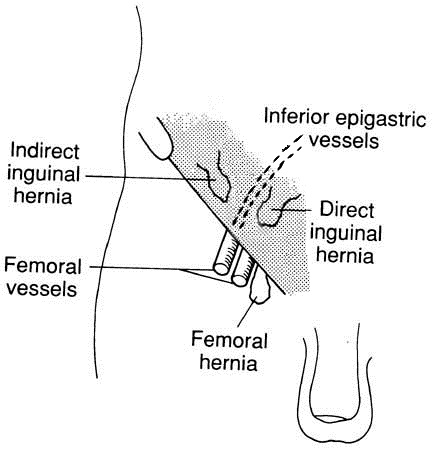
An abdominal hernia comprises a protrusion of abdominal contents through the fascia of the abdominal wall; an inguinal hernia is where this protrudes through the internal inguinal ring. Hernias contain a portion of peritoneal sac and may contain viscera, usually small bowel and omentum.
Ljumskbråck
Epidemiologi för ljumskbråck
Inguinal hernias are common, making up 75% of all abdominal hernias.
Inguinal hernias are more common in men (the lifetime risk of an inguinal hernia is 27-43% in men and 3-6% in women).1 Although they are much more common in men, women with a groin hernia are still more likely to have an inguinal than a femoral hernia.2
As well as male sex, risk factors include increasing age (although there is also a significant spike in cases below the age of 5 years) and a genetic predisposition.2
Other risk factors are thought to include: smoking, chronic obstructive pulmonary disease, lower body mass index, high intrabdominal pressure, thoracic or abdominal aortic aneurysm, patent processes vaginalis, history of open appendectomy, peritoneal dialysis, and collagen vascular disease.2
Presentation av ljumskbråck
An inguinal hernia will usually present as a swelling in the groin that may appear with lifting and be accompanied by sudden pain.
There may be a cough impulse. The hernia may not be visible when lying flat but may appear on standing.
The hernia may be reducible.
Indirect hernias can cause pain in the scrotum and cause a 'dragging sensation'.
Medfödda ljumskbråck upptäcks vanligtvis vid födseln och alla behöver akut remiss till öppenvård för kirurgisk reparation.
Inguinal hernias in older children and adults usually develop gradually but can occur suddenly with an episode of heavy lifting:
Vid första anblicken är ett bråck vanligtvis lätt att reducera när patienten ligger ner. Men det kan kräva manuell återplacering om det är stort.
Med tiden förstoras bråcket och blir svårare att återställa på grund av att fibrösa vidhäftningar bildas.
När det inte längre kan reduceras, är det irreducibelt eller inkarcererat. Detta kan inträffa när som helst, liksom strangulering. Detta inträffar när de viscerala innehållen i bråcket blir vridna eller fastklämda av den smala öppningen. Detta komprometterar blodtillförseln, vilket orsakar svullnad och så småningom infarkt. Strangulering leder vanligtvis till tarmobstruktion.
Det finns två typer av ljumskbråck:
Indirekt: a protrusion through the internal inguinal ring passes along the inguinal canal through the abdominal wall, running laterally to the inferior epigastric vessels. This is the more common form accounting for 80% of inguinal hernias, especially in children. It is associated with failure of the inguinal canal to close properly after passage of the testis in utero or during the neonatal period.
Direkt: bråcket tränger direkt genom en svaghet i den bakre väggen av inguinalkanalen, löper medialt till de nedre epigastriska kärlen. Det är vanligare hos äldre och sällsynt hos barn.
Bedömning3
Undersök patienten både stående och liggande och be dem hosta eller anstränga sig.
För in ett finger genom toppen av pungen in i den yttre inguinalringen och känn efter en knöl vid hosta - hostimpuls.
Glidbråck är sannolika vid stora skrotalbråck.
Differentialdiagnos
Se även den separata Knölar i ljumsken och pungen artikel.
Hydrocele (when differentiating from an inguinoscrotal hernia, note that it is possible to get above a hydrocele on examination).
Spermatiska kordens hydrocele.
Lymfkörtelsvullnad.
Abscess.
Saphena varix.
Blödning.
Utredningar
Whilst most specialists agree that imaging is not necessary to make the diagnosis, in the UK there are often local constraints on referrals for hernia repair which mean that the diagnosis needs to be confirmed by imaging. Ultrasound scan is the imaging option of choice.34
Behandling och hantering av ljumskbråck
Vuxna5 2
If the inguinal hernia is small, the patient may only need reassurance. There is good recent evidence that "watchful waiting" is a safe option for many adults with inguinal hernias. Long-term follow-up of these patients suggests that around 68% proceed to surgical management eventually, usually due to worsening pain or lifestyle limitations from progression.2
Patients with pain, reduced mobility or other symptoms should be offered surgical management. Many patients with chronically incarcerated hernias may be asymptomatic but patients with obstruction or strangulation are a surgical emergency.
However, there is always the chance of it becoming a surgical emergency through obstruction and incarceration. Episodes of pain and tenderness suggest the need for urgent treatment but when these become prolonged and severe then emergency surgery is indicated for possible strangulation. The fundamentals of indirect inguinal hernia treatment are the same regardless of the patient's age. Reduction or excision of the sac and closure of the defect with minimal tension are the essential steps in any hernia repair.
Surgical guidelines recommend tailoring the choice of surgery to individual patient factors. Surgical options include either an open (tissue- or mesh-based) procedure or a minimally invasive (laparoscopic or robotic) procedure.
An open repair with mesh is associated with a 50%-75% lower risk of hernia recurrence, lower risk of chronic pain post-operatively, and an earlier return to work compared with a sutured repair. A tissue (sutured) repair is usually used where mesh is contraindicated, for example where there may be potential for infection from a contaminated field. Laparoscopic repair is recommended for bilateral inguinal hernias as the same port sites can be used.
Studies have shown no significant difference between mesh, laparoscopic and robotic procedures in terms of post-operative haematoma, surgical site infection, urinary retention, or hospital length of stay. However post-operative chronic pain appears to be lower in patients who have undergone laparoscopic procedures, though studies have been of questionable quality.
Ljumskbråck hos barn
The incidence of incarcerated or strangulated hernias in paediatric patients is higher than in adults, at around 7-11%.6 It is higher in infants than in older children. The risk increases with waiting time from diagnosis to procedure.67
Surgical repair is usually recommended as early as possible in paediatric patients because of these risks.
Laparoscopic repair has been shown to have better outcomes than open repair though both have low risks of complications.8910
Komplikationer
Dessa inkluderar:
Post-operative chronic pain is reported to occur in between 8 and 16% of patients, though laparoscopic repair appears to reduce the risk.2
Recurrence: 1.0% - most happening within five years of operation. Recurrence rate increases:
Hos barn yngre än 1 år.
Hos äldre patienter.
Efter fängelsevistelser.
Hos dem med pågående ökat intraabdominellt tryck.
Där det finns tillväxtproblem.
Vid prematuritet.
Där det finns kroniska andningsproblem.
Hos flickor med glidbråck.
Infarkterad testikel eller äggstock med atrofi.
Sårinfektion.
Blåsskada.
Tarmsskada.
En hydrocele från vätskeansamling i den distala säcken löser sig vanligtvis spontant men ibland krävs aspiration.
Prognos
This is generally very good, depending on comorbidity.
Exklusiva uppdateringar för vårdpersonal
Håll dig informerad med de senaste kliniska uppdateringarna, professionella insikter och evidensbaserad vägledning. Patient Pro-nyhetsbrevet sammanställer viktigt innehåll för vårdpersonal—levererat direkt till din inkorg.
Genom att prenumerera accepterar du våra Sekretesspolicy. Du kan avsluta prenumerationen när som helst. Vi säljer aldrig dina uppgifter.
Vidare läsning och referenser
- Jorgenson E, Makki N, Shen L, et al; En genomomfattande associationsstudie identifierar fyra nya mottaglighetsloci som ligger till grund för ljumskbråck. Nat Commun. 2015 Dec 21;6:10130. doi: 10.1038/ncomms10130.
- Gudigopuram SVR, Raguthu CC, Gajjela H, et al; Ljumskbråcknätreparation: Faktorer att överväga vid beslut mellan öppen och laparoskopisk reparation. Cureus. 2021 Nov 16;13(11):e19628. doi: 10.7759/cureus.19628. eCollection 2021 Nov.
- Tigora A, Radu PA, Garofil DN, et al; Modern Perspectives on Inguinal Hernia Repair: A Narrative Review on Surgical Techniques, Mesh Selection and Fixation Strategies. J Clin Med. 2025 Jul 9;14(14):4875. doi: 10.3390/jcm14144875.
- Current status of inguinal hernia management; P J McBee et al; International Journal of Abdominal Wall and Hernia Surgery
- Hassler KR, Saxena P, Baltazar-Ford KS; Open Inguinal Hernia Repair.
- LeBlanc KE, LeBlanc LL, LeBlanc KA; Ljumskbråck: diagnos och behandling. Am Fam Physician. 2013 Jun 15;87(12):844-8.
- HerniaSurge Group; Internationella riktlinjer för ljumskbråckshantering. Hernia. 2018;22(1):1-165. doi:10.1007/s10029-017-1668-x
- Olesen CS, Mortensen LQ, Oberg S, et al; Risk of incarceration in children with inguinal hernia: a systematic review. Hernia. 2019 Apr;23(2):245-254. doi: 10.1007/s10029-019-01877-0. Epub 2019 Jan 12.
- Retrospective Cohort Study on Inguinal Hernia in Children: Infant Vulnerability to Incarceration and Pediatricians’ Awareness; A G Grewal et al; CHRISMED Journal of Health and Research
- Ma Q, Liu X, Zou Z, et al; Surgical methods and outcomes of inguinal hernia repair in children, adolescents and young adults in a retrospective cohort study. Sci Rep. 2025 Mar 17;15(1):9220. doi: 10.1038/s41598-025-93841-5.
- Morgado M, Holland AJ; Inguinal hernias in children: Update on management guidelines. J Paediatr Child Health. 2024 Nov;60(11):648-653. doi: 10.1111/jpc.16677. Epub 2024 Sep 25.
- A 10-year review of pediatric inguinal hernia management at a tertiary center; B Yu et al; Frontiers in Pediatrics
Om författarenVisa fullständig biografi
Uppdaterad av

Dr Philippa Vincent, MRCGP
Allmänläkare, Medicinsk Författare
MB BS, Bsc, MRCGP (2000), DCH, DFSRH, DRCOG
Dr Philippa Vincent är en NHS-läkare som arbetar i norra London.
Om recensentenVisa fullständig biografi

Dr Toni Hazell, FRCGP
MBBS, BSc, FRCGP, DFSRH, Dip GU med, DRCOG, DCH (London, UK, 2000)
Dr. Toni Hazell tog examen från St. Mary’s Hospital Medical School och genomförde sin VTS vid Northwick Park Hospital.
Artikelhistorik
Artikeln finns också på Engelska, Tyska, Spanska, Franska, Italienska, Portugisiska, Hindi, Hebreiska, Arabiska, och Svenska.
Next review due: 1 Apr 2031
1 Oct 2026 | Senaste versionen
Enkel tillgång till pålitliga behandlingar och hälsotjänster online.
Common conditions
Get help with common conditions through the NHS, without a GP appointment.





Mer om historia och undersökning
- Akut buksmärta hos barn
- Akut urinretention
- Ascites
- Ryggsmärta hos barn
- Andnöd
- Caplans syndrom
- Kardiovaskulär historia och undersökning
- Bröstkorgsdeformitet
- Komplext regionalt smärtsyndrom
- Medfödda öronproblem
- Cyanos
- Huvudvärk
- Hälsoprogram för barn
- Gulsot
- Smärta i vänster fossa iliaca
- Lentigo
- Klumpar
- Pigmenterad purpurisk dermatit
- Axelundersökning
- Sydenhams korea