Femoralbråck
Granskad av Dr Toni Hazell, FRCGPSenast uppdaterad av Dr Philippa Vincent, MRCGPSenast uppdaterad 10 Sept 2026
Uppfyller patientens redaktionella riktlinjer
- Ladda nerLadda ner
- Dela
- Language
- Diskussion
- Ask Patient
- Ljudversion
- Lägg till i föredragna källor på Google
Medicinska yrkesverksamma
Professionella referensartiklar är utformade för att användas av vårdpersonal. De är skrivna av brittiska läkare och baserade på forskningsbevis, brittiska och europeiska riktlinjer. Du kan hitta Bråck artikel mer användbar, eller en av våra andra hälsoartiklar.
Vad är femoralbråck?
Hernias in the groin are either inguinal or, less commonly, femoral in origin.
Ljumskbråck
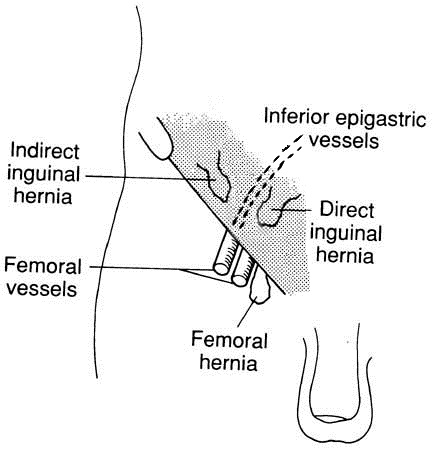
The femoral canal has the inguinal ligament as its anterior border, the pectineal ligament as its posterior border, the lacunar ligament as its medial border, and the femoral vein as its lateral border.
Epidemiologi1
Femoral hernias account for only around 3% of all groin hernias. The lifetime incidence of a groin hernia is 27% to 43% in men and 3% to 6% in women.
Femoral hernias are more common in women than in men, though inguinal hernias remain the most common groin hernias in women.
The prevalence of femoral hernias increases with age, as does the risk of complications.
10% of women with a femoral hernia and 50% of men with a femoral hernia will have a co-existing inguinal hernia.
Symptom på femoralbråck (presentation)
Presentation is as a lump in the groin, lateral and inferior to the pubic tubercle. A large hernia may bulge over the inguinal ligament.
The femoral hernia often bulges more on coughing or straining, and reduces in size or disappears when relaxed or supine.
Femoral hernias are more common on the right (due to a developmental delay in closure of the processus vaginalis).
Det kan finnas en hostimpuls.
Femoral hernias are more likely to strangulate than inguinal hernias.
Undersökning
Diagnosis is largely clinical but ultrasound confirmation is often required before making a referral.
Imaging techniques are helpful. Ultrasound scanning is most commonly used but CT scans can be helpful in patients with incarceration or strangulation.1
Differentialdiagnos
Andra orsaker till knölar i ljumsken inkluderar:
Hydrocele (when differentiating from an inguinoscrotal hernia, note that it is possible to get above a hydrocele on examination).
Spermatiska kordens hydrocele.
Enlarged lymph node.
Psoasabscess eller bursa.
Saphena varix.
Haematoma.
Komplikationer vid femoralbråck
Femoral hernias are at a 12 times higher risk of strangulation than inguinal hernias.
The risk of strangulation in a femoral hernia is 22% at 3 months and 45% at 21 months.
Femoral hernias may not be noticed by the patient prior to strangulation, especially in those who have obesity.
One study reported that 45.9% of patients required femoral hernia repair as an emergency.2
If strangulation occurs, the lump may become red and tender as well as tense and irreducible. Other features include colicky abdominal pain, distension and vomiting, indicating bowel obstruction.
Behandling och hantering av femoralbråck3
In view of the higher risk of strangulation, it is recommended that femoral hernias should be repaired; referral should be made for elective repair as soon as the diagnosis is made.4 In many parts of the UK, there is a hernia pathway which includes all femoral hernias (confirmed by ultrasound scan) but only includes other hernias that are symptomatic.
Femoral hernias may be repaired using a standard inguinal approach, an open preperitoneal approach, or a minimally invasive (laparoscopic or robotic-assisted laparoscopic) approach.15Laparoscopy does not appear to lead to more complications,67 but there is no consensus on the best approach, particularly as these often present in an acute situation and are therefore dealt with by junior surgeons.8
Emergency femoral hernia repair (for a strangulated hernia) is associated with a significantly higher risk of complications, including bowel resection, and a higher mortality than elective repairs.2
Prognos
The mortality for elective hernia repair is low, regardless of age. However, after emergency surgery, mortality is increased seven-fold.9
Studies report that the overall operative mortality rate for strangulated hernias ranges from 1.4-13.4% but there is limited recent data.
Recurrence rates for femoral hernias are between 1 and 10%. They are more common in smokers and people with obesity, increased intra-abdominal pressure, coexisting infection, collagen tissue disorders, diabetes, and poor nutritional state.1
Chronic pain has been reported in up to 15% of people after femoral hernia repair.1
Exklusiva uppdateringar för vårdpersonal
Håll dig informerad med de senaste kliniska uppdateringarna, professionella insikter och evidensbaserad vägledning. Patient Pro-nyhetsbrevet sammanställer viktigt innehåll för vårdpersonal—levererat direkt till din inkorg.
Genom att prenumerera accepterar du våra Sekretesspolicy. Du kan avsluta prenumerationen när som helst. Vi säljer aldrig dina uppgifter.
Vidare läsning och referenser
- Goethals A, Azmat CE, Patel PJ, et al; Femoral Hernia.
- Humes DJ, Radcliffe RS, Camm C, et al; Befolkningsbaserad studie av presentation och negativa resultat efter ljumskbråckskirurgi. Br J Surg. 2013 Dec;100(13):1827-32. doi: 10.1002/bjs.9336.
- Development of an Acute Femoral Hernia Treatment Algorithm: Insights From the ACHQC National Database; I Kim et al; The American Surgeon
- Femoral hernia: Treatment delay and cause of death – A case report and an integrative review; Y Hassan et al; Muller Journal of Medical Sciences and Research
- Open Surgical Repair of Adult Inguinal and Femoral Hernias: Contemporary Techniques and Clinical Outcomes; N Subhan; Journal of Society Medicine
- Coelho JCU, Hajar FN, Moreira GA, et al; FEMORAL HERNIA: UNCOMMON, BUT ASSOCIATED WITH POTENTIALLY SEVERE COMPLICATIONS. Arq Bras Cir Dig. 2021 Oct 15;34(2):e1603. doi: 10.1590/0102-672020210002e1603. eCollection 2021.
- Incarerated femoral hernia in women – A critical view on approach options; L Pietrogiovanna et al; International Journal of Surgery Case Reports
- An Update on the Management of Femoral Hernias: Narrative Review Article; H Kumar; SAR Journal of Surgery
- Nilsson H, Stylianidis G, Haapamaki M, et al; Dödlighet efter ljumskbråckskirurgi. Ann Surg. 2007 Apr;245(4):656-60.
Om författarenVisa fullständig biografi
Uppdaterad av

Dr Philippa Vincent, MRCGP
Allmänläkare, Medicinsk Författare
MB BS, Bsc, MRCGP (2000), DCH, DFSRH, DRCOG
Dr Philippa Vincent är en NHS-läkare som arbetar i norra London.
Om recensentenVisa fullständig biografi

Dr Toni Hazell, FRCGP
MBBS, BSc, FRCGP, DFSRH, Dip GU med, DRCOG, DCH (London, UK, 2000)
Dr. Toni Hazell tog examen från St. Mary’s Hospital Medical School och genomförde sin VTS vid Northwick Park Hospital.
Artikelhistorik
Artikeln finns också på Engelska, Tyska, Spanska, Franska, Italienska, Portugisiska, Hindi, Hebreiska, Arabiska, och Svenska.
Next review due: 10 Mar 2031
10 Sept 2026 | Senaste versionen
Enkel tillgång till pålitliga behandlingar och hälsotjänster online.
Common conditions
Get help with common conditions through the NHS, without a GP appointment.





Mer om historia och undersökning
- Buksmärta
- Tvetydiga genitalier
- Ascitestappning
- Färgseende och dess störningar
- Komplext regionalt smärtsyndrom
- Dysartri och dysfasi
- Öron-, näs- och halsundersökning
- Hemoptys
- Smärta i vänster fossa iliaca
- Förlust av libido
- Narkolepsi och kataplexi
- Nacksmärta (cervicalgia) och nackspärr
- Fetma hos barn
- Pediatrisk undersökning
- Bäcken smärta
- Screening för kognitiv nedsättning
- Splenomegali och hypersplenism
- Strabism (skelning) klassificering och hantering
- Tenesmus
- Vaskulit