Hypermetropia
Long-sightedness
Peer reviewed by Dr Philippa Vincent, MRCGPLast updated by Dr Colin Tidy, MRCGPLast updated 12 Jan 2024
Meets Patient’s editorial guidelines
- DownloadDownload
- Share
- Language
- Discussion
- Audio Version
- Add to preferred sources on Google
In this series:Presbyopia
The medical name for long-sightedness is hypermetropia, sometimes called hyperopia. Eyesight problems, such as hypermetropia, are also known as refractive errors. Long-sightedness leads to problems with near vision (seeing things that are close up) and the eyes may commonly become tired. Distance vision (long sight) is, in the beginning, good. Long sight can be corrected by glasses, contact lenses, or laser eye surgery.
At a glance
Hypermetropia, or long-sightedness, is when light does not focus correctly on the retina.
This causes blurred vision, especially for close-up objects.
Symptoms can include tired eyes, headaches, and uncomfortable vision.
It is usually hereditary but can be caused by other conditions like diabetes.
Options for correction include glasses, contact lenses, laser eye surgery, or lens surgery.
Most people should have their eyesight tested every two years.
Have your eyes checked if you notice any changes in your vision.
What is hypermetropia?
Hypermetropia (long-sightedness) is a refractive error and occurs when light from near objects is not quite brought to focus in time to hit the retina. The point of focus would in fact fall behind the retina, if the light could get that far.
The lens tries hard to change its thickness (becomes fatter or more rounded) in an attempt to bring the light into focus on the retina - a process called accommodation.
However, people with long sight cannot accommodate fully and so the light does not focus on the retina and vision is blurred. This occurs because the eyeball is too short, the cornea is too flat (and so bends the light rays less), or the lens cannot become round enough (and so lacks power).
People with a mild hypermetropia can usually see at distance, as this light does not need to be bent as much in order to focus it on the retina.
Their near sight may also be clear. However, they may get tiring of the eyes, often with a headache and vision discomfort, because the lens is having to work so hard. People with more severe hypermetropia are not able to see objects close to them clearly in focus.
Long sight means exactly what the term suggests: you can see objects which are a long distance from you quite clearly.
long sight
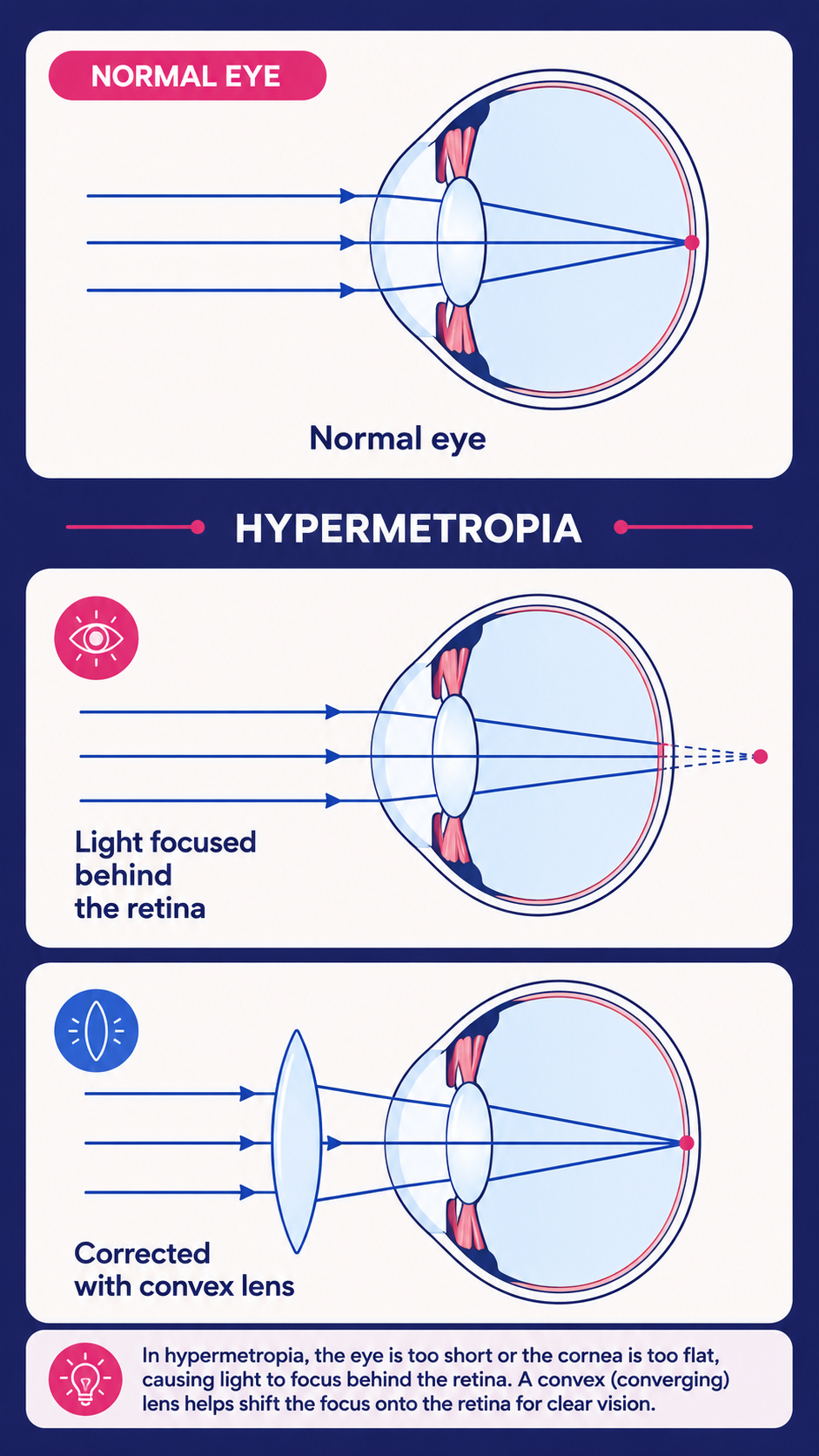
The diagram above shows the differences in focusing between a normal and a long-sighted (hypermetropic) eye.
What is a refractive error?
Before we can understand hypermetropia, we need to understand refractive errors.
A refractive error is an eyesight problem. Refractive errors are the most common reason worldwide for reduced level of eyesight (visual acuity).
Eye cross-section
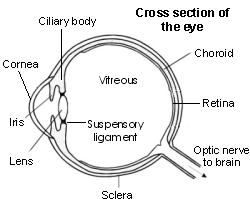
Refraction refers to the bending of light, in this case by the eye, in order to focus it. A refractive error means that the eye cannot focus light on to the retina properly. This usually occurs either due to abnormalities in the shape of the eyeball, or because age has affected the workings of the focusing parts of the eye.
There are four types of refractive error:
Short-sightedness (myopia).
Long-sightedness (hypermetropia).
Age-related long sight (presbyopia).
Astigmatism (a refractive error due to an unevenly curved cornea).
In order to understand refractive errors fully, it is useful to know how we see.
When we look at an object, light rays from the object pass through the eye to reach the retina. This causes nerve messages to be sent from the cells of the retina, down the optic nerve, to the vision centres in the brain. The brain processes the information it receives, resulting in an image that we can see.
Focusing the eye
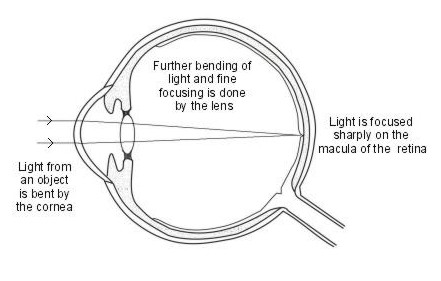
Light rays come off an object in all directions, as they result from the light around us bouncing back off the object. The part of this bounced light that come into the eye from an object needs to be focused on a small area of the retina. If this doesn't happen, what we look at will be blurred.
The cornea and lens have the job of focusing light. The cornea does most of the work, as it bends (refracts) the light rays which then go through the lens, which finely adjusts the focusing. The lens does this by changing its thickness. This is called accommodation. The lens is elastic and can become flatter or more rounded. The more rounded (convex) the lens, the more the light rays can be bent inwards.
The shape of the lens is varied by small muscles in the ciliary body. Tiny string-like structures called the suspensory ligaments are attached at one end to the lens and at the other to the ciliary body. This is a bit like a trampoline with the central bouncy bit being the lens, the suspensory ligaments being the springs and the ciliary muscles being the rim around the edge.
When the ciliary muscles in the ciliary body tighten, the suspensory ligaments slacken, causing the lens to become fatter. This happens for near objects. For looking at far objects, the ciliary muscle relaxes, making the suspensory ligaments tighten, and the lens thins out.
More bending (refraction) of the light rays is needed to focus on nearby objects, such as when reading. Less bending of light is needed to focus on objects far away.
What are the symptoms of hypermetropia?
The main symptom is a difficulty with near vision.
Other common symptoms of hypermetropia (long sight) include:
'Tiring' of the eyes (asthenopia).
Uncomfortable vision.
Difficulties seeing with both eyes (binocular vision).
Long-sighted people may have difficulty with depth perception (3-dimensional vision), as this needs two eyes to work together, more or less equally.
What causes hypermetropia?
The causes of hypermetropia (long sight) are usually hereditary (genetic). Long sight can occur at any age but it tends to become more noticeable above the age of 40 years.
In rare cases, long sight is caused by other conditions such as diabetes, small eye syndrome (microphthalmia), cancers around the eye and problems with the blood vessels in the retina.
Many babies and very young children tend to be slightly long-sighted but usually grow out of this by about 3 years of age.
A particular type of age-related long sight (presbyopia) occurs because the lens of the eye becomes more stiff with age.
Complications of hypermetropia
If severe hypermetropia (long sight) is present from a very young age, lazy eye (amblyopia) can result. The eye with less good vision does not learn to see properly because the brain ignores its signals and concentrates only on the better eye.
Visual development in the brain occurs in the first few years of life and if this problem is not spotted until after vision has finished developing, the poorer eye will not fully develop its 'information route' into the brain, so will never see as well.
What is the treatment for hypermetropia?
Glasses
The simplest, cheapest and safest way to correct long sight is with glasses. Convex prescription lenses (called plus lenses) are used to bend light rays slightly inwards to give a little bit of additional focusing power to the eye.
The light rays then have a lesser angle to bend travelling through the cornea and lens and the lens has less work to do. As a result, the light rays are able to focus on the retina. There is an enormous choice of spectacle frames available, to suit all budgets, faces, and personal styles.
Contact lenses
These do the same job as glasses but they sit right on the surface of the eye. Many different types of contact lenses are available. Lenses may be soft or rigid gas-permeable.
They can be daily disposable, extended wear, monthly disposable, or non-disposable. Your optician can advise which type is most suitable for your eyes and your prescription.
Contact lenses tend to be more expensive than glasses. They require more care and meticulous hygiene. They provide good all-round vision and do not mist over (for example, while doings sports or in hot environments).
They do, however, require more care and meticulous hygiene, and should not be worn during swimming, showering or sleeping. They are more suitable for older teenagers and adults, rather than very young children.
Laser eye surgery
Laser eye surgery is an option for some people with long-sightedness. Generally, this type of surgery is not available on the NHS and can be expensive. Many private companies advertise laser eye surgery.
Complete and permanent resolution of the refractive error is possible in a number of people. Others have a significant improvement even though perfect vision is not achieved and glasses or contact lenses may still be needed.
These usually get better over time. Over-correction or under-correction of short-sightedness can also happen.
Complications include eye infection and dry eyes. Permanent loss of vision is very rare; if this happens, around 1 in 5,000 people need a corneal transplant to restore their vision. Up to 1 in 10 patients may need additional surgery to get the best result.
For more information, see the leaflet on Laser Eye Surgery.
Lens surgery
Refractive lens exchange (RLE)
In this procedure, your eye's natural lens is replaced by a clear synthetic implant called an intraocular lens (IOL). It is essentially the same process as modern cataract surgery.
Multifocal IOLs aim to improve distance, intermediate, and close (near) vision, and can therefore be used to treat long-sightedness.
RLE is suitable for people over the age of 50 years who have a prescription that is higher than the normal range for laser eye surgery. RLE can correct almost any level of long-sightedness. It is generally preferred in older people because, as you get older, your eye's natural lens becomes less flexible and less clear, so there is more benefit in replacing it. It also eliminates the need to have cataract surgery later in life. However, you should discuss with your operating surgeon which treatment option is best for you.
The operation typically takes about 20 minutes per eye, is performed with eye-drop anaesthetics, and you can go home the same day. You can have both eyes done at the same time, or one eye at a time.
Side-effects include eye discomfort, visual effects (such as blurring of vision, haloes around lights, and shadowing or shimmering arcs around the edges of vision), and subconjunctival haemorrhages. These usually get better over time.
Permanent, serious loss of vision is much more common after RLE than after laser eye surgery. It affects approximately 1 in 500 patients. Other risks of the operation include bleeding, infection, and retinal detachment.
How often do I need an eyesight test?
The NHS recommends that most people should get their eyesight tested every two years. Children will routinely be offered eye checks at various stages from birth to school age.
People at higher risk of sight problems need more frequent eyesight checks. You should check to see what your optician or doctor recommends about regular check-ups if you have:
Or a family history of these conditions.
People over the age of 70 years and children who wear glasses may also need more frequent eye tests.
You should get your eyes checked if you notice any changes in your vision.
Some opticians offer a home visiting service to carry out sight tests for people who are unable to get out and about.
Dr Mary Lowth is an author or the original author of this leaflet.
Patient picks for Eye conditions
Eye health
Retinal artery occlusion
Retinal artery occlusion occurs when the retinal artery or one of its branches becomes blocked. This cuts off the blood and nutrient supply to the nerve layer of the retina, leading to permanent damage. It is a common cause of sudden loss of vision in one eye, which occurs over a few seconds. The loss is usually severe. Occasionally both eyes are affected but this is rare. The condition is an emergency, as very early treatment is needed if there is to be a chance of restoring your sight.
by Dr Mary Elisabeth Lowth, FRCGP
Eye health
Charles Bonnet syndrome
Charles Bonnet syndrome is a common condition experienced by people who are losing, or have lost, their sight. It involves seeing things which are not really there (having visual hallucinations). The hallucinations are most marked in low light or when relaxing and are often complicated scenes involving faces, children and wild animals. People often feel distressed, sometimes because they are worried that they may be considered as having a psychiatric condition if they tell anyone what they're experiencing. However, Charles Bonnet syndrome is caused by problems with the eyes rather than the mind.
by Dr Hayley Willacy, FRCGP
Frequently asked questions
How do children with hypermetropia usually cope with this condition?
Many babies and very young children are naturally slightly long-sighted and often outgrow this by around 3 years of age. If severe hypermetropia is present from a very young age and not addressed, it can lead to amblyopia, also known as 'lazy eye'.
Can diet and exercise prevent or cure hypermetropia?
The article does not mention diet or exercise playing a role in preventing or curing hypermetropia. It states that long sight is usually hereditary and can also be caused by conditions like diabetes or small eye syndrome in rare cases.
What is the difference between hypermetropia and presbyopia?
Hypermetropia is a refractive error where the eye cannot focus light correctly, often due to a short eyeball or flat cornea. Presbyopia, on the other hand, is a specific type of age-related long sight. It occurs because the lens of the eye becomes stiffer with age, making it less able to change shape and focus on near objects.
Are there any non-surgical ways to improve hypermetropia without glasses or contact lenses?
The article only discusses glasses and contact lenses as non-surgical treatments for hypermetropia. It does not mention any other non-surgical methods or exercises that can improve the condition.
Can hypermetropia get worse over time, even with correction?
The article mentions that hypermetropia tends to become more noticeable after the age of 40 years. It also states that age-related changes can lead to presbyopia, where the eye's lens becomes stiffer. While correction methods manage the symptoms, the underlying condition can progress with age.
Further reading and references
- Photorefractive (laser) surgery for the correction of refractive error; NICE Interventional procedures guidance, March 2006
- Settas G, Settas C, Minos E, et al; Photorefractive keratectomy (PRK) versus laser assisted in situ keratomileusis (LASIK) for hyperopia correction. Cochrane Database Syst Rev. 2012 Jun 13;6:CD007112. doi: 10.1002/14651858.CD007112.pub3.
- Professional Standards for Refractive Surgery; Royal College of Ophthalmologists (Dec 2021)
- Li SM, Kang MT, Wang NL, et al; Wavefront excimer laser refractive surgery for adults with refractive errors. Cochrane Database Syst Rev. 2020 Dec 18;12(12):CD012687. doi: 10.1002/14651858.CD012687.pub2.
- Laser Vision Correction; Royal College of Ophthalmologists Patient Information Leaflet
- Phakic Intraocular Lens Implantation; Royal College of Ophthalmologists Patient Information Leaflet
- Refractive Lens Exchange; Royal College of Ophthalmologists Patient Information Leaflet
About the authorView full bio

Dr Colin Tidy, MRCGP
General Practitioner, Medical Author
MBBS, MRCGP, MRCP (Paediatrics), DCH
Dr Colin Tidy is an NHS Doctor, based in Oxfordshire.
About the reviewerView full bio

Dr Philippa Vincent, MRCGP
General Practitioner, Medical Author
MB BS, Bsc, MRCGP (2000), DCH, DFSRH, DRCOG
Dr Philippa Vincent is an NHS GP working in North London.
Article history
The information on this page is written and peer reviewed by qualified clinicians.
Article also available in English, German, Spanish, French, Italian, Portuguese, Hindi, Hebrew, Arabic, and Swedish.
Next review due: 11 Jan 2029
12 Jan 2024 | Latest version
Join the conversation
Share your thoughts or experiences with others in our patient communities.

Ask, share, connect.
Browse discussions, ask questions, and share experiences across hundreds of health topics.

Feeling unwell?
Assess your symptoms online for free
Sign up to the Patient newsletter
Your weekly dose of clear, trustworthy health advice - written to help you feel informed, confident and in control.
By subscribing you accept our Privacy Policy. You can unsubscribe at any time. We never sell your data.
More in eye health
- Blepharitis
- Chalazion
- Colour vision deficiency
- Dealing with eye injuries
- Diabetic retinopathy
- Ectropion
- Entropion
- Episcleritis and scleritis
- Eye infection (herpes simplex)
- Eye problems
- Hay fever
- House dust mite and pet allergy
- Infective conjunctivitis
- Myopia
- Retinal artery occlusion
- Retinal vein occlusion
- Stye
- Subconjunctival haemorrhage
- Uveitis
- Watering eyes