Pityriasis rosea
Granskad av Dr Colin Tidy, MRCGPSenast uppdaterad av Dr Hayley Willacy, FRCGP Senast uppdaterad 30 Dec 2024
Uppfyller patientens redaktionella riktlinjer
- Ladda nerLadda ner
- Dela
- Language
- Diskussion
- Ljudversion
- Lägg till i föredragna källor på Google
Pityriasis rosea is a self-limiting rash, In other words it goes away on its own without any treatment. Although the rash can be quite dramatic, the illness is very mild. It most commonly affects young adults but can affect all ages.
Överblick
Pityriasis rosea is a common, self-limiting skin rash found in children and young adults.
A single "herald patch" often appears first, followed by a more widespread rash.
The rash can be itchy, but there are no known remedies to clear it faster.
Simple creams, menthol, antihistamines, or steroid creams may help with itching.
Pityriasis rosea is not considered contagious.
It typically clears up within 2 to 12 weeks, but can last longer.
See your doctor if the rash lasts over three months or if itching is severe.
Vad är pityriasis rosea?
Pityriasis rosea is a self-limiting rash that can occur both in adults and in children. Pityriasis rosea is more common in children and young adults. It is most common in people aged between 10 and 35 years. It is more common in the spring and autumn months. Unfortunately, having pityriasis rosea during the first 15 weeks of pregnancy is associated with miscarriage and preterm delivery.
Pityriasis rosea symptoms
Most people with pityriasis rosea feel perfectly well but are aware of a rash. The rash may be itchy but is not always. Some people may have:
A mild headache.
A high temperature (fever).
A feeling of sickness (nausea).
A feeling of being more tired than usual.
Any symptoms that do occur usually start before the rash appears. Some people develop intense itching before the rash first appears.
Occasionally, some people also have affected areas in their mouths - for example, blisters or ulcers.
Pityriasis rosea treatment
Pityriasis rosea is a condition that will clear itself naturally. No treatment is needed.
Although this rash disappears without leaving a scar, some people find they have marks of discolouration on their skin for a few months.
There are no known pityriasis rosea remedies that will clear the rash more quickly than its natural course. The following may help if itching is a problem:
Avoid fragranced soaps, hot water, wool and synthetic fabrics.
As much as possible try not to scratch. It is thought that scratching can make itch worse and an itch-scratch vicious cycle may develop with regular scratching. (That is, you itch more because you scratch, so you scratch more because you itch more ... and so on.)
Simple creams (also called emollients) may be soothing to the skin and reduce the itching.
A menthol cream or ointment may be cooling and soothing.
Antihistamine tablets may help to reduce the itching. These can be prescribed by your doctor or bought from a pharmacy.
Your doctor may prescribe a steroid cream if your itching is more severe.
If symptoms are very severe you may be referred to a skin specialist who may advise some ultraviolet light treatment. There is no definite evidence that this is effective; however, it is often tried. Other treatments, such as aciclovir, may also be considered.
Pityriasis rosea causes
Its exact cause is unknown. No germ (bacterium, virus, or fungus) has been found in people with the rash. However, certain types of human herpes viruses may be a part of the cause. It is not associated with food, medicines or stress. However, some medicines can cause a rash which looks similar to pityriasis rosea.
What does the rash look like in pityriasis rosea?
A 'herald patch' usually appears on the skin first. This is usually an oval- or round-shaped patch which can vary from 2-5 cm in diameter. This is usually pink/red in colour. It most commonly appears on your chest or upper back. It can sometimes appear on your tummy (abdomen), neck, back, thigh or upper arms. However, many cases do not have a herald patch or it goes unnoticed.
Around 5-15 days later a more widespread rash gradually appears over about 10 days. Most commonly this is on the back or the chest and abdomen. This rash can spread over much of your body. However, it does not usually affect your face.
The rash usually consists of oval-shaped spots 1-3 cm in diameter which are pinky in colour. These spots are smaller than the herald patch. Often the spots seem to form lines in parallel with your skin creases.
This rash may be very itchy. The rash fades in time but this may take several weeks. It leaves no marks or scarring. Second attacks are very rare but have been reported.
This description is the typical case which most people seem to have. Occasionally, the rash may just affect the arms and legs. Rarely, it can cause scaling or flaking of the skin, which can be troublesome.
Pityriasis rosea på buken
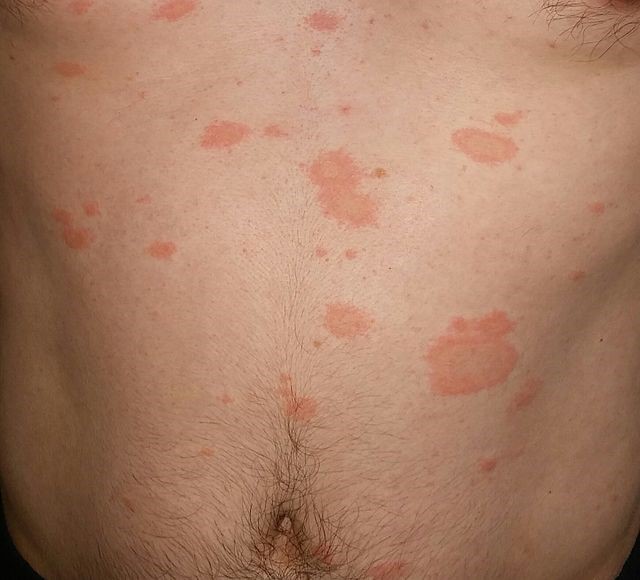
© Marekzerzan, CC BY-SA 4.0, via Wikimedia Commons
Further pictures of pityriasis rosea can be found at the DermNet NZ and DermIS websites - see references below.
Frequently Asked Questions:
Is pityriasis rosea contagious?
Pityriasis is not usually contagious so does not spread to other people.
Do I need any tests?
Usually no tests are needed. Your doctor will be able to diagnose pityriasis rosea from the typical rash. If the rash does not go away after three months, or if the itching is very bad, you may be referred to a skin specialist (dermatologist). You may also be referred if your doctor is not sure about the diagnosis.
How long can pityriasis rosea last?
It usually lasts for 2-12 weeks but can last as long as five months. Most commonly it lasts about five weeks before going away completely. If the rash is lasting a longer time, you may need to see a skin specialist to check the diagnosis.
Can stress cause pityriasis rosea?
The exact cause for pityriasis rosea is not yet known but so far no association between pityriasis rosea and stress has been found.
Patientval för Skin rashes

Hud, nagel och hårhälsa
Värmeutslag och svettutslag
Värmeutslag är en av de vanligaste typerna av hudutslag, och det är också känt som miliaria, svettutslag eller värmeutslag. Värmeutslag uppstår hos vissa personer när de svettas mycket. Det kan klia mycket. Det beror på en blockering av svettkanalerna som gör att svett tränger in i hudcellerna. Den huvudsakliga behandlingen är att hålla sig sval så mycket som möjligt.
av Dr Rosalyn Adleman, MRCGP

Hud, nagel och hårhälsa
Polymorf ljusutslag
Polymorphic light eruption is a skin rash that can happen when you go out in the sun.
av Dr Hayley Willacy, FRCGP
Vanliga frågor
Can you have pityriasis rosea without a herald patch?
Yes, while a 'herald patch' is typically the first sign, many cases do not have one, or it might go unnoticed. The widespread rash appears about 5-15 days after the herald patch would have appeared, if present.
Is pityriasis rosea dangerous?
Pityriasis rosea is a self-limiting rash, meaning it will clear up on its own. Most people feel perfectly well despite having the rash. However, if pityriasis rosea occurs during the first 15 weeks of pregnancy, it is associated with miscarriage and preterm delivery.
Is pityriasis rosea linked to cancer?
No, there is no information in the article to suggest a link between pityriasis rosea and cancer. The condition clears up on its own and does not leave scars, although some people may have discolouration for a few months.
Can pityriasis rosea spread to the face?
The rash in pityriasis rosea usually appears on the back, chest, and abdomen, spreading over much of the body. However, it does not usually affect your face.
How did I get pityriasis rosea?
The exact cause of pityriasis rosea is unknown. No specific germ (bacterium, virus, or fungus) has been definitively identified as the cause, although certain types of human herpes viruses might play a role. It is not associated with food, medicines, or stress, although some medicines can cause a similar-looking rash.
Vidare läsning och referenser
- Pityriasis rosea; NICE CKS, april 2020 (endast tillgång i Storbritannien)
- Contreras-Ruiz J, Peternel S, Jimenez Gutierrez C, et al; Interventioner för pityriasis rosea. Cochrane Database Syst Rev. 2019 Okt 30;2019(10). doi: 10.1002/14651858.CD005068.pub3.
- Pityriasis Rosea; DermIS (Dermatology Information System)
- Pityriasis rosea; DermNet NZ
Om författarenVisa fullständig biografi

Dr Hayley Willacy, FRCGP
Allmänläkare, Medicinsk Författare
MBChB (1992), DRCOG, DFFP, MRCOG (Part 1) MRCGP (2007), DFSRH (2013), MSc - medical education (2020)
Dr Hayley Willacy var en NHS-läkare som arbetade i nordvästra England och gick i pension från klinisk praktik 2022 efter 30 år.
Om recensentenVisa fullständig biografi

Dr Colin Tidy, MRCGP
Allmänläkare, Medicinsk Författare
MBBS, MRCGP, MRCP (Paediatrics), DCH
Dr Colin Tidy är en NHS-läkare, baserad i Oxfordshire.
Artikelhistorik
Informationen på denna sida är skriven och granskad av kvalificerade kliniker.
Artikeln finns också på Engelska, Tyska, Spanska, Franska, Italienska, Portugisiska, Hindi, Hebreiska, Arabiska, och Svenska.
Next review due: 29 Dec 2027
30 Dec 2024 | Senaste versionen

Fråga, dela, anslut.
Bläddra i diskussioner, ställ frågor och dela erfarenheter inom hundratals hälsorelaterade ämnen.

Känner du dig sjuk?
Bedöm dina symtom online gratis
Anmäl dig till Patientens nyhetsbrev
Din veckovisa dos av tydliga, pålitliga hälsoråd - skrivna för att hjälpa dig känna dig informerad, självsäker och i kontroll.
Genom att prenumerera accepterar du våra Sekretesspolicy. Du kan avsluta prenumerationen när som helst. Vi säljer aldrig dina uppgifter.