Öronvax
Granskad av Dr Doug McKechnie, MRCGPSenast uppdaterad av Dr Philippa Vincent, MRCGPSenast uppdaterad 14 nov 2024
Uppfyller patientens redaktionella riktlinjer
- Ladda nerLadda ner
- Dela
- Language
- Diskussion
- Ask Patient
- Ljudversion
- Lägg till i föredragna källor på Google
I denna serie:HörselnedsättningHörselnedsättning hos äldre personerÖroninflammation med vätskaOtosclerosisPerforerad trumhinnaKolesteatom
A build-up of earwax can cause reduced hearing and sometimes other symptoms. Earwax can usually be easily removed.
Överblick
Earwax is a natural protective coating in your ear canal.
Too much earwax can cause dulled hearing, fullness in the ear, or ringing.
You can use ear drops from a pharmacy to soften earwax.
Microsuction is considered a safe way to remove earwax.
Do not try to clean inside your ear with cotton buds.
Explore earwax removal options
Get expert healthcare advice from the comfort of home. Complete a quick online consultation, available 24/7, with your request reviewed by a UK-registered clinician. Next day delivery available on eligible treatments.

Vad är öronvax?
Earwax in ear canal
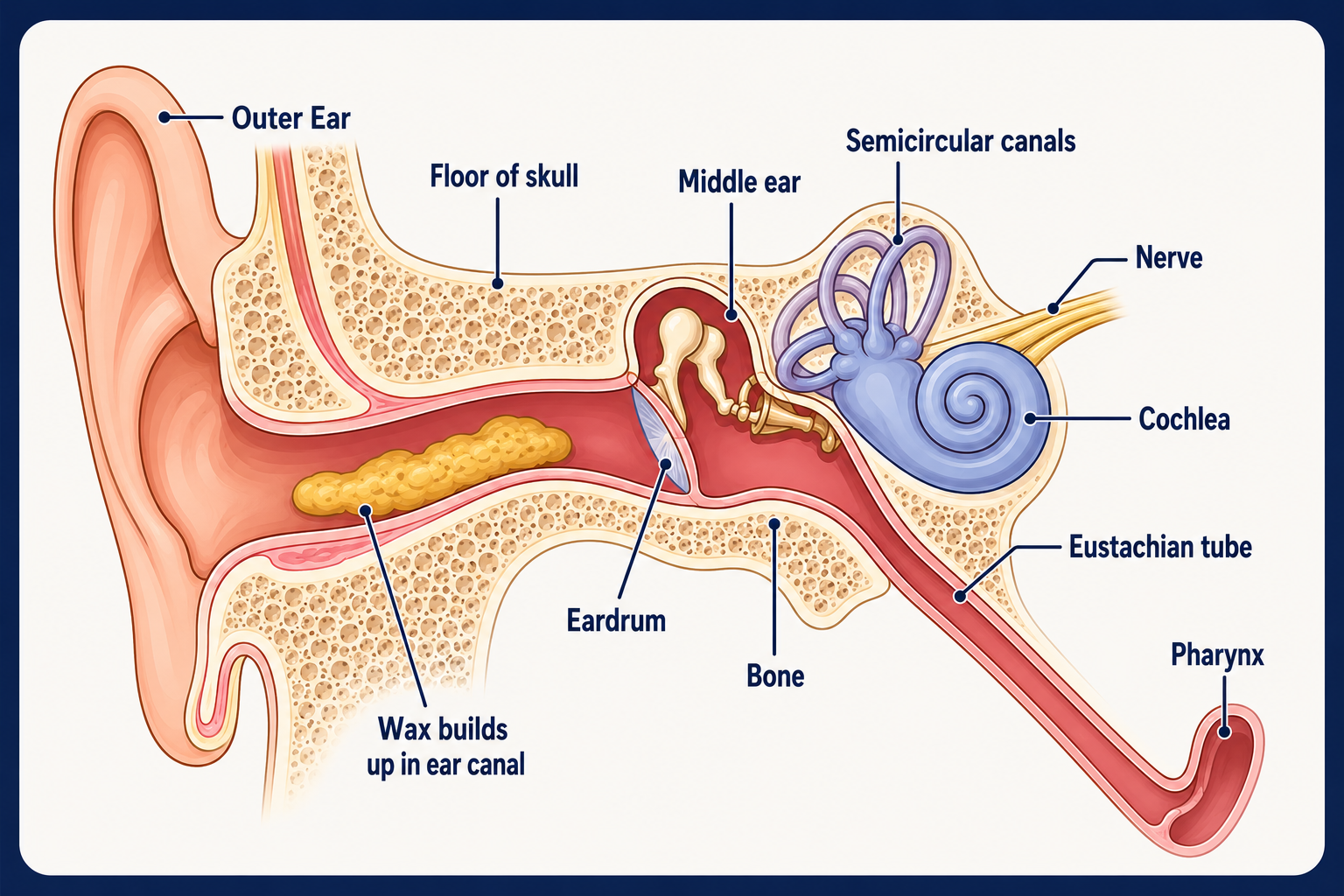
Earwax is a build-up of dead cells, hair, foreign material such as dust, and cerumen. Cerumen is the natural wax produced by glands in the ear. It forms a protective coating of the skin in the ear canal. Small amounts are made all the time. Flakes or crusts of earwax break off and fall out of the ear from time to time.
The quantity of earwax made varies greatly from person to person. Some people form plugs of earwax in their ear canal. This may cause a feeling of fullness and dulled hearing. It can feel uncomfortable. A hard plug of earwax can also sometimes cause 'ringing in the ear' (tinnitus) or occasionally even a mild type of dizziness (vertigo).
A clinician can look into the ear canal and confirm that a plug of earwax has formed. A plug of earwax is not a serious problem but can be a nuisance. Earwax only needs to be removed if it is causing symptoms such as reduced hearing. Earwax may also need to be removed for fitting of a hearing aid, or if the eardrum needs to be examined.
Notera: do not try to clean the ear canal with cotton wool buds, etc. This can make things worse as earwax can be pushed deeper inside. It may also cause an ear infection or even damage the eardrum itself. It is best to let the ear clean itself.
What can I do if earwax builds up and causes symptoms?
Örondroppar
Ear drops, which can be bought from pharmacist, will often clear a plug of earwax without the need for any more treatment. For example, olive oil, almond oil, sodium bicarbonate, and sodium chloride ear drops are commonly used for this purpose.
The drops should be kept at room temperature before using them. (Let the bottle stand in the room for about half an hour.) Pour a few drops into the affected ear. Lie with the affected ear uppermost when putting in drops. Stay like this for 2-3 minutes to allow the drops to soak into the earwax.
The earwax is softened and it often breaks up if you put drops in 2-3 times a day for 3-7 days. Flakes or crusts of earwax often fall out bit by bit.
Ear microsuction
Microsuction is considered to be one of the safest ways of removing ear wax. A trained practitioner uses a microscope to look into the ear as the wax is suctioned away without using water. This is available on the NHS in some GP surgeries and in ear, nose and throat departments at hospitals. It is also available in many private clinics across the UK.
Ear irrigation (syringing)
Ear irrigation was a traditional method of removing ear wax. Ear irrigation involves lukewarm water being squirted into the ear canal which dislodges the wax plug which then falls out with the water. Although ear irrigation was mostly successful and painless there were complications associated with it in some instances (for example, damage to the eardrum, inflammation or infection). Ear irrigation is rarely offered any longer by GP surgeries, due to these risks and the fact that it is not part of the NHS contract.
Can I prevent a build-up of earwax?
Some people are troubled by repeated build-up of earwax and require earwax removal every so often. In this situation, to prevent earwax building up and forming a plug, some doctors recommend using ear drops regularly - for example, olive oil ear drops. Some people also buy a bulb syringe to use at home to perform their own irrigation.
However, there is no clear research evidence on this issue. For example, it is not clear how often the drops should be used and different doctors advise different things - from daily, to once a fortnight. It is also not clear if regular use of ear drops does actually prevent earwax from building up. However, people troubled by build-up of earwax may wish to try using ear drops on a regular basis to see if this prevents the problem.
Explore earwax removal options
Get expert healthcare advice from the comfort of home. Complete a quick online consultation, available 24/7, with your request reviewed by a UK-registered clinician. Next day delivery available on eligible treatments.
Patientval för Hörselproblem
Öra, näsa och hals
Hörselnedsättning
I den här artikeln pratar vi om de olika orsakerna till hörselnedsättning, deras olika egenskaper och vad du kan göra åt dem. Hörselnedsättning är vanligt. Det kan vara mycket oroande, särskilt om det blir värre eller om det påverkar båda öronen. Allas hörsel blir sämre när de blir äldre. Det finns dock många typer av hörselnedsättning och inte alla är begränsade till äldre människor.
av Dr Surangi Mendis, MRCGP
Öra, näsa och hals
Öroninflammation med vätska
Öronkatarr är ett tillstånd där mellanörat fylls med en klisterliknande vätska istället för luft. Detta orsakar nedsatt hörsel. I de flesta fall försvinner det utan någon behandling. En operation för att avlägsna vätskan och sätta in ventilationsrör (rör) eller tillfällig användning av hörapparater kan rekommenderas om öronkatarren kvarstår.
av Dr Surangi Mendis, MRCGP
Vanliga frågor
What does cerumen mean?
Cerumen is the medical term for the natural wax produced by glands in the ear canal. It forms a protective coating for the skin inside the ear.
How often do I need to get rid of earwax?
Earwax only needs to be removed if it's causing symptoms like reduced hearing, if you need a hearing aid fitted, or if a doctor needs to examine your eardrum. Otherwise, the ear generally cleans itself.
Can ear microsuction cause any problems?
The article states that microsuction is considered one of the safest ways to remove earwax. It involves a trained practitioner using a microscope to view and suction away the wax without using water.
Is ear syringing still used to remove earwax?
Ear irrigation, also known as syringing, is rarely offered by GP surgeries anymore due to associated risks such as potential damage to the eardrum, inflammation, or infection, and because it is no longer part of the NHS contract. Microsuction is now a more common method.
Can I prevent earwax from building up regularly?
For people who frequently experience earwax build-up, some doctors suggest using ear drops regularly, such as olive oil, to try and prevent large plugs from forming. While there's no strong research about how effective this is or how often drops should be used, some choose to try it if they are troubled by repeated build-up.
Vidare läsning och referenser
- Hörselnedsättning hos vuxna: bedömning och hantering; NICE-riktlinje (juni 2018 - senast uppdaterad oktober 2023)
- Aaron K, Cooper TE, Warner L, et al; Örondroppar för avlägsnande av öronvax. Cochrane Database Syst Rev. 2018 Jul 25;7:CD012171. doi: 10.1002/14651858.CD012171.pub2.
- Öronvax; NICE CKS, May 2023 (UK access only)
Om författarenVisa fullständig biografi
Uppdaterad av

Dr Philippa Vincent, MRCGP
Allmänläkare, Medicinsk Författare
MB BS, Bsc, MRCGP (2000), DCH, DFSRH, DRCOG
Dr Philippa Vincent är en NHS-läkare som arbetar i norra London.
Om recensentenVisa fullständig biografi

Dr Doug McKechnie, MRCGP
Medicinsk skribent
MA, MBBS, MSc, DRCOG, MRCP(UK), MRCGP(2021), FHEA
Dr Doug McKechnie är en NHS-läkare som arbetar i London. Han arbetar kliniskt på heltid och är också biträdande ansvarig för modulen Klinisk och Professionell Praxis vid University College London Medical School.
Artikelhistorik
Artikeln finns också på Engelska, Tyska, Spanska, Franska, Italienska, Portugisiska, Hindi, Hebreiska, Arabiska, och Svenska.
Nästa granskning: 13 nov 2027
14 nov 2024 | Senaste versionen
Medicinska yrkesverksamma
Looking for more in-depth clinical detail? Our Professional Reference articles are written for doctors, nurses and other healthcare professionals. They include comprehensive clinical guidance, diagnostic information and UK/European evidence summaries. If you need the clinical version, you can read the Professional Reference article on this topic.
Dela dina tankar eller erfarenheter med andra i vår patientgemenskaper.
Enkel tillgång till pålitliga behandlingar och hälsotjänster online.
Common conditions
Get help with common conditions through the NHS, without a GP appointment.





Anmäl dig till Patientens nyhetsbrev
Din veckovisa dos av tydliga, pålitliga hälsoråd - skrivna för att hjälpa dig känna dig informerad, självsäker och i kontroll.
Genom att prenumerera accepterar du våra Sekretesspolicy. Du kan avsluta prenumerationen när som helst. Vi säljer aldrig dina uppgifter.