Lokaliserad sklerodermi
Morféa
Granskad av Dr Doug McKechnie, MRCGPSenast uppdaterad av Dr Colin Tidy, MRCGPSenast uppdaterad 18 feb 2025
Uppfyller patientens redaktionella riktlinjer
- Ladda nerLadda ner
- Dela
- Language
- Diskussion
- Ljudversion
- Lägg till i föredragna källor på Google
Lokaliserad sklerodermi causes one or more patches of hard skin. There are different types. The common plaque type usually causes no problems (apart from sometimes an unsightly appearance) and tends to fade in time. The linear type can cause problems to underlying tissues such as muscles and bones. Often no treatment is needed for the plaque type but treatment may be advised in more severe cases and for the linear type.
Överblick
Lokaliserad sklerodermi är ett tillstånd som gör att områden av huden blir hårdare än vanligt.
Det påverkar bara huden, men kan ibland sprida sig till underliggande vävnader som muskler eller ben.
Orsaken är inte klar, men det involverar celler som producerar för mycket kollagen i huden.
Symptoms include thickened, discoloured skin patches, and hair loss in affected areas.
Det finns olika typer, såsom plackmorfé, linjär sklerodermi och en coup de sabre.
Behandlingen varierar men kan innefatta krämer, ljusbehandling eller mediciner som påverkar immunsystemet.
What is localised scleroderma?
Scleroderma is a condition that causes areas of the skin to become harder than usual. Hence the name scleroderma, which means hard skin.
There are two kinds of scleroderma.
Localised scleroderma (also known as morphoea or morphea) only affects the skin. In some cases it can spread to the tissues underneath the skin, such as muscles and bones.
Systemisk skleros affects the skin but may also involve the body's internal organs. See separate leaflet called Systemic sclerosis for more details.
The rest of this leaflet is only about localised scleroderma.
Types of localised scleroderma
There are different types of localised scleroderma. The most common types are:
Plaque morphoea.
Superficial morphoea.
Linear scleroderma.
En coup de sabre.
Generalised morphoea.
Symptoms of localised scleroderma
Localised scleroderma usually comes on gradually. Areas of the skin may be thickened and discoloured, and hair may be lost over the area of scleroderma.
Scleroderma
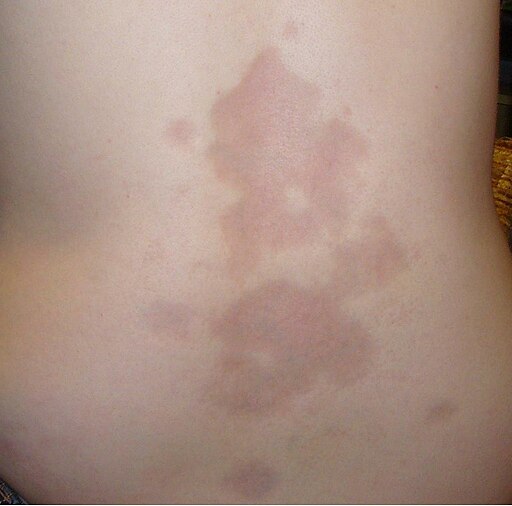
Plaque morphoea symptoms
Plaque morphoea are oval patches that can range from 2-20 cm across. They start off mauve in colour, then gradually become white. Older patches may become brown. The surface is smooth, shiny and hairless. One to three plaques may develop in different areas of the skin. This type mainly affects adults and usually has no other symptoms or problems, although the affected skin can look unsightly.
Superficial morphoea symptoms
Superficial morphoea is similar to the plaque type. It is typically seen as symmetrical mauve-coloured patches, usually in skin folds of the groin, armpits or under breasts. This type is most commonly found in middle-aged women.
Linear scleroderma symptom
Linear scleroderma usually occurs on an arm or leg of a child. It is a long, narrow area of thickened skin. In more severe cases the tissues just beneath the skin are affected which may cause scarring (contractures) underneath the skin.
En coup de sabre symptoms
En coup de sabre is a deep form of linear scleroderma affecting the scalp and temple. The name comes from its shape, meaning 'like a sword cut'. Hair is lost over the affected skin, and the skull bone may be shrunk underneath it.
Generalised morphoea symptoms
This is a rare type where there are more plaques spread around different areas of the body.
Causes of localised scleroderma
The cause is not clear. What is known is that cells called fibroblasts make too much of a protein called collagen. The collagen gets deposited in the skin, causing scarring and thickening (fibrosis).
It is not known why the fibroblasts produce too much collagen in the areas of affected skin. It is probably some fault with the immune system. It is sometimes seen after the development of diseases in which the immune system attacks the body's own cells (autoimmune conditions), such as lichen sclerosus och lichen planus. It can also occur after tick bites (Lyme disease), mässling, strålbehandling, local injury to the skin and pregnancy. Most of the time, however, there is no obvious cause.
How common is localised scleroderma?
Localised scleroderma is uncommon. The exact number of people affected is not known. However, it is thought that quite a number of cases are not diagnosed. This is because many people who have a small plaque or two of localised scleroderma causing no symptoms may not report it to a doctor.
It is two or three times more common in women than in men. It can occur at any age and is as common in children as it is in adults. About 3 in a million children in the UK and Ireland develop localised scleroderma every year. Children are nine or ten times more likely to develop localised scleroderma than systemic sclerosis.
Diagnosing localised scleroderma
Localised scleroderma can usually be recognised by its appearance. The diagnosis can be confirmed by a biopsi.
A biopsy is a procedure in which a small sample of skin is removed under local anaesthetic and examined under the microscope. Sometimes blood tests can give a clue but there is not a specific blood test for this condition.
In some cases en ultraljudsundersökning eller a magnetic resonance imaging (MRI) scan may be used to assess whether the scleroderma is affecting tissues underneath the skin. X-rays are occasionally used to check that children's bones are growing properly.
Treatment for localised scleroderma
The most common form, plaque morphoea, does not always need treatment. This form often does not cause symptoms and often gradually improves or clears away after a number of years.
However, strong creams or ointments are sometimes used as they may help to stop it spreading.
Creams which may be used include:
Cream or ointment containing kalcipotriol.
Tacrolimus ointment.
Imiquimod cream.
For other types of localised scleroderma, treatment will vary depending on the individual situation, the severity of the condition and whether underlying tissues are affected. One of the creams or ointments above may be used in some cases. If it is too widespread or too deep or too severe, one or more of the following treatments may be used:
Ultraviolet light therapy.
High-dose steroider.
Medicines affecting the immune system, such as metotrexat or mycophenolate mofetil. Other treatments sometimes used include hydroxychloroquine, ciclosporin, and penicillamine.
Physiotherapy or surgery may help if the skin is very tight or if there is a deformity or scar underneath the skin.
Complications of localised scleroderma
Usually, localised scleroderma does not cause any complications. It is not linked to the systemic sclerosis form of scleroderma and it does not involve internal organs.
Some types of localised scleroderma may affect not only the skin but the tissues directly underneath it such as bone or muscle. This only happens in the deeper types of scleroderma (linear scleroderma and en coup de sabre). In this situation, the scleroderma can affect growth in the underlying tissues and so may cause some degree of deformity. About one third of people with deep localised scleroderma have this type of problem. Rarely, if the affected skin is located on the head, the brain or eye can be affected.
Vad är utsikterna (prognosen)?
Limited plaque morphoea tends to improve with time, often over 3-5 years, but some cases may last for many years with new lesions developing as old one's fade. Some improvement in generalised plaque morphoea is usually seen over a few years, although the condition may last for many years.
The affected areas of skin may gradually go back to normal. However, a brown stain may remain and sometimes a small depressed area of skin. In some cases the plaques remain for many years.
Linear-type localised scleroderma tends to persist for longer but may improve after several years. It may come and go and may flare up after a long time of being settled. However, linear-type localised scleroderma, especially the en coup de sabre subtype, may become more extensive with time. This may cause severe contractures that result in limited movement and permanent disability of an arm or leg. Damage to underlying brain and eye tissue is a potential, serious complication of the en coup de sabre subtype.
Patientval för Störningar i immunsystemet

Allergier, blod och immunsystem
Sjögrens syndrom
Sjögrens syndrom är en autoimmun sjukdom som gör att körtlarna som producerar tårar och saliv slutar fungera. Det är ett livslångt tillstånd men behandlingar kan hjälpa till att kontrollera symtom som torra ögon och torr mun.
av Dr Doug McKechnie, MRCGP

Allergier, blod och immunsystem
Immunologisk trombocytopen purpura
Vid immunologisk trombocytopen purpura bildas antikroppar mot blodplättar. När antikropparna har fäst sig vid blodplättarna fungerar de inte så bra.
av Dr Colin Tidy, MRCGP
Vanliga frågor
Vad är skillnaden mellan lokaliserad sklerodermi och systemisk skleros?
Lokaliserad sklerodermi, även känd som morfea, påverkar främst bara huden. I vissa fall kan det sträcka sig till vävnaderna under huden, som muskler och ben. I kontrast kan systemisk skleros påverka huden och även involvera kroppens inre organ.
Behandlas alla typer av lokaliserad sklerodermi på samma sätt?
Nej, behandling för lokaliserad sklerodermi varierar beroende på dess typ, svårighetsgrad och om underliggande vävnader är påverkade. Till exempel behöver plackmorfé ofta ingen behandling eftersom det kan förbättras av sig självt. Andra typer, särskilt om de är utbredda, djupa eller allvarliga, kan kräva starkare behandlingar som ultraviolett ljusbehandling, högdossteroider eller mediciner som påverkar immunsystemet.
Kan lokaliserad sklerodermi påverka barn?
Ja, lokaliserad sklerodermi kan förekomma i alla åldrar och är lika vanligt hos barn som hos vuxna. Ungefär 3 av en miljon barn i Storbritannien och Irland utvecklar detta tillstånd varje år. Barn är också nio eller tio gånger mer benägna att utveckla lokaliserad sklerodermi än den mer allvarliga systemiska sklerosen.
Är lokaliserad sklerodermi ärftlig?
Artikeln nämner inte om lokaliserad sklerodermi är ärftlig eller förekommer i familjer. Den anger att orsaken inte är klar, men man tror att det handlar om fibroblaster som producerar för mycket kollagen, möjligen på grund av ett fel i immunsystemet.
Kommer de drabbade hudområdena någonsin att återgå till det normala efter att ha haft lokaliserad sklerodermi?
De drabbade hudområdena kan gradvis återgå till det normala över tid, även om en brun fläck eller ett litet nedsänkt hudområde kan kvarstå. I vissa fall kan placken kvarstå i många år. Linjär typ av lokaliserad sklerodermi tenderar att vara längre, och även om det kan förbättras efter flera år, kan det också komma och gå eller blossa upp igen. En coup de sabre-subtypen kan bli mer omfattande över tid.
Vidare läsning och referenser
- Morféa; Primary Care Dermatology Society. July 2023.
- Morféa; DermNet NZ
- Careta MF, Romiti R; Localized scleroderma: clinical spectrum and therapeutic update. An Bras Dermatol. 2015 Jan-Feb;90(1):62-73. doi: 10.1590/abd1806-4841.20152890.
- Wenzel D, Haddadi NS, Afshari K, et al; Upcoming treatments for morphea. Immun Inflamm Dis. 2021 Dec;9(4):1101-1145. doi: 10.1002/iid3.475. Epub 2021 Jul 17.
Om författarenVisa fullständig biografi
Uppdaterad av

Dr Colin Tidy, MRCGP
Allmänläkare, Medicinsk Författare
MBBS, MRCGP, MRCP (Paediatrics), DCH
Dr Colin Tidy är en NHS-läkare, baserad i Oxfordshire.
Om recensentenVisa fullständig biografi

Dr Doug McKechnie, MRCGP
Medicinsk skribent
MA, MBBS, MSc, DRCOG, MRCP(UK), MRCGP(2021), FHEA
Dr Doug McKechnie är en NHS-läkare som arbetar i London. Han arbetar kliniskt på heltid och är också biträdande ansvarig för modulen Klinisk och Professionell Praxis vid University College London Medical School.
Artikelhistorik
Artikeln finns också på Engelska, Tyska, Spanska, Franska, Italienska, Portugisiska, Hindi, Hebreiska, Arabiska, och Svenska.
Nästa granskning: 17 feb 2028
18 feb 2025 | Senaste versionen
Delta i konversationen
Dela dina tankar eller erfarenheter med andra i vår patientgemenskaper.

Fråga, dela, anslut.
Bläddra i diskussioner, ställ frågor och dela erfarenheter inom hundratals hälsorelaterade ämnen.

Känner du dig sjuk?
Bedöm dina symtom online gratis
Anmäl dig till Patientens nyhetsbrev
Din veckovisa dos av tydliga, pålitliga hälsoråd - skrivna för att hjälpa dig känna dig informerad, självsäker och i kontroll.
Genom att prenumerera accepterar du våra Sekretesspolicy. Du kan avsluta prenumerationen när som helst. Vi säljer aldrig dina uppgifter.