Axelsmärta
Granskad av Dr Colin Tidy, MRCGPSenast uppdaterad av Dr Philippa Vincent, MRCGPSenast uppdaterad 10 aug 2023
Uppfyller patientens redaktionella riktlinjer
- Ladda nerLadda ner
- Dela
- Language
- Diskussion
- Ask Patient
- Ljudversion
- Lägg till i föredragna källor på Google
Shoulder pain is very common. Some causes of shoulder pain resolve within a few weeks without any treatment apart from simple medicines for pain relief. However, some causes of shoulder pain can last for a long time and further tests and treatment might be needed. Medical attention should be sought if the pain is severe, if it follows an injury or if it doesn't get better after a few weeks.
Överblick
Axelsmärta är vanligt och har många orsaker, inklusive frusen axel och rotatorkuffsjukdomar.
Orsaker kan också inkludera problem i nacken, artros och olika skador.
Smärta som känns i axeln kan ibland ha sitt ursprung från andra delar av kroppen.
Sök läkare omedelbart om smärtan är svår, uppstår efter en skada, eller om axeln är varm eller röd.
Medicinsk uppmärksamhet behövs också om smärtan påverkar båda axlarna, eller inte förbättras med smärtstillande medel.
Inledande behandlingar kan inkludera smärtstillande läkemedel, ispåsar och att undvika aktiviteter som förvärrar tillståndet.
Explore pain relief options
Get expert healthcare advice from the comfort of home. Complete a quick online consultation, available 24/7, with your request reviewed by a UK-registered clinician. Next day delivery available on eligible treatments.

Shoulder pain causes
See also the separate leaflet called Joint Pain. Shoulder pain is a common problem with a number of different causes which include (starting with the four most common):
Frusen skuldra
Frusen skuldra is sometimes called adhesive capsulitis of the shoulder. It is a condition where a shoulder becomes painful and stiff. Without treatment, symptoms usually settle but this may take up to 2-3 years.
Rotator cuff disorders
The rotator cuff is a group of muscles and tendons that surround the shoulder joint and help to keep it stable. Rotator cuff disorders are one of the most common causes of shoulder pain. Most people can be successfully treated and have complete recovery.
Pain coming from a problem in the neck.
Se de separata broschyrerna kallade Neck Pain och Whiplash Neck Sprain.
Acromioclavicular joint disorders
Some conditions (such as a shoulder injury or osteoarthritis) may affect the acromioclavicular joint, which is the joint at the top of the shoulder (see the diagram at the end of this leaflet). Problems with this joint are usually due to wear and tear of the joint or because of injury.
Artros
Artros due to general wear and tear in the shoulder joint is a very common cause of shoulder pain.
Septisk artrit
Septisk artrit is an infection in the joint. Symptoms include pain and tenderness over a joint, pain on moving the joint, and feeling unwell. Septic arthritis is uncommon but needs urgent hospital treatment.
Artrit
Artrit which affects a number of other different joints as well - eg, reumatoid artrit - can cause shoulder pain, but would rarely cause shoulder pain on its own.
Polymyalgia reumatika
Polymyalgia reumatika is a condition which causes pain, stiffness and tenderness in large muscles, typically around the shoulders, upper arms and hips.
Injury (trauma):
A broken bone (fracture), such as a fracture of the upper arm bone (humerus) or a broken collarbone (clavicle) can cause shoulder pain.
Shoulder pain can be caused by a soft tissue injury such as an injury to a ligament, tendon or muscle around the shoulder joint. This may be caused in many different ways, such as a sports injury, a road traffic accident or a shoulder strain following heavy lifting or carrying.
Shoulder dislocation, where the ball of the joint has moved out of its socket, can cause severe shoulder pain. See the separate leaflet called Joint Dislocations.
Shoulder instability
The shoulder is unstable because the joint does not keep the bones close together. The humerus often 'pops out' of position.
Referred pain
This is a pain which is felt in the shoulder due to the nerve pathways, but is actually caused by a problem elsewhere in the body. The neck is the most common source of referred pain. (See the links above for more information).
Occasionally pain may be felt in the shoulder when the source is the heart or the diaphragm (the muscle which separates the thorax - chest area - from the abdomen - tummy area. A problem within the abdomen can cause an irritation of the diaphragm which can sometimes be felt in the shoulder. Usually in these cases, there is pain in the abdomen or chest as well.
How do I know what is causing my shoulder pain?
Some general guidelines which may help are as follows. However, remember there are always exceptions to every rule!
A shoulder pain usually - but not always - comes from a problem with the shoulder. It is more likely to be due to the shoulder itself if it hurts more when moving the shoulder, when touching the shoulder or if the shoulder looks abnormal, for example, if the shape looks different to the other side or if it is hot or red.
If the shoulder hurts when lifting the arm, it is likely to be due to a problem with the shoulder joint itself, such as a frozen shoulder, rotator cuff problem or shoulder injury.
If the pain started following a fall or injury of some type, it is likely that the trauma is causing the pain. A bone, joint, ligament, muscle or tendon may be damaged in some way.
Shoulder pain is very common and can affect all ages. Some causes of shoulder pain, such as osteoarthritis, frozen shoulder and rotator cuff disorders, mainly affect middle-aged and older people. Shoulder pain caused by sports injuries is more common in younger age groups. Sports that more commonly cause shoulder injuries include sports with repeated throwing or bowling, or contact sports such as rugby. Shoulder instability and acromioclavicular joint disorders often affect people who play regular sport.
If there are pains in other joints as well as the shoulder, it is more likely to be a generalised problem.
Pain and stiffness in both shoulders which is worse in the mornings or overnight may be due to polymyalgia reumatika.
Clues that suggest shoulder pain is coming from some other problem than the shoulder itself include:
If there is a blistery painful or itchy rash, it might be bältros.
If the shoulder pain is coming from the neck, there is likely to be some neck pain and/or stiffness as well.
If the pain is in the left shoulder, and if it comes with a pain or tightness in the chest, it may be coming from the heart. Usually with angina or a heart attack, there are other symptoms as well as or instead of shoulder pain. See the separate leaflets called Angina och Hjärtattack (Hjärtinfarkt) för detaljer.
If many joints are achy and if feeling hot one minute and cold the next, this may be due to a hög temperatur (feber) due to an infection - for example a kall eller influensa.
If there is tummy pain and pain at the tip of the shoulder blade, it might be coming from the liver or gall bladder in the abdomen.
If there is chest pain or shortness of breath or a persisting cough, with pain in the shoulder, it might be due to a problem with the lungs rather than the shoulder.
Should I see a doctor about shoulder pain?
Generally speaking:
It is sensible to seek medical attention urgently (straightaway) if:
The pain follows an injury or trauma and is a severe pain or the shoulder cannot be moved at all.
If the shoulder is hot to touch or red.
If there is chest pain or difficulty breathing or a feeling of being generally very unwell (call 999/112/911).
Medical attention should be sought soon if:
The pain is affecting both shoulders and is worse in the mornings or overnight.
The pain is not improving with simple painkillers for a couple of weeks.
The pain is affecting your daily activities.
There are other symptoms as well as shoulder pain, such as:
Tummy pain.
A persisting cough.
Nattliga svettningar.
Viktnedgång.
A blistery rash.
There is a high temperature (fever) which is not responding to simple measures such as paracetamol, or if there is no obvious simple cause.
There is a past history of cancer and a persisting pain in the bone area of the shoulder.
There is new pain in more than one joint.
There is swelling of the shoulder.
How to relieve shoulder pain?
Initial treatment for some of the more common shoulder problems include:
Taking simple medicines for pain relief, such as ibuprofen eller paracetamol.
Ice packs can also be used to reduce or relieve pain.
Avoiding activities that may cause more pain in the shoulder, such as heavy lifting and carrying.
If these measures are not working, see a health professional.
Shoulder pain treatment
This will depend on the cause of the pain.
Treatments may include:
Fysioterapi
A physiotherapist might advise exercises, perform manipulation and/or recommend a steroid injection into your shoulder.
Hänvisning
In some cases, a referral to a bone and joint specialist (orthopaedic specialist or rheumatology specialist) might be advised to see if any further treatment is required, such as a surgical operation to treat the cause of the shoulder pain. Surgery is not needed for most causes of shoulder pain.
Kirurgi
In a few cases an operation may be required. Most commonly, this is done through a 'keyhole' procedure - an arthroscopy. During an arthroscopy, the parts of the shoulder joint can be examined to see what is the cause of the problem. Damaged tissues may be repaired or removed.
Decompression is one surgical option for shoulder tip (subacromial) pain. Decompressing means removing bone spurs and soft tissue through a thin telescope introduced through the keyhole cut. Evidence suggests that there is little value in this particular operation for pain for most people and this should be discussed during the decision-making process.
Occasionally, shoulder joints can be replaced with an artificial joint, particularly if the problem is wear and tear (osteoarthritis).
Läkemedel
If the pain is thought to be due to inflammation, such as in reumatoid artrit eller polymyalgia reumatika, then medicines are used. A rheumatologist is needed to prescribe drugs called disease-modifying-drugs for rheumatoid or other inflammatory arthritis. Steroids are usually used for polymyalgia rheumatica and these are usually prescribed in general practice. See the specific leaflets about these conditions for more information about treatment options.
Akupunktur
Recent evidence is that acupuncture may reduce shoulder pain but that more investigation into this is needed.
Shoulder pain tests
Investigations might be advised and these will depend on an initial examination to determine the most likely cause of the shoulder pain. Investigations may include:
Blood tests to look for underlying arthritis such as rheumatoid arthritis.
X-rays may be needed to diagnose a bone problem or joint problems.
An ultrasound scan may be needed to assess whether there is a problem with the soft tissues of the shoulder.
Referral might be needed for further investigations, such as an MRI scan. Specialists include:
A doctor specialising in bones and joints (an orthopaedic specialist).
A doctor specialising in diagnosis and treatment of arthritis and musculoskeletal conditions (a rheumatology specialist).
A physiotherapist.
Vad är resultatet (prognos)?
The outcome will depend on the underlying cause. Shoulder pain may only last for up to a few weeks, may last a few years or may be a lifelong problem. However, if the cause of the shoulder pain is diagnosed and treated early then this can often help to resolve or greatly reduce the pain in the shoulder.
The shoulder joint
Rotator cuff
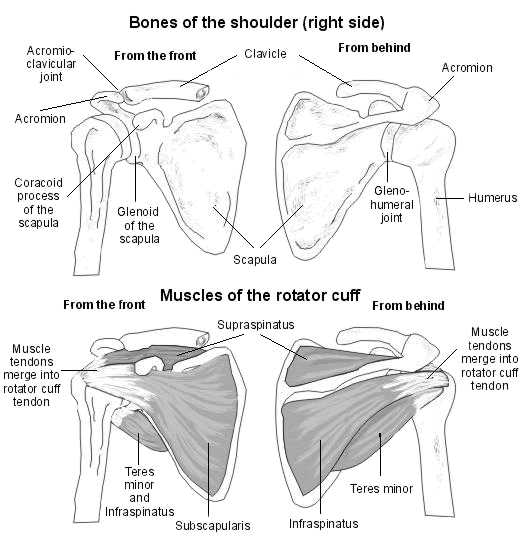
There are three bones in the shoulder region - the collarbone (clavicle), the shoulder blade (scapula) and the upper arm bone (humerus). The scapula is a triangular-shaped bone that has two important parts to it: the acromion and the glenoid. The three bones in the shoulder region form part of two main joints:
The acromioclavicular joint between the acromion of the scapula and the clavicle.
The glenohumeral joint between the glenoid of the scapula and the humerus.
There are also a number of muscles, ligaments and tendons around the shoulder. Ligaments are fibres that link bones together at a joint. Tendons are fibres that attach muscle to bone.
Explore pain relief options
Get expert healthcare advice from the comfort of home. Complete a quick online consultation, available 24/7, with your request reviewed by a UK-registered clinician. Next day delivery available on eligible treatments.
Patientval för Ledvärk

Ben, leder och muskler
Tennisarmbåge
Tennis elbow is a condition where there is pain on the outer side of the elbow. It is often caused by overuse strain, causing damage to tendons around the elbow. In many people, symptoms improve over time just by stopping activities that bring on the symptoms. Studies have not yet confirmed the best way to treat tennis elbow. Painkillers may help to ease the pain until the condition improves. A steroid injection may also ease pain in the short term. However, the pain often returns. Physiotherapy is another treatment option. Other treatments are sometimes used if symptoms persist.
av Dr Philippa Vincent, MRCGP

Ben, leder och muskler
Frusen skuldra
Frusen skuldra (medicinskt kallad adhesiv kapsulit i axeln) är ett tillstånd där axeln blir smärtsam och stel, ofta utan någon särskild anledning. Axelrörelserna blir begränsade, ibland helt 'frusna'. Det påverkar vanligtvis bara en axel men kan påverka båda. Det tros bero på att ärrliknande vävnad bildas i axelkapseln. Utan behandling försvinner symtomen vanligtvis, men det kan ta lång tid, upp till tre år i vissa fall. Olika behandlingar kan lindra smärtan och förbättra rörligheten i din axel.
av Dr Philippa Vincent, MRCGP
Vanliga frågor
Vilka medicinska specialister behandlar axelsmärta?
Beroende på orsaken till din axelsmärta kan du bli remitterad till en ben- och led specialist (en ortoped), en läkare som specialiserar sig på artrit och muskuloskeletala tillstånd (en reumatolog), eller en fysioterapeut.
Vad är den förväntade återhämtningstiden för axelsmärta?
Varaktigheten av axelsmärta varierar kraftigt beroende på dess underliggande orsak. Vissa typer av axelsmärta kan försvinna inom några veckor, medan andra kan pågå i flera år eller till och med vara ett livslångt problem. Tidig diagnos och behandling kan ofta hjälpa till att avsevärt minska eller lösa smärtan.
Kan axelsmärta påverka dagliga aktiviteter?
Ja, axelsmärta kan påverka dina dagliga aktiviteter avsevärt. Om du märker att smärtan stör dina rutinuppgifter är det lämpligt att söka medicinsk hjälp.
Kan min axelsmärta vara kopplad till underliggande hälsotillstånd?
Ja, axelsmärta kan ibland vara ett symptom på tillstånd någon annanstans i kroppen. Till exempel, om du har nuvarande eller tidigare cancer och upplever ihållande smärta i benområdet av din axel, eller om du har ny smärta i flera leder, kan dessa indikera underliggande hälsoproblem. Andra symptom som ihållande hosta, nattsvettningar eller oförklarlig viktminskning tillsammans med axelsmärta kräver också medicinsk undersökning.
Vad händer under en axeldekompressionsoperation?
Axeldekompression är ett kirurgiskt alternativ som ibland övervägs för smärta i axelspetsen. Det innebär att man tar bort benutväxter och mjukvävnad med hjälp av ett tunt teleskop som förs in genom ett 'nyckelhåls'-snitt. Dock tyder nuvarande bevis på att denna specifika operation har begränsat värde för smärtlindring hos de flesta människor, och detta bör diskuteras under beslutsprocessen för behandling.
Kan axelleder ersättas med en konstgjord led?
Ja, i vissa fall kan axelleder ersättas med en konstgjord led. Detta övervägs särskilt när problemet beror på betydande slitage, såsom vid avancerad artros.
Vidare läsning och referenser
- Buchbinder R, Green S, Youd JM; Corticosteroid injections for shoulder pain. Cochrane Database Syst Rev. 2003;(1):CD004016.
- Green S, Buchbinder R, Hetrick S; Physiotherapy interventions for shoulder pain. Cochrane Database Syst Rev. 2003;(2):CD004258.
- Page MJ, Green S, Kramer S, et al; Manual therapy and exercise for adhesive capsulitis (frozen shoulder). Cochrane Database Syst Rev. 2014 Aug 26;8:CD011275. doi: 10.1002/14651858.CD011275.
- Beard DJ, Rees JL, Cook JA, et al; Arthroscopic subacromial decompression for subacromial shoulder pain (CSAW): a multicentre, pragmatic, parallel group, placebo-controlled, three-group, randomised surgical trial. Lancet. 2018 Jan 27;391(10118):329-338. doi: 10.1016/S0140-6736(17)32457-1. Epub 2017 Nov 20.
- Artus M, Holt TA, Rees J; The painful shoulder: an update on assessment, treatment, and referral. Br J Gen Pract. 2014 Sep;64(626):e593-5. doi: 10.3399/bjgp14X681577.
- Axelsmärta; NICE CKS, november 2022 (endast tillgång i Storbritannien)
- Ben-Arie E, Kao PY, Lee YC, et al; The Effectiveness of Acupuncture in the Treatment of Frozen Shoulder: A Systematic Review and Meta-Analysis. Evid Based Complement Alternat Med. 2020 Sep 25;2020:9790470. doi: 10.1155/2020/9790470. eCollection 2020.
Om författarenVisa fullständig biografi
Uppdaterad av

Dr Philippa Vincent, MRCGP
Allmänläkare, Medicinsk Författare
MB BS, Bsc, MRCGP (2000), DCH, DFSRH, DRCOG
Dr Philippa Vincent är en NHS-läkare som arbetar i norra London.
Om recensentenVisa fullständig biografi

Dr Colin Tidy, MRCGP
Allmänläkare, Medicinsk Författare
MBBS, MRCGP, MRCP (Paediatrics), DCH
Dr Colin Tidy är en NHS-läkare, baserad i Oxfordshire.
Artikelhistorik
Artikeln finns också på Engelska, Tyska, Spanska, Franska, Italienska, Portugisiska, Hindi, Hebreiska, Arabiska, och Svenska.
Nästa granskning ska göras senast: 8 aug. 2028
10 aug 2023 | Senaste versionen
Dela dina tankar eller erfarenheter med andra i vår patientgemenskaper.
Enkel tillgång till pålitliga behandlingar och hälsotjänster online.
Common conditions
Get help with common conditions through the NHS, without a GP appointment.





Anmäl dig till Patientens nyhetsbrev
Din veckovisa dos av tydliga, pålitliga hälsoråd - skrivna för att hjälpa dig känna dig informerad, självsäker och i kontroll.
Genom att prenumerera accepterar du våra Sekretesspolicy. Du kan avsluta prenumerationen när som helst. Vi säljer aldrig dina uppgifter.