Meralgia paresthetica
Granskad av Dr Colin Tidy, MRCGPSenast uppdaterad av Dr Toni Hazell, FRCGPSenast uppdaterad 15 sep 2023
Uppfyller patientens redaktionella riktlinjer
- Ladda nerLadda ner
- Dela
- Language
- Diskussion
- Ask Patient
- Ljudversion
- Lägg till i föredragna källor på Google
Meralgia paraesthetica is a nerve (neurological) condition that causes pain in the outer thigh. It is caused by compression of a nerve called the lateral cutaneous nerve of the thigh. This nerve supplies feeling (sensation) to the outer thigh. In many cases, the cause is not known. Usually the condition improves with conservative (non-surgical) treatment - such as anti-inflammatories, painkillers or steroid injections.
Överblick
Meralgia paraesthetica is a nerve condition causing pain, numbness, or tingling in the outer thigh.
It is caused by compression or trapping of the lateral cutaneous nerve of the thigh.
Symptoms are often worse with standing or walking and better when lying down.
Risk factors include obesity, pregnancy, and ascites.
Treatment often involves non-surgical options like rest, weight loss, or painkillers.
What is meralgia paraesthetica?
Meralgia paraesthetica is a nerve (neurological) condition that causes an area of skin over the upper outer thigh to become painful, numb or tingly.
Meralgia paraesthetica is known as a nerve entrapment syndrome. This means it is a collection of symptoms caused by a trapped or compressed nerve. The trapped nerve in question is called the lateral cutaneous nerve of the thigh (also known as the lateral femoral nerve).
Meralgia paraesthetica symptoms
The most common symptoms are burning pain or numbness in the upper thigh, on the outer side. Children and younger people may just have pain that limits normal activities.
Other symptoms include altered sensation of that part of the thigh, or tingling/pirrningar. Symptoms tend to be made worse by walking and standing but relieved by lying down with the hip flexed. (Hip flexion is movement of the leg towards your tummy (abdomen); this can be with your knee bent or straight - but on your back it is easiest to draw your bent knee up to your chest.)
Other reported symptoms include aching in the groin, pain in the buttocks and an area of skin that seems super-sensitive to heat and light touch (as opposed to firm pressure).
Meralgia paraesthetica causes
Most cases have no identifiable cause.
Meralgia paraesthetica can, however, be caused by direct injury to the lateral cutaneous nerve of the thigh accidentally. For example:
A seat belt injury from a car accident.
Inadvertently, during medical or surgical procedures - for example, keyhole (laparoscopic) hernia repairs.
Various sports and physical activities can be associated with meralgia paraesthetica. These include gymnastics, baseball, soccer, bodybuilding and strenuous exercise.
Rarer causes include a neuroma. Neuromas are non-cancerous (benign) growths (tumours) on a nerve. Pelvic or intra-abdominal tumours (including cancerous ones) could also compress the nerve and cause this problem. This is rare.
Other possible causes include lying down for long periods of time in a curled-up position. Diabetes can affect nerves in general and, although it would be unusual simply to have this one nerve affected, the lateral cutaneous nerve of the thigh could potentially be damaged by diabetes.
What is the lateral cutaneous nerve of the thigh?
Meralgia Paraesthetica
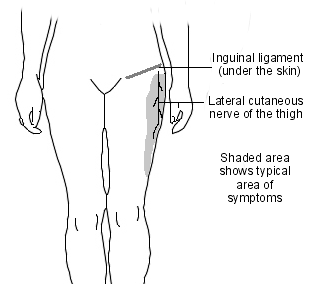
The lateral cutaneous nerve of the thigh is found in the upper leg. It provides sensation to an area of skin on the upper outer thigh. If this nerve is trapped or compressed, burning pain, numbness or tingling might be felt in the area of skin supplied by the nerve. These symptoms constitute meralgia paraesthetica.
The lateral cutaneous nerve of the thigh is a sensory nerve that supplies the skin. It starts off in the lower part of the spinal cord, in the lumbar region. It has to pass over the front of the hip bones and under the inguinal ligament before reaching the thigh. The inguinal ligament is a tough fibrous band in the groin. This is the site at which the nerve is most commonly compressed or trapped.
Who develops meralgia paraesthetica?
Anyone can develop meralgia paraesthetica. It is more common in men than in women. Generally it occurs between the ages of 30-40 years. It is much rarer in children.
Risk factors include obesity, pregnancy and ascites. Ascites is the term used for a tense swelling of the tummy (abdomen) due to fluid.
How common is meralgia paraesthetica?
Meralgia paraesthetica is a very uncommon condition. It most often affects people between the ages of 30-40 years. The condition is thought to be much rarer in children. It occurs more often in men than in women.
How is meralgia paraesthetica diagnosed?
A doctor can make the diagnosis based on your symptoms and examination of your body. The diagnosis is likely to be suspected if you have typical pain or sensory symptoms affecting the upper outer thigh. The condition can, occasionally, affect both sides at the same time (about 1 in 5 cases).
Examination might show altered sensation in the area of skin supplied by the lateral cutaneous nerve of the thigh. The pain can usually be provoked by getting you to extend your hip. Hip extension is the movement of the leg backwards. The main buttock muscle (gluteus maximus) tightens when you make this movement.
Because the lateral cutaneous nerve of the thigh is a sensory nerve, it affects feeling and sensation. It does not affect movement of the leg or hip. Your doctor will check to see that there is no weakness of the muscles - if there is, the diagnosis is not meralgia paraesthetica.
Behöver jag några undersökningar?
Often no investigations (such as blood tests, X-rays and scans) are needed for the diagnosis of meralgia paraesthetica. However, an ultraljudsskanning may be used if there is concern that a mass in the pelvis is causing the symptoms.
Further tests may be done if an underlying problem or alternative diagnosis is suspected. If you have meralgia paraesthetica arising from an accident or injury (such as a pelvic fracture) then other tests will be needed.
In some cases, nerve conduction tests are performed if surgery for meralgia paraesthetica is planned. Nerve conduction tests look at the electrical activity running through a nerve. This is adversely affected if a nerve is compressed or trapped.
Meralgia paraesthetica treatment
Treatments can be grouped into conservative treatments (which are non-surgical) and surgical treatment (operations). In most cases, only conservative treatments are needed.
Examples of conservative treatments include:
Rest - meralgia paraesthetica is aggravated by standing and walking. Reduction in physical activity may be advised in severe cases. It may even be necessary to rest in bed.
Viktnedgång - if obesity is thought to be the cause.
Physical therapies - manipulation, massage and stretching exercises sometimes help.
Painkillers (analgesics) - såsom paracetamol eller kodein.
Non-steroidal anti-inflammatory drugs (NSAIDs) - såsom ibuprofen, naproxen och diclofenac.
Corticosteroid injections - commonly referred to as steroid injections. A steroid and, usually some local anaesthetic, can be injected around the lateral cutaneous nerve to numb it and reduce inflammation.
Andra läkemedel - sometimes medications are used that act as nerve painkillers. Some types of antidepressant medications (tricykliska antidepressiva) such as amitriptyline eller anticonvulsant drugs can be useful for nerve-related pain (also called neuralgia or neuropathic pain). Examples of these drugs include gabapentin (brand name Neurontin®), pregabalin (brand name Lyrica®) och carbamazepine (brand name Tegretol®).
If you have meralgia paraesthetica it is also advisable to avoid tight clothing, such as belts or corsets, that presses on the upper thigh/hip area.
Surgical treatment involves taking the pressure off the nerve (surgical decompression) and releasing any entrapment.
What is the outlook (prognosis) for meralgia paraesthetica?
Generally, the prognosis is good. Often, the symptoms of pain and pins and needles resolve with time but sometimes the numbness and altered sensation can remain long-term. However, if there is a serious underlying cause of the entrapment (this is rare) then the prognosis will depend on the underlying cause.
Patientval för Svaghet och domningar i lemmar

Hjärna och nerver
Hand-arm vibrationssyndrom
Hand-arm vibrationssyndrom (ibland förkortat till HAVS) orsakar förändringar i känseln i fingrarna vilket kan leda till permanent domningar i fingrarna, muskelsvaghet och, i vissa fall, anfall av vita fingrar. Det orsakas av arbete med vibrerande verktyg. Det skulle vara ovanligt att utveckla hand-arm vibrationssyndrom utan att regelbundet använda vibrerande verktyg i minst tio år. Att sluta arbeta med vibrerande verktyg kan förhindra att milda symtom förvärras.
av Dr Colin Tidy, MRCGP
Hjärna och nerver
Cauda equina-syndrom
Cauda equina-syndromet är en särskilt allvarlig typ av nervrotproblem. Detta är en sällsynt sjukdom där det finns tryck på nerverna längst ner i ryggmärgen. Samlingen av nerver längst ner i ryggmärgen kallas cauda equina eftersom det sägs se ut som en hästsvans. Cauda equina betyder hästsvans på latin. Tillståndet kan orsaka smärta i nedre delen av ryggen och problem med tarm- och blåsfunktion (vanligtvis oförmåga att kissa), domningar i sadelområdet, vilket är runt bakpassagen (anus), och svaghet i ett eller båda benen. Det kräver omedelbar undersökning och behandling för att förhindra att nerverna till blåsan och tarmen blir permanent skadade. Kontakta en vårdpersonal omedelbart om du misstänker CES.
av Dr Colin Tidy, MRCGP
Vanliga frågor
Can meralgia paraesthetica affect both of my thighs at the same time?
Yes, meralgia paraesthetica can occasionally affect both sides of the body simultaneously. This occurs in about 1 in 5 cases.
If I have meralgia paraesthetica, does it mean I have muscle weakness in my leg?
No, if you have meralgia paraesthetica, it will not cause muscle weakness in your leg or hip. The lateral cutaneous nerve of the thigh is a sensory nerve, meaning it only affects feeling and sensation, not muscle movement. If there is muscle weakness, it suggests a different diagnosis.
Are there any specific exercises or physical activities that can help with meralgia paraesthetica?
Physical therapies such as manipulation, massage, and specific stretching exercises are sometimes helpful in managing meralgia paraesthetica symptoms.
What kind of non-surgical medications are used for meralgia paraesthetica if standard painkillers aren't enough?
If standard painkillers are not sufficient, other medications that act as nerve painkillers might be used. These can include certain types of antidepressant medications, such as tricyclic antidepressants like amitriptyline, or anticonvulsant drugs like gabapentin, pregabalin, and carbamazepine, which are useful for nerve-related pain.
Vidare läsning och referenser
- Treatment for meralgia paraesthetica; Cochrane Library, 2012
- Cheatham SW, Kolber MJ, Salamh PA; Meralgia paresthetica: a review of the literature. Int J Sports Phys Ther. 2013 Dec;8(6):883-93.
- Klauser AS, Abd Ellah MM, Halpern EJ, et al; Meralgia paraesthetica: Ultrasound-guided injection at multiple levels with 12-month follow-up. Eur Radiol. 2016 Mar;26(3):764-70. doi: 10.1007/s00330-015-3874-1. Epub 2015 Jun 21.
- Chopra PJ, Shankaran RK, Murugeshan DC; Meralgia paraesthetica: Laparoscopic surgery as a cause then and a cure now. J Minim Access Surg. 2014 Jul;10(3):159-60. doi: 10.4103/0972-9941.134883.
- Solomons JNT, Sagir A, Yazdi C; Meralgia Paresthetica. Curr Pain Headache Rep. 2022 Jul;26(7):525-531. doi: 10.1007/s11916-022-01053-7. Epub 2022 May 27.
Om författarenVisa fullständig biografi
Uppdaterad av

Dr Toni Hazell, FRCGP
MBBS, BSc, FRCGP, DFSRH, Dip GU med, DRCOG, DCH (London, UK, 2000)
Dr. Toni Hazell tog examen från St. Mary’s Hospital Medical School och genomförde sin VTS vid Northwick Park Hospital.
Om recensentenVisa fullständig biografi

Dr Colin Tidy, MRCGP
Allmänläkare, Medicinsk Författare
MBBS, MRCGP, MRCP (Paediatrics), DCH
Dr Colin Tidy är en NHS-läkare, baserad i Oxfordshire.
Artikelhistorik
Artikeln finns också på Engelska, Tyska, Spanska, Franska, Italienska, Portugisiska, Hindi, Hebreiska, Arabiska, och Svenska.
Nästa granskning förfaller: 13 sept 2028
15 sep 2023 | Senaste versionen
Medicinska yrkesverksamma
Looking for more in-depth clinical detail? Our Professional Reference articles are written for doctors, nurses and other healthcare professionals. They include comprehensive clinical guidance, diagnostic information and UK/European evidence summaries. If you need the clinical version, you can read the Professional Reference article on this topic.
Dela dina tankar eller erfarenheter med andra i vår patientgemenskaper.
Enkel tillgång till pålitliga behandlingar och hälsotjänster online.
Common conditions
Get help with common conditions through the NHS, without a GP appointment.





Anmäl dig till Patientens nyhetsbrev
Din veckovisa dos av tydliga, pålitliga hälsoråd - skrivna för att hjälpa dig känna dig informerad, självsäker och i kontroll.
Genom att prenumerera accepterar du våra Sekretesspolicy. Du kan avsluta prenumerationen när som helst. Vi säljer aldrig dina uppgifter.