
Vad är medellängden för män?
Granskad av Dr Krishna Vakharia, MRCGPSenast uppdaterad av Amberley DavisSenast uppdaterad 30 maj 2024
Uppfyller patientens redaktionella riktlinjer
- Ladda nerLadda ner
- Dela
- Language
- Diskussion
- Ask Patient
- Ljudversion
- Lägg till i föredragna källor på Google
Hur står du dig mot genomsnittslängden för män i ditt land? Längd har kopplats till livslängd, sjukdomar och till och med akademisk och ekonomisk framgång. Här utforskar vi vad din längd och midjemått kan avslöja om din hälsa.
Videoval för Allmän mänhälsaVideobibliotek
Average height of men by region
You may wonder if you're shorter or taller than the average height for men in your country, or how you measure up on a global scale.
Several factors influence how tall you could grow. Understanding them, and knowing your height-to-weight ratio, can help you understand your own health a bit better.
Average height for men in the UK
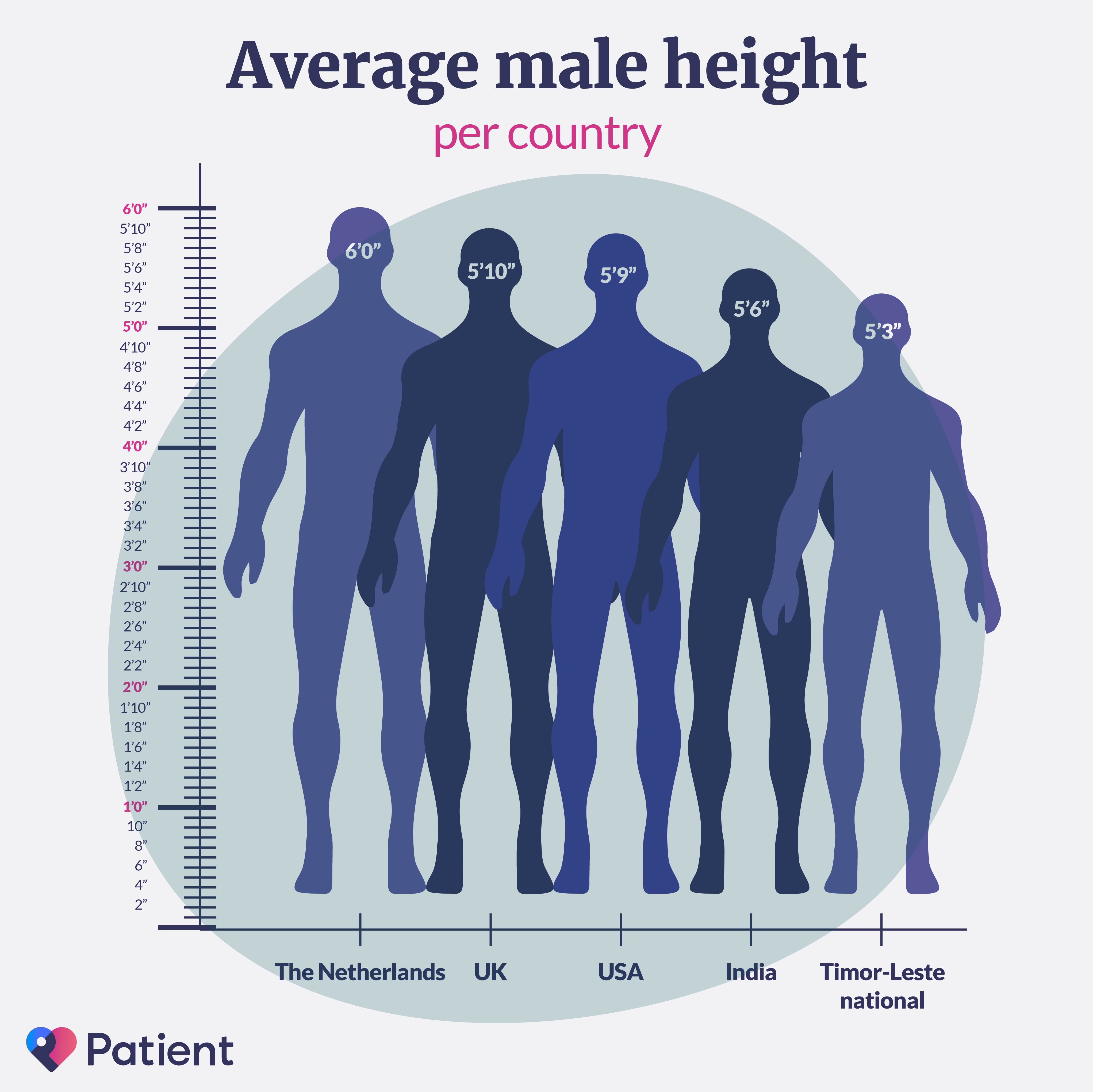
In the UK, the average man is considered relatively tall compared with other countries. According to 2024 data1, the average height for men here is 178.2 cm - this is equal to 5 ft 10 in.
Average height for men in the USA, Canada, Australia, and India
There's not a great deal of difference in height between men from the UK and those in the USA, Australia, and Canada. On average, Indian men are four to five inches shorter than these countries - this reflects the general trend that South Asia is the continent with the shortest height.
The average height for men in Canada - 178.7 cm/ 5 ft 10.5 in.
The average height for men in Australia - 178.8 cm/ 5 ft 10.5 in.
The average height for men in the USA - 176.9 cm/ 5 ft 9.5 in.
The average height for men in India - 167.6 cm/ 5 ft 6 in.
What are the 5 tallest countries for men?
The Netherlands - 183.8 cm/ 6 ft.
Montenegro - 183.3 cm/ 6 ft.
Estonia - 182 cm/ 5 ft 11.5 in.
Croatia - 181 cm/ 5 ft 11 in.
Slovenia - 180.5 cm/ 5 ft 11 in.
What are the 5 shortest global countries for men?
Timor Leste - 160 cm/ 5 ft 3 in.
Laos - 162.5 cm/ 5 ft 4 in.
Soloman Islands - 162.8 cm/ 5 ft 4 in.
Papua New Guinea - 163 cm/ 5 ft 4 in.
Mozambique - 165 cm/ 5 ft 5 in.
Figures in cm are rounded up or down for conversion into feet and inches
Average male height
Factors that influence height
There is around 24 cm (9.4 in) between the shortest and tallest average height for men in the world. Within any given population, the actual height difference can be even greater than this.
This is because there are several factors that influence differences in height. These influence both men and women equally, but women have genetics to thank for shorter average heights.
Genetik
Experts believe that your inherited DNA determines around 80% of your height2. This means that 80% of height differences between people can be attributed to genetics. This is a predetermined height that could never be changed, no matter where you grew up or how your health has been affected.
Geographical location
Genetics also partially explains the height differences between different countries. When it comes to the biological differences between regions, each race has a set of shared genetic characteristics, including average height3.
But this is only part of the story. Your location also impacts many other height-influencing factors, including your exposure to vitamin D through sunlight, access to nutritious food, and vulnerability to serious diseases.
Nutrition
What you eat growing up also affects how tall you'll grow. Key nutrients such as vitamin D and kalcium are needed for bone growth, and so a diet lacking in these could lead you to fall short of your potential maximum height.
Birth weight and premature birth
Your birth weight is determined by several factors, including genetics and the nutrition you receive in the womb. It's an important predictor of a person's adult height - the general rule is that the more you weigh at birth, the taller you're likely to be4.
För tidigt födda barn - those born before their due date - usually have a below average birth weight. At the same time, prematurity is also an independent factor that slows down growth. Although many preterm babies reach the same average heights as non-preterm babies in adulthood, many are shorter in childhood and adolescence5.
Environment versus genetics - The Romans in Britain
The Roman occupation in Britain during 200-410 AD is a great example of the effects of the environment on average height. Although the genetic traits of Britons didn't change, average height rose from 167 cm (5 ft 5 in) to 170 cm (5 ft 6 in) during this period.
Scientists attribute this national growth spurt to improved health thanks to the Roman's infrastucture6:
Cleaner drinking water.
Improved sanitation systems.
A more varied diet.
Over time, height declined when Britons abandoned Roman cities and their more hygienic water and waste systems.
What medical conditions can affect men's height?
Children or adolescents affected by serious diseases and disorders will generally be shorter as adults7. Here are some examples8:
Illnesses affecting the whole body, known as systemic diseases - for example diabetes, hjärtsjukdom, and digestive tract diseases.
Illnesses that create hormone imbalances, known as endocrine diseases - for example growth hormone deficiency and Cushing’s syndrome.
A handful of medical conditions can also lead to extremes in height, including:
Achondroplasia - leads to short legs and arms and is the most common cause of those with short stature (medical term: dwarfism).
Spondyloepiphyseal dysplasias (SED) - leads to a shorter trunk.
Hypofystumörer - in children these tumours can cause excess growth and result in people becoming much taller than they would have.
Acromegaly - is a condition in adults where too much growth hormone is produced causing increased height but also increased bone in arms, hands and the face. There are also a number of other symptoms associated with this rare condition. Famously, Richard Kiel (Jaws in James Bond) had this condition.
What is the link between height, weight, and health?
Do taller people enjoy better health and wellbeing? Studies suggest that people who are taller - but aren't extremely tall - generally live longer and have a lesser chance of developing some diseases, including stroke och hjärtsjukdom7.
However, being tall can also make you more at risk of some cancers, including, ovarian, pancreatic, prostate and colorectal cancer7.
Extremes of height at both ends of the spectrum can also have lots of health risks. For example, being very short could lead to back pain or breathing difficulties if you have a hunched or swayed back, while being very tall puts extra strain on your metabolic systems, increasing your chances of heart disease and diabetes.
Height and weight
Some of these health issues are outside of your control, but others aren't. While you can't control your height, you can manage your weight, and your height to weight ratio determines your risk of cardiovascular illnesses - diseases affecting you heart and blood vessels.
It's this rule that favours taller people - it's generally easier to maintain a healthy weight-height balance when you're tall. If you've ever had a healthcare professional check your kroppsmasseindex (BMI), this is what they're measuring.
A BMI-kalkylator works out if your weight is healthy for your height.
Although a useful tool, BMI doesn't tell the whole story, for example, where fat sits on your body and influencing factors such as gender. Modern studies reveal that storing excess fat around your waist is a significant predictor of health. Relative fat mass (RFM) aims to take this into account9.
A RFM calculator specifically measures the fat around your waist in comparison to your height.
Vidare läsning
National Library of Medicine: Is height determined by genetics?
Mittal et al: Short stature: understanding the stature of ethnicity in height determination.
Jelenkovic et al: Associations between birth size and later height from infancy through adulthood.
Ferguson et al: Adult height of preterm infants: a longitudinal cohort study.
University of Oxford: Highs and lows of an Englishman’s average height over 2000 years.
Woolcott and Bergman: Relative fat mass (RFM) as a new estimator of whole-body fat percentage.
Patientval för Allmän mänhälsa
Mäns hälsa
Vad är medellängden för män?
Hur står du dig mot genomsnittslängden för män i ditt land? Längd har kopplats till livslängd, sjukdomar och till och med akademisk och ekonomisk framgång. Här utforskar vi vad din längd och midjemått kan avslöja om din hälsa.
av Amberley Davis

Mäns hälsa
Hur det är att ha bröstcancer när du är man
Även om bröstcancer ofta uppfattas som en kvinnosjukdom, kan män också diagnostiseras. Vi pratade med Tony Herbert, som fick diagnosen bröstcancer 2011.
av Abi Millar
Om författarenVisa fullständig biografi
Uppdaterad av

Amberley Davis
Seniorförfattare
BA (Hons), CPD
Amberley är en senior skribent hos Patient och har skrivit omfattande om en rad olika hälso- och välbefinnandeämnen.
Författad av
Amberley Davis
Seniorförfattare
BA (Hons), CPD
Amberley är en senior skribent hos Patient och har skrivit omfattande om en rad olika hälso- och välbefinnandeämnen.
Om recensentenVisa fullständig biografi

Dr Krishna Vakharia, MRCGP
Medicinsk chef för hälsa, Optum UK
MBChB, MRCGP(2013), BMedSci (hons), DFSRH, DRCOG, PGDipDerm (Distn)
Dr Krishna Vakharia är en NHS-läkare. Hon är också en regelbunden examinator för den postgraduate Diplom i Praktisk Dermatologi vid Cardiff University samt Chief Medical Officer för hälsa på Optum UK.
Artikelhistorik
Artikeln finns också på Engelska, Tyska, Spanska, Franska, Italienska, Portugisiska, Hindi, Hebreiska, Arabiska, och Svenska.
Nästa granskning: 30 maj 2027
30 maj 2024 | Senaste versionen
22 Nov 2022 | Ursprungligen publicerad
Författad av:
Amberley Davis
Dela dina tankar eller erfarenheter med andra i vår patientgemenskaper.
Anmäl dig till Patientens nyhetsbrev
Din veckovisa dos av tydliga, pålitliga hälsoråd - skrivna för att hjälpa dig känna dig informerad, självsäker och i kontroll.
Genom att prenumerera accepterar du våra Sekretesspolicy. Du kan avsluta prenumerationen när som helst. Vi säljer aldrig dina uppgifter.